
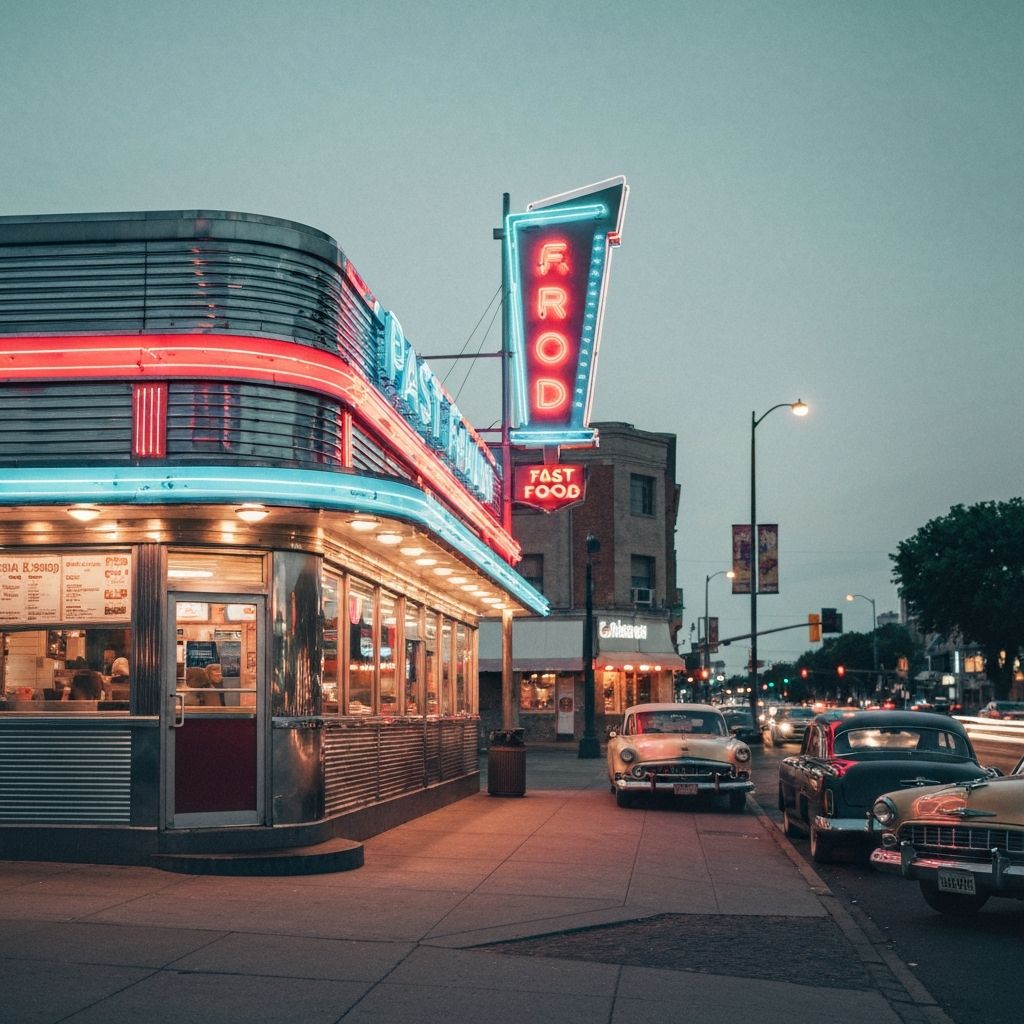
Defining Fast Food: Where It All Began
The question of which restaurant was the first fast food establishment depends on how you define fast food. If we are talking about the modern concept of a standardized menu with quick service, consistent quality, and a drive-through or counter-service model, the history of fast food is a uniquely American story that begins in the early 20th century. However, the concept of quickly prepared, inexpensive food served to go has roots that stretch back much further in culinary history.
Ancient Rome had thermopolia, street-side counters that served ready-to-eat food to workers and travelers who did not have cooking facilities at home. Medieval Europe had pie shops and street vendors offering quick meals. In the 19th century, American cities developed lunch counters and automats that served pre-prepared food quickly and efficiently. Each of these predecessors contributed to the evolution of what we now recognize as the fast food industry.
White Castle: America's First Fast Food Chain
White Castle is widely recognized as the first fast food hamburger chain in the United States. Founded on September 13, 1921, by Billy Ingram and Walter Anderson in Wichita, Kansas, White Castle introduced many of the concepts that would come to define the fast food industry. The restaurant featured a standardized menu centered on small, square hamburgers sold for 5 cents each, a clean and visible cooking area, and a commitment to speed and consistency that was revolutionary for its time.
Walter Anderson, a fry cook, had been selling hamburgers from a modified streetcar since 1916, but it was his partnership with Billy Ingram, a real estate and insurance professional, that transformed the concept into a scalable business. Ingram understood the power of branding and image, and he designed the first White Castle restaurants to look clean, modern, and trustworthy at a time when ground beef had a reputation for being unsanitary and unappetizing.
The name White Castle was deliberately chosen to convey purity through the color white and permanence through the word castle. The restaurants featured white porcelain exteriors, stainless steel kitchens, and employees in white uniforms. These design choices were intended to reassure customers about the cleanliness and quality of the food at a time when the safety of ground meat was a genuine public concern, particularly in the wake of Upton Sinclair's 1906 novel The Jungle, which had exposed the horrifying conditions in America's meatpacking industry.
A&W and the Drive-In Revolution
While White Castle pioneered the fast food hamburger concept, A&W Root Beer, founded in 1919 by Roy Allen, played an important role in developing the drive-in service model that would become synonymous with American fast food culture. Allen began selling root beer from a roadside stand in Lodi, California, and the concept proved so popular that he partnered with Frank Wright in 1922 to form A&W Root Beer, which began franchising locations across the country.
A&W is notable for being one of the first food service operations to develop a franchise model, allowing independent operators to use the A&W brand name and recipes in exchange for fees and adherence to quality standards. This franchise model would later be adopted and refined by McDonald's, Burger King, and virtually every other major fast food chain. A&W also pioneered the carhop service model, where waitresses brought food to customers in their cars, which evolved into the drive-through window system used by fast food restaurants today.
McDonald's and the Fast Food Revolution
Although McDonald's was not the first fast food restaurant, it was the chain that transformed fast food from a regional novelty into a global industry. The original McDonald's restaurant was opened by brothers Richard and Maurice McDonald in 1940 in San Bernardino, California. Initially a standard drive-in restaurant with carhop service, the brothers revolutionized their operation in 1948 with what they called the Speedee Service System.
The Speedee Service System was inspired by assembly line manufacturing techniques. The brothers drastically simplified their menu, eliminated carhop service in favor of a walk-up counter, and redesigned their kitchen for maximum efficiency. Each worker was assigned a specific task in the food preparation process, much like workers on a factory assembly line. This approach allowed McDonald's to serve food faster, more consistently, and at lower prices than any competitor.
The true expansion of McDonald's came through Ray Kroc, a milkshake machine salesman who visited the San Bernardino location in 1954 and was so impressed by the operation's efficiency that he convinced the brothers to let him franchise the concept nationally. Kroc opened his first McDonald's franchise in Des Plaines, Illinois, in 1955 and eventually purchased the entire company from the McDonald brothers in 1961 for 2.7 million dollars. Under Kroc's leadership, McDonald's grew into the largest restaurant chain in the world, and its operational model became the template that virtually every fast food chain would follow.
The Legacy of Fast Food Pioneers
The fast food industry that these pioneers created has fundamentally changed how Americans and people around the world eat. Today, the global fast food market is valued at over 900 billion dollars, with hundreds of chains operating millions of locations in virtually every country. While the industry faces ongoing criticism regarding nutrition, labor practices, and environmental impact, its influence on modern food culture, business practices, and American society is undeniable. The innovations introduced by White Castle, A&W, McDonald's, and other early fast food pioneers, from standardized menus and franchise models to assembly-line kitchens and drive-through service, continue to shape the restaurant industry more than a century later.
