
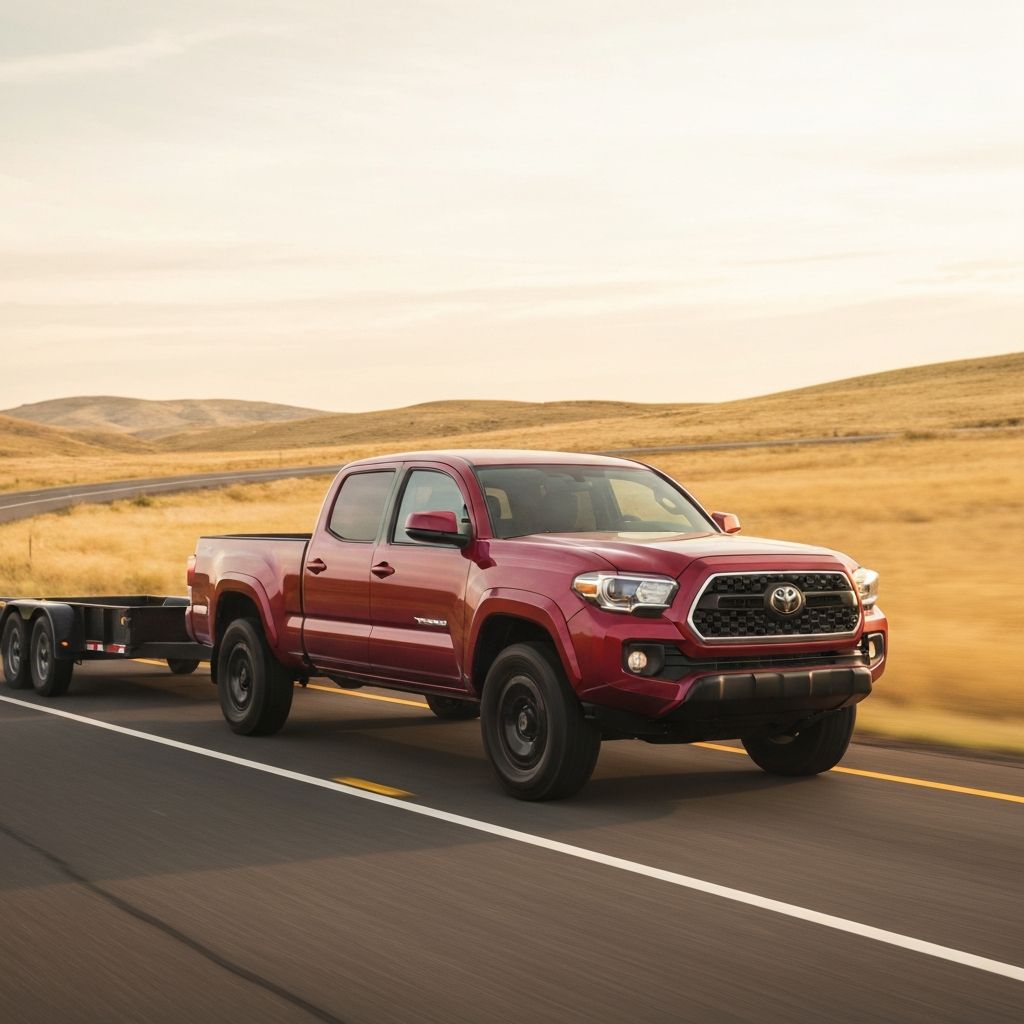
Toyota Tacoma: A Towing Overview
The Toyota Tacoma has been one of the most popular mid-size pickup trucks in the United States for decades, known for its legendary reliability, rugged capability, and strong resale value. For many Tacoma owners and prospective buyers, towing capacity is a critical consideration, as the ability to tow trailers, boats, campers, and other heavy loads is a primary reason for choosing a pickup truck. Understanding the towing capacity of the Toyota Tacoma, including how it varies across different model years, trim levels, and configurations, is essential for anyone who plans to use their truck for towing.
The towing capacity of the Toyota Tacoma has evolved significantly over the years, with newer models offering improved towing capabilities thanks to more powerful engines, stronger frames, and advanced towing technologies. However, the Tacoma's towing capacity varies considerably depending on several factors, including the engine choice, transmission type, cab configuration, bed length, drive system (two-wheel drive versus four-wheel drive), and whether the vehicle is equipped with an optional tow package. In this comprehensive guide, we will break down the towing capacity of the Toyota Tacoma across recent model years and configurations.
Current Generation Towing Capacity
The fourth-generation Toyota Tacoma, introduced for the 2024 model year, represents a significant redesign and improvement over the previous generation. Built on the new TNGA-F platform, the fourth-generation Tacoma offers improved towing capabilities alongside a more refined driving experience and updated technology features.
The base engine in the fourth-generation Tacoma is a 2.4-liter turbocharged four-cylinder that produces 228 horsepower and 243 pound-feet of torque in its standard tune, or 278 horsepower and 317 pound-feet of torque in its high-output configuration. A hybrid i-FORCE MAX powertrain is also available, combining the 2.4-liter turbo engine with an electric motor for a combined output of 326 horsepower and 465 pound-feet of torque. The maximum towing capacity for the fourth-generation Tacoma ranges from 6,000 to 6,500 pounds when properly equipped, depending on the specific configuration.
The i-FORCE MAX hybrid powertrain offers the highest towing capacity in the Tacoma lineup, thanks to its substantial torque advantage. The electric motor provides instant low-end torque that is particularly beneficial when starting from a stop with a heavy trailer attached. The hybrid system also contributes to improved fuel efficiency, which is a welcome benefit for owners who frequently tow and would otherwise consume significant amounts of fuel.
Third Generation Towing Capacity (2016-2023)
The third-generation Toyota Tacoma, which was produced from 2016 through 2023, was one of the best-selling mid-size trucks in the country throughout its production run. This generation offered two engine options: a 2.7-liter four-cylinder producing 159 horsepower and 180 pound-feet of torque, and a 3.5-liter V6 producing 278 horsepower and 265 pound-feet of torque.
With the 2.7-liter four-cylinder engine, the third-generation Tacoma had a maximum towing capacity of 3,500 pounds. While adequate for light towing duties such as small utility trailers, personal watercraft, and light cargo trailers, the four-cylinder engine was not recommended for heavier towing applications due to its limited power output. Acceleration and hill-climbing ability were notably reduced when towing near the maximum capacity with this engine.
The 3.5-liter V6 engine significantly increased the Tacoma's towing capability, offering a maximum towing capacity of 6,800 pounds when properly equipped with the tow package. This made the V6 Tacoma capable of towing a wide range of loads, including mid-size boats, small to medium travel trailers, enclosed cargo trailers, and car dollies. The V6's towing capacity made it competitive with other mid-size trucks in its class and suitable for the majority of recreational and light commercial towing needs.
Understanding Tow Package Options
To achieve the maximum towing capacity, the Toyota Tacoma must be equipped with the optional tow package, which adds several components designed to improve towing performance and safety. Understanding what the tow package includes and how it affects towing capacity is important for anyone considering using their Tacoma for towing.
The Tacoma's tow package typically includes a transmission oil cooler, which helps keep the automatic transmission at safe operating temperatures during the sustained high loads of towing. Towing generates significant heat in the transmission, and without an auxiliary cooler, the transmission fluid can overheat, leading to accelerated wear, slipping, and potential failure. The transmission oil cooler circulates the transmission fluid through a separate heat exchanger, dissipating excess heat and maintaining optimal operating temperatures.
The tow package also includes a heavy-duty battery and alternator to handle the increased electrical demands of towing, including powering trailer lights, electric brakes, and other accessories. A trailer hitch receiver, wiring harness with a seven-pin connector, and trailer sway control system are also typically included. Some tow packages also include a higher-capacity rear axle ratio, which improves the truck's ability to accelerate and climb hills when loaded.
Factors That Affect Towing Capacity
Several factors beyond the engine and tow package influence the Tacoma's actual towing capacity for a specific vehicle. The cab configuration (Access Cab versus Double Cab) affects the truck's payload capacity, which in turn affects how much weight can be safely placed on the tongue of the trailer. The bed length (five-foot short bed versus six-foot long bed) similarly affects the truck's weight distribution and payload capacity.
The drive system is another important factor. Two-wheel-drive (2WD) Tacomas typically have slightly higher towing capacities than their four-wheel-drive (4WD) counterparts because the 4WD system adds weight to the vehicle, reducing the available payload and towing capacity. However, the difference is usually only a few hundred pounds, and the added traction of 4WD can be valuable when towing in adverse weather conditions or on unpaved roads.
The truck's Gross Vehicle Weight Rating (GVWR) and Gross Combined Weight Rating (GCWR) are the ultimate determinants of safe towing capacity. The GVWR is the maximum total weight of the truck, including passengers, cargo, and the tongue weight of the trailer. The GCWR is the maximum combined weight of the truck and trailer. Exceeding either of these ratings is unsafe and can result in loss of vehicle control, brake failure, tire blowout, and structural damage.
Safe Towing Tips for Tacoma Owners
Towing safely requires more than just staying within the truck's rated towing capacity. Proper trailer setup, weight distribution, and driving techniques are all essential for a safe and enjoyable towing experience.
Always ensure that the trailer's tongue weight is within the recommended range, typically 10 to 15 percent of the total trailer weight. Too little tongue weight can cause the trailer to sway dangerously, while too much tongue weight can overload the truck's rear axle and reduce steering responsiveness. Use a weight distribution hitch for heavier trailers to distribute the tongue weight more evenly across both the truck and trailer axles.
Before each towing trip, inspect the trailer hitch, safety chains, lighting connections, tire pressures, and brake systems. Adjust the truck's tire pressures to the recommended levels for towing, which are often higher than the standard pressures for unloaded driving. Ensure that all cargo inside the trailer is secured and evenly distributed to prevent shifting during transit.
When driving while towing, allow significantly more following distance and braking distance than you would when driving unloaded. The added weight of the trailer increases the truck's stopping distance substantially. Avoid sudden lane changes and sharp turns, and use a lower gear when descending steep grades to take advantage of engine braking and reduce stress on the truck's braking system. By following these guidelines and respecting the Tacoma's rated capacities, you can enjoy safe, reliable towing for years to come.
How Tacoma Compares to Competitors
In the competitive mid-size truck segment, the Toyota Tacoma's towing capacity is generally competitive with its main rivals. The Chevrolet Colorado and GMC Canyon offer maximum towing capacities of up to 7,700 pounds with their available turbodiesel engines, giving them an edge over the Tacoma for heavy towing applications. The Ford Ranger offers up to 7,500 pounds of towing capacity, while the Nissan Frontier provides up to 6,720 pounds.
While the Tacoma may not lead its class in raw towing numbers, it compensates with its legendary reliability, strong resale value, and comprehensive suite of safety features. The Tacoma's standard Toyota Safety Sense suite, which includes features like adaptive cruise control, lane departure alert, and automatic emergency braking, provides added peace of mind when towing. For buyers who prioritize long-term ownership value and dependability alongside respectable towing capability, the Toyota Tacoma remains one of the best choices in the mid-size truck market.
