
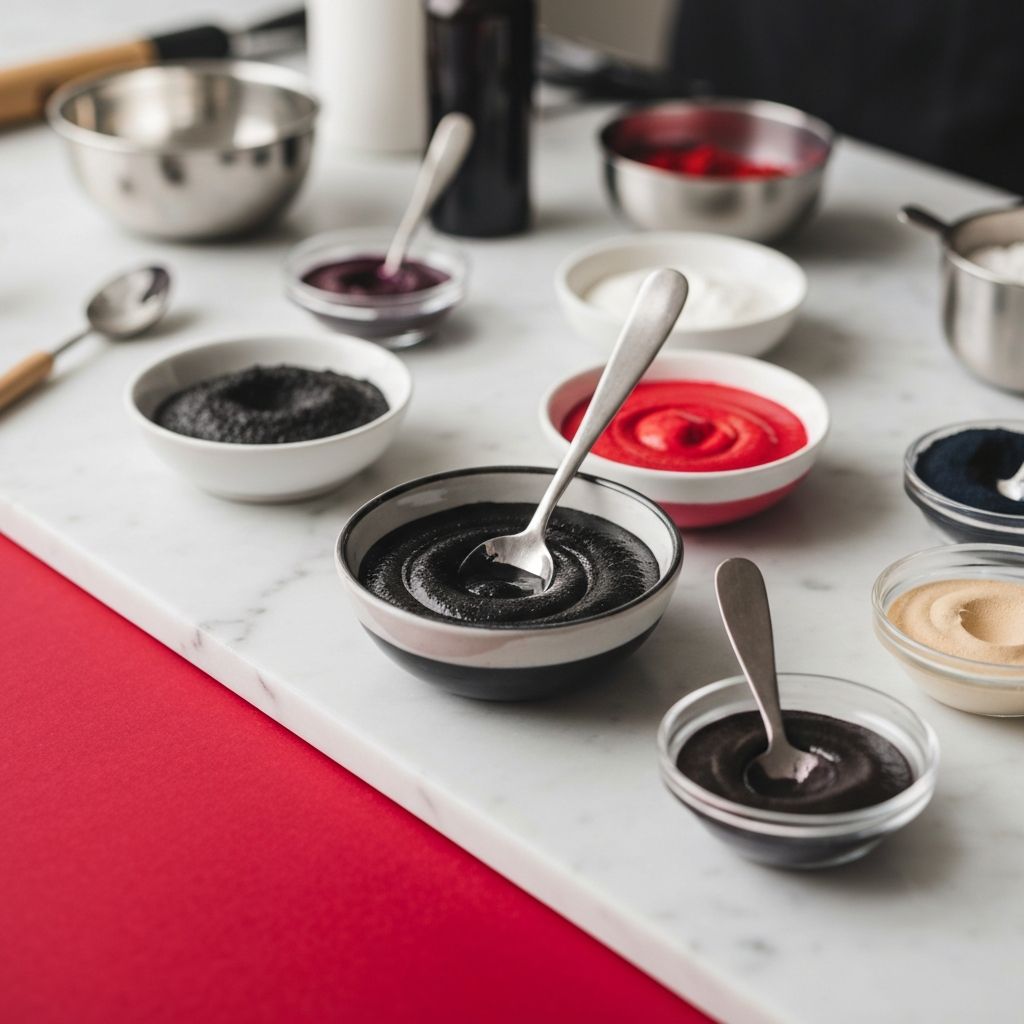
Why Black Food Coloring Is Difficult to Achieve
Black is one of the most challenging colors to achieve in food coloring because it is not a primary or secondary color that can be easily mixed from basic food dyes. Unlike red, blue, or yellow, black requires either a very concentrated amount of dark dye or a precise combination of multiple colors mixed together. Many home bakers discover this challenge when they try to create black frosting, fondant, or batter and end up with dark grey, dark purple, or dark green instead of the true black they were hoping for.
The difficulty arises from the way food colorings interact with the base medium. Buttercream frosting has a yellow tint from the butter, royal icing has a white base, and cake batter has its own color that can affect the final result. These underlying colors mix with the food coloring and dilute the intensity, making it nearly impossible to achieve true black with just a small amount of dye. Understanding the science behind color mixing is the first step toward creating the perfect black food coloring.
Method One: Mixing Primary Food Colors
The most accessible method for making black food coloring at home involves combining equal parts of red, blue, and yellow food coloring. In color theory, mixing all three primary colors together creates a dark brown or black shade. Start by adding equal drops of each color to a small bowl and mixing thoroughly. You will likely start with a dark brown that gradually deepens as you add more color.
To push the mixture toward true black, add extra blue and red food coloring in small increments. Blue is the darkest primary color and helps eliminate any warm brown undertones, while additional red adds depth. A common ratio that works well is 3 parts blue, 2 parts red, and 1 part yellow. Mix thoroughly after each addition and test the color on a white plate or paper towel to see how it looks against a neutral background.
Keep in mind that this method requires a significant amount of food coloring to achieve a deep black, which can affect the taste and texture of your food. Liquid food coloring in large quantities can make frosting too thin, while large amounts of gel food coloring can create a bitter aftertaste. For best results, use concentrated gel food coloring rather than liquid, as you will need far less product to achieve the same intensity.
Method Two: Using Cocoa Powder as a Base
One of the most effective tricks for achieving black food coloring in frostings and batters is to start with a dark base. By adding black cocoa powder or Dutch-processed cocoa powder to your recipe, you create a dark brown starting point that requires much less food coloring to reach true black. Black cocoa powder, which is the same type used in Oreo cookies, is extremely dark and provides an excellent foundation for black-colored desserts.
To use this method, substitute one-third to one-half of the flour or powdered sugar in your recipe with black cocoa powder, then add a small amount of black gel food coloring to finish the color. For black buttercream, for example, you might use one cup of powdered sugar, half a cup of black cocoa powder, butter, and a teaspoon of black gel food coloring. The cocoa powder does most of the heavy lifting colorwise, meaning you need far less artificial coloring and the frosting tastes like rich chocolate rather than having a chemical aftertaste.
Method Three: Activated Charcoal
Activated charcoal has become increasingly popular as a natural black food coloring option. Food-grade activated charcoal is a fine black powder that produces an intense, true black color with very small quantities. It is tasteless and odorless, making it ideal for applications where you want black color without affecting the flavor of your food.
To use activated charcoal, add one to two teaspoons of food-grade activated charcoal powder per cup of frosting, batter, or dough. Mix thoroughly until the color is evenly distributed. The result is a dramatic, deep black that is difficult to achieve with traditional food coloring alone. However, it is important to use only food-grade activated charcoal purchased from reputable suppliers, as industrial activated charcoal may contain contaminants that are not safe for consumption.
There are some important health considerations when using activated charcoal in food. Activated charcoal can interfere with the absorption of certain medications, including birth control pills, antidepressants, and heart medications. If you or your guests take any prescription medications, it is important to be aware of this interaction and either avoid activated charcoal or consume it several hours apart from medications.
Professional Tips for Perfect Black Coloring
Professional bakers and cake decorators have several additional tips for achieving the perfect black. First, always mix your black coloring the night before and let it sit covered in the refrigerator overnight. Black food coloring deepens significantly over time, and what looks dark grey today may be perfectly black tomorrow. This resting period allows the dye molecules to fully develop and distribute evenly throughout the medium.
Second, use a high-quality professional-grade gel food coloring specifically formulated in black, such as Americolor Super Black or Wilton Black. These concentrated gels are designed to produce deep blacks with minimal product and less impact on taste and consistency than standard food colorings. Third, when coloring fondant or gum paste, knead the color in wearing gloves, as black food coloring stains skin and surfaces very easily. Work on a surface protected by parchment paper or a silicone mat, and be prepared for the kneading process to take several minutes to achieve even color distribution.
