
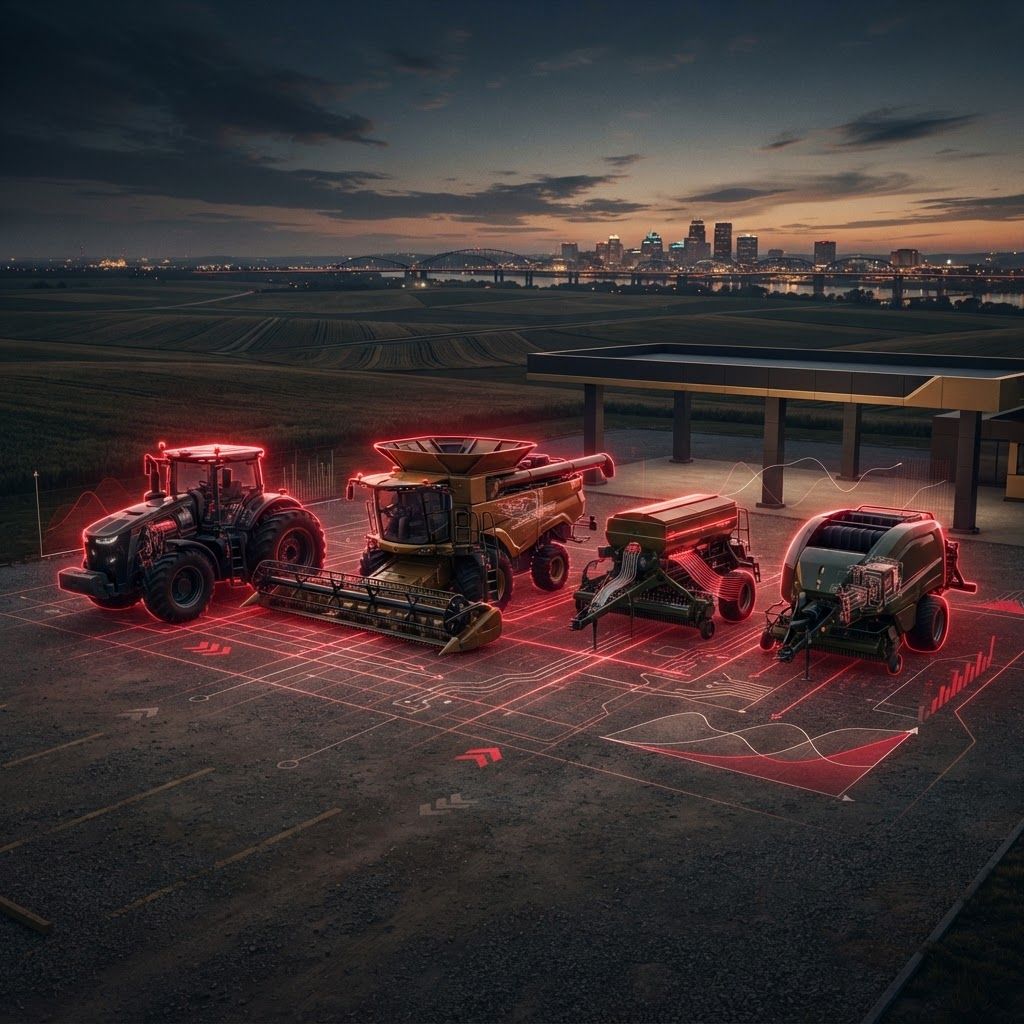
Agricultural equipment is the largest capital investment most farms make, and the choice of brand shapes operating costs, uptime and resale value for a decade or more. Around Louisville, farmers have access to an unusually complete range of manufacturers and dealer support, reflecting both the surrounding agricultural belt and the city's role as a distribution and equipment exposition center for the region.
Why Brand Choice Matters More Than Ever
Modern farm machinery is as much software as steel. Guidance systems, variable rate controllers, yield monitors and telematics platforms differ meaningfully between manufacturers, and data compatibility across a mixed fleet can become a genuine operational headache. At the same time, dealer parts availability and technician response during harvest determine whether a breakdown costs hours or days. Because weather windows for planting and harvest are narrow and unforgiving, support quality often outweighs modest differences in list price.
Resale value is another practical consideration. Brands with strong secondary demand effectively lower the cost of ownership, which matters especially for operations that trade equipment on a regular cycle.
The Ten Best Agricultural Equipment Brands in the Louisville Market
1. John Deere
The most recognized name in agriculture, John Deere offers a complete lineup from compact utility tractors to high-horsepower row crop machines, combines, planters, sprayers and hay equipment. Its precision agriculture ecosystem is deeply integrated, connecting guidance, section control, documentation and fleet telematics in one platform. Dealer density and parts availability across Kentucky are strong, and resale values remain among the highest in the industry, which offsets premium purchase pricing for many operations.
2. Case IH
Case IH is particularly respected for its combines and articulated four-wheel-drive tractors, along with a well-regarded lineup of planters and tillage tools. Its advanced farming systems provide guidance and data management with an emphasis on straightforward operator interfaces. Row crop growers around the region often cite harvesting capacity and cleaning performance as reasons for brand loyalty, and dealer technical support for harvest equipment is a recognized strength.
3. New Holland
New Holland has built a strong reputation in hay and forage equipment, an important consideration in a state with extensive cattle and horse operations. Balers, mower conditioners and forage harvesters are core strengths, complemented by a full tractor line. The brand has also invested in alternative fuel research, including methane-powered tractors, positioning it well as emissions expectations tighten.
4. Kubota
Dominant in the compact and utility segment, Kubota serves small farms, hay operations, horse properties and grounds maintenance with reliable diesel tractors, loaders, utility vehicles and compact construction machines. Its reputation for engine durability and ease of maintenance appeals to owners who service their own equipment, and lower entry pricing makes it a common first tractor for smaller operations near the metro.
5. Massey Ferguson
Massey Ferguson delivers a balance of capability and value across utility and row crop tractors, hay tools and combines. Operators appreciate straightforward mechanical design that is approachable for on-farm repair, along with comfortable cab ergonomics in higher trim levels. The brand has a long history in the region and a loyal following among mid-sized family farms.
6. Kuhn
A specialist rather than a full-line manufacturer, Kuhn focuses on implements including mowers, tedders, rakes, spreaders, tillage tools and mixers. Build quality and precision in hay and forage tools have earned it strong respect among producers who prioritize forage quality. Because implements often outlast tractors, Kuhn's durability translates directly into low cost per acre over time.
7. Great Plains
Great Plains is known for seeding and tillage equipment, particularly no-till drills and vertical tillage tools that support soil conservation practices. As regenerative and reduced-tillage systems expand across the region, demand for accurate seed placement in heavy residue conditions has grown, and the brand's drills are frequently chosen for cover crop establishment and small grain seeding.
8. Krone
Krone concentrates on forage harvesting and hay equipment, with a reputation for large square balers, mowers and self-propelled forage harvesters built for high-capacity operations. Custom harvesters and larger livestock operations value throughput and bale density, both areas where the brand competes strongly. Engineering focus on a narrow product range is central to its appeal.
9. Bobcat
While often associated with construction, Bobcat is indispensable on many farms for skid steers, compact track loaders, telehandlers and a wide attachment ecosystem. Livestock operations use them constantly for feeding, bedding, manure handling and general chores. Attachment versatility means a single machine can replace several purpose-built implements, which is a meaningful advantage on capital-constrained operations.
10. Vermeer
Vermeer built its reputation on round balers and continues to serve hay producers with balers, mowers, rakes and bale processors, alongside agricultural and environmental equipment. Its bale handling and processing tools are popular with cattle producers managing large forage volumes, and simplicity of design supports reliability during the compressed hay harvest season.
Technology Trends in Farm Equipment
Autonomous and semi-autonomous operation is moving from demonstration to limited commercial availability, driven largely by labor scarcity. Electrification has taken hold in compact equipment and is progressing toward larger machines, while alternative fuels including biomethane offer another path for high-horsepower applications. Precision technology continues to advance toward individual plant management, with camera-guided sprayers applying herbicide only where weeds appear. Telematics-based predictive maintenance is reducing unplanned downtime, and right-to-repair discussions are gradually improving farmer access to diagnostic tools and documentation.
How to Choose and Manage Equipment
Buyers should calculate cost per acre or per hour rather than focusing on purchase price, factoring in fuel, maintenance, depreciation and expected resale. Standardizing on fewer brands simplifies parts inventory, operator training and data compatibility. Evaluating dealer service capacity, including technician count and after-hours response during harvest, is at least as important as machine specifications. Used equipment with documented maintenance history can deliver excellent value, and for machines used only a few days each year, rental, leasing or custom hire is often more economical than ownership.
Final Thoughts
The Louisville market provides access to the full spectrum of agricultural equipment brands, from full-line manufacturers with comprehensive precision platforms to specialists that excel in hay, seeding or material handling. The best choice depends on the operation's acreage, enterprise mix, technology strategy and, critically, the quality of local dealer support. Farms that weigh total cost of ownership and service reliability alongside machine capability consistently make the strongest equipment decisions.
