
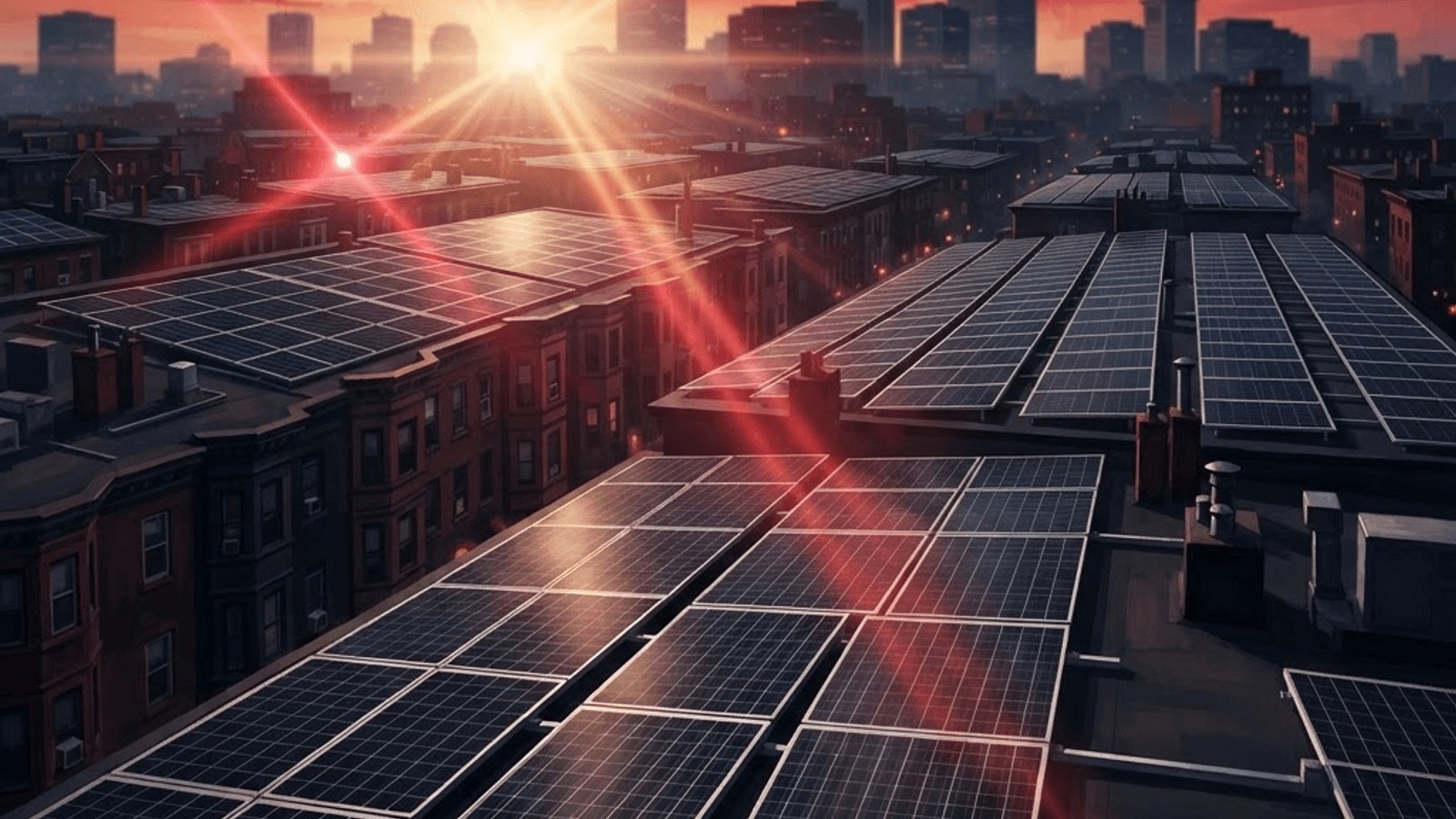
Does Solar Actually Work in Boston?
The most common objection to solar in New England is climate, and it is largely mistaken. Solar panels convert light rather than heat, and they operate more efficiently at cooler temperatures. Boston receives roughly comparable annual sunlight to parts of Germany, long one of the world's leading solar markets. More importantly, the economics depend on the price of the electricity being displaced, and Massachusetts electricity rates are among the highest in the continental United States.
Combined with net metering, state incentive programs, and federal tax credits, that pricing produces payback periods that many homeowners and businesses find attractive. Snow does reduce winter production, but panels installed at tilt typically shed snow within days, and annual production models already account for seasonal losses.
The Top 10 Solar Companies Serving Boston
1. Boston Solar. One of the largest locally owned installers in Massachusetts, Boston Solar has completed thousands of residential and commercial installations and is known for handling permitting, utility interconnection, and incentive paperwork in-house.
2. SunBug Solar. A Massachusetts-based installer with a strong reputation for engineering quality and careful roof work, SunBug serves residential, commercial, and nonprofit clients and is frequently recommended for complex roof geometries.
3. Nexamp. Rather than rooftop installation, Nexamp focuses on community solar, allowing Boston residents in apartments, condominiums, or shaded homes to subscribe to offsite projects and receive utility bill credits.
4. Solar Wolf Energy. Serving eastern Massachusetts, this installer covers residential solar and storage, with emphasis on battery pairing for outage resilience.
5. Trinity Solar. Operating throughout the Northeast with substantial Massachusetts volume, Trinity offers both purchase and third-party ownership options and maintains a large service organization.
6. Revolusun. A New England installer known for design-forward installations, commercial projects, and integration of storage and electric vehicle charging alongside solar.
7. Ameresco. For institutional and municipal clients, Ameresco delivers larger solar projects often bundled with efficiency upgrades and financed through performance-based structures.
8. Sunwealth. This Cambridge-based investor finances small and mid-sized commercial solar, partnering with local installers to serve schools, houses of worship, and community organizations that struggle to access conventional financing.
9. EnergySage. A Boston-based comparison marketplace where property owners receive competing quotes with standardized assumptions, making it easier to evaluate equipment, production estimates, and pricing side by side.
10. Rayah Solar. A regional installer serving Greater Boston with residential rooftop systems and storage, known for direct communication and straightforward proposals for first-time buyers.
Understanding Incentives
Incentive stacking drives Massachusetts solar economics. The federal residential clean energy credit reduces income tax liability by a percentage of system cost, and commercial systems may also access accelerated depreciation. The state offers an income tax credit for residential installations subject to a cap, and a sales tax exemption applies to equipment. Municipal property tax exemptions for solar improvements are available in many communities.
The state incentive program for generation provides a per-kilowatt-hour payment for a fixed term, with adders for storage pairing, low income service, and certain siting categories. Net metering credits exported electricity against consumption, though credit values and program capacity vary by utility territory and customer class. Because these programs change, a reputable installer will provide current figures in writing rather than general estimates.
Permitting and Practical Constraints in Boston
Installations within the city require electrical and building permits, utility interconnection approval, and in many neighborhoods additional review. Properties in historic districts, including parts of Beacon Hill, the Back Bay, and South End, may require architectural commission approval, which can influence panel placement and visibility from the street. Flat roofs common on triple-deckers and commercial buildings require ballasted or attached racking with structural verification. Condominium installations need association consent and often a formal amendment allocating roof rights.
Shading from mature trees and adjacent buildings is the most frequent physical limitation. A proper site assessment uses shade modeling rather than visual estimation, and if production would fall substantially, community solar is usually the better choice.
How to Evaluate a Solar Proposal
Compare proposals on a consistent basis. Request system size in kilowatts, estimated annual production in kilowatt hours, price per watt, specific panel and inverter models, warranty terms for equipment and workmanship, production guarantee if offered, and a clear breakdown of how incentives are applied. Be skeptical of production estimates noticeably higher than competitors for the same roof, since inflated projections are a common sales tactic.
Verify licensing and insurance, and confirm who performs the roof penetrations and who warrants against leaks. Ask about the interconnection timeline, because utility approval often takes longer than installation itself. If considering a lease or power purchase agreement, calculate total payments over the full term and understand escalation clauses and transfer provisions when selling the property, since these arrangements can complicate a sale.
Adding Storage
Battery storage pairs naturally with solar in Boston, providing backup during storm outages and additional incentive value. Batteries add meaningful cost, so define your objective first. If resilience is the priority, size the system around essential circuits such as heating controls, refrigeration, and communications rather than whole-home backup. If bill savings drive the decision, evaluate whether your rate structure and program participation actually reward stored energy dispatch.
Final Thoughts
Solar is now a mainstream infrastructure decision in Boston rather than an experiment. The installers and platforms profiled here cover rooftop residential work, commercial projects, community subscriptions, and financing for organizations without capital. Get at least three quotes, insist on written production and incentive figures, confirm structural and permitting requirements early, and choose a company likely to remain in business to honor its workmanship warranty. Done carefully, a solar installation delivers decades of predictable savings in one of the country's most expensive electricity markets.
