
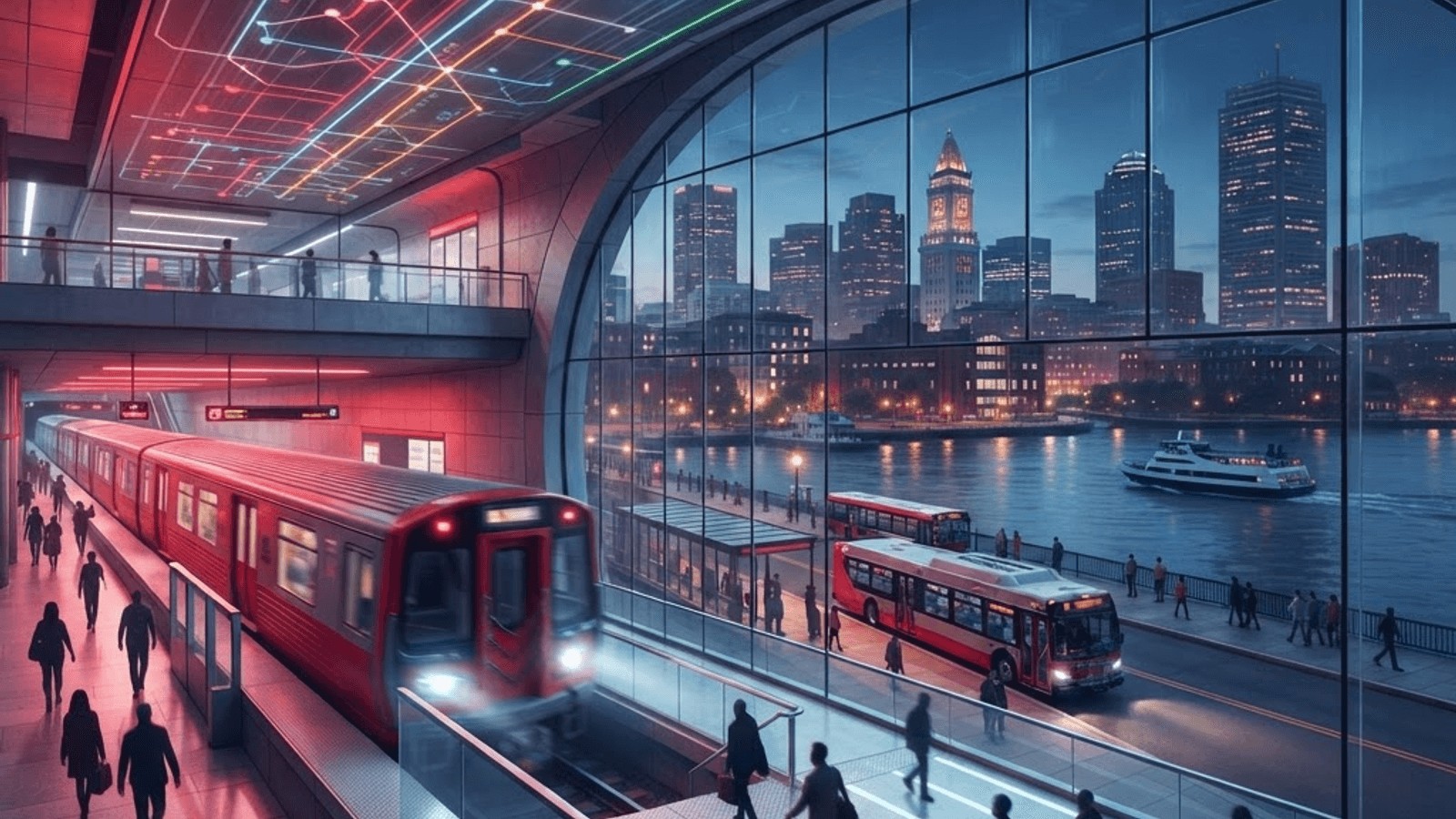
A City Built Around Transit
Boston opened the first subway tunnel in the United States, and that early commitment still shapes daily life. A large share of city residents commute without a car, and the compact geography of the metro area means that transit is frequently faster than driving once parking is factored in. The network is genuinely multimodal: heavy rail subway lines, light rail branches running on both tunnel and street segments, an extensive bus network, commuter rail reaching deep into the suburbs, harbor ferries, and a layer of institutional shuttles operated by universities and hospitals.
Understanding how these pieces fit together is what separates a frustrating trip from an efficient one. Fare integration, transfer points, and the difference between a rapid transit line and a street-running branch all affect how long a journey actually takes.
The Top 10 Public Transit Services in Boston
1. The Red Line
The Red Line is the workhorse of the system, linking Cambridge and Somerville through downtown to the southern suburbs, with branches serving Braintree and Ashmont. It connects two of the most important activity centers in the region, Harvard Square and the downtown financial district, and interchanges with every other subway line. New rail vehicles and signal upgrades have targeted the crowding and slow zones that long defined the line.
2. The Green Line
The oldest part of the network, the Green Line combines a downtown subway with several surface branches reaching Boston College, Cleveland Circle, Riverside, Heath Street, and, following a major extension, Somerville and Medford. It serves an enormous concentration of universities, hospitals, and residential neighborhoods. Riders should note that surface segments are affected by street traffic, so travel times vary more than on fully grade-separated lines.
3. The Orange Line
Running from Forest Hills through downtown to Oak Grove, the Orange Line serves densely populated neighborhoods and provides key connections at Back Bay and North Station. A comprehensive fleet replacement and track rehabilitation program has focused on restoring reliability and reducing travel times along the corridor, and the line remains one of the most efficient ways to cross the city north to south.
4. The Blue Line
The Blue Line connects downtown to East Boston, Logan Airport via shuttle connection, and the northern coastal communities toward Wonderland. It is often the fastest way to reach the airport from the city center, avoiding tunnel traffic entirely. The line's relatively short length and modern fleet make it one of the more consistently reliable rapid transit routes.
5. The Silver Line Bus Rapid Transit
The Silver Line provides bus rapid transit service connecting South Station to the Seaport District and directly to Logan Airport terminals, with additional branches serving Roxbury and Chelsea. Dedicated tunnel and busway segments allow it to bypass surface congestion, and direct terminal access with luggage space makes it a practical airport option for travelers.
6. The MBTA Bus Network
The bus network carries a very large share of total ridership and reaches neighborhoods that rail does not serve. A network redesign effort has focused on increasing frequency on the busiest corridors, adding dedicated bus lanes and signal priority, and simplifying routes. High-frequency key routes now function much like rail lines, where riders can turn up without consulting a schedule.
7. MBTA Commuter Rail
Commuter rail lines radiate from North Station and South Station to communities across eastern Massachusetts and into Rhode Island. Beyond serving suburban commuters, several lines are useful for intra-city travel because a train can cross from the outer neighborhoods to downtown far faster than local transit. Expanded midday and weekend service has made the network more useful for non-commute trips.
8. Boston Harbor Ferry Services
Ferry routes connect downtown wharves with Charlestown, the Seaport, Hingham, Hull, and the Harbor Islands. For the communities they serve, ferries offer a fast, comfortable, and notably pleasant alternative to congested highways. Seasonal island service also functions as recreational transportation, opening the harbor to residents and visitors alike.
9. The RIDE Paratransit Service
The RIDE provides door-to-door paratransit transportation for people whose disabilities prevent them from using fixed-route transit. Ongoing improvements include on-demand partnerships that shorten wait times and simplified booking. Alongside station accessibility upgrades across the rail network, these services are central to making the system genuinely usable by everyone.
10. University and Medical Shuttle Networks
Institutional shuttles operated by major universities and the Longwood Medical Area hospitals form a substantial informal transit layer. Many routes are open to the public or to broad affiliate groups and fill gaps between rail stations and large employment centers. For students, staff, and patients, these shuttles often provide the fastest final connection of the journey.
What Is Changing Across the Network
Several efforts are reshaping the rider experience. Fare modernization is introducing tap-to-pay contactless boarding with automatic transfer handling, replacing older paper and card processes. Accessibility investment continues at stations that predate modern standards, adding elevators and raised platforms. Dedicated bus lanes are expanding across city streets, delivering large travel time savings at modest cost. Track and signal renewal programs aim to eliminate the speed restrictions that accumulated over decades of deferred maintenance. Together these projects target the two things riders care about most: predictability and speed.
Practical Tips for Riding Transit in Boston
Use a contactless fare method and understand your transfer rights, since a bus-to-subway trip is usually cheaper than two separate fares. Check real-time arrival information before leaving, particularly for surface Green Line branches and buses. Learn one or two backup routes for your regular trip so a single disruption does not derail your day. Consider combining modes: bike share to a rail station, or ferry to a downtown connection, often beats a single-mode journey. Finally, plan extra time around major events and stadium schedules, when the system carries dramatically higher loads. Boston's transit network rewards riders who know it well, and a modest amount of preparation converts it from a source of frustration into one of the city's genuine advantages.
