
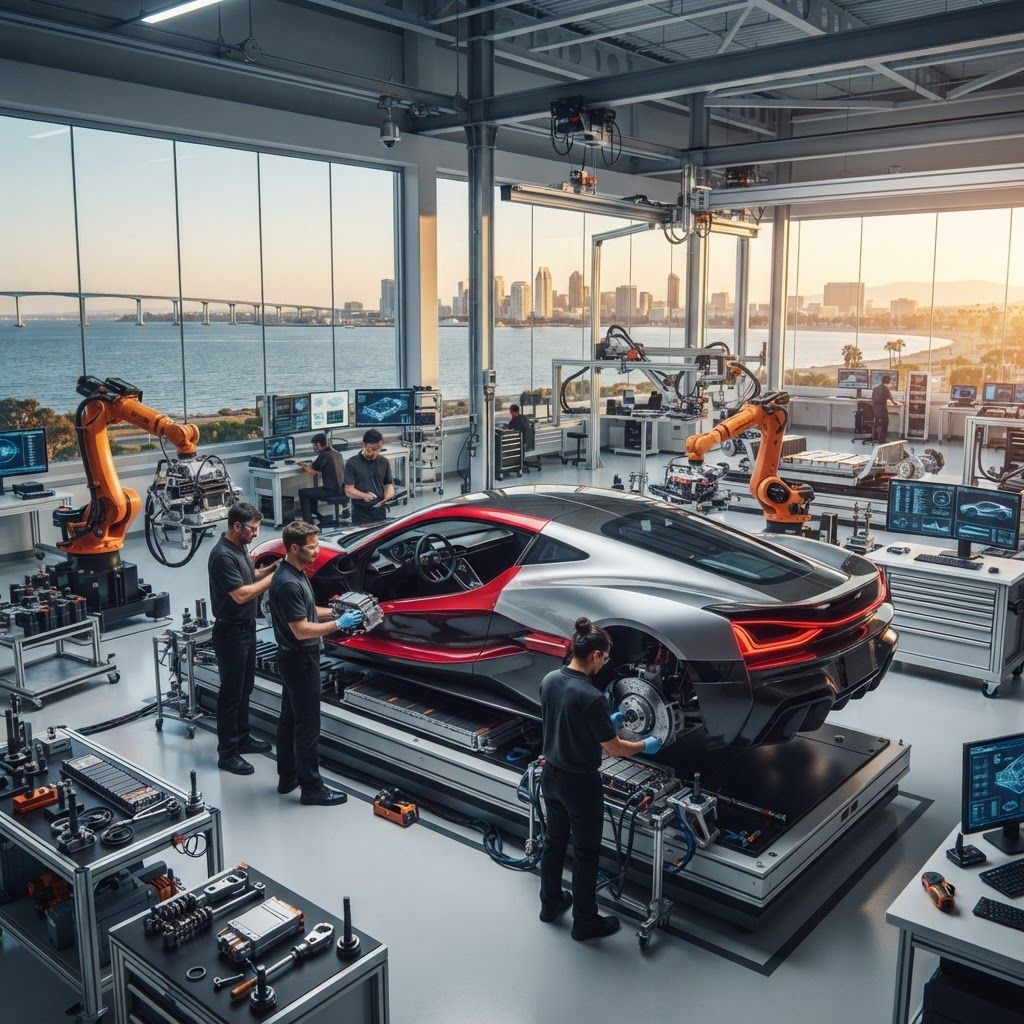
San Diego's Automotive Manufacturing Niche
San Diego is not a traditional high-volume automobile assembly center. Its advantages lie in electric mobility, charging, defense vehicles, off-road equipment, performance components, software, and cross-border supply chains. The companies below include vehicle manufacturers and specialized automotive technology businesses that illustrate how the region contributes to modern transportation.
1. Aptera Motors
Carlsbad-based Aptera Motors is developing a lightweight solar electric vehicle focused on extreme efficiency. Its unconventional aerodynamic design, integrated solar cells, and composite structure distinguish it from conventional passenger cars. The company represents San Diego's willingness to rethink vehicle architecture around energy use rather than simply enlarging batteries.
2. Nuvve
Nuvve is a San Diego vehicle-to-grid technology company rather than a conventional automaker. Its platform coordinates electric-vehicle charging and can allow compatible fleet vehicles to interact with the grid. School buses and commercial fleets are promising applications because predictable schedules can create flexible energy capacity.
3. Beam Global
San Diego-based Beam Global manufactures solar-powered electric-vehicle charging and energy infrastructure. Its transportable systems can be deployed without extensive civil work in suitable applications, supporting fleets, public agencies, emergency operations, and remote sites. The company connects automotive electrification with resilient distributed energy.
4. General Atomics
General Atomics and its affiliated operations develop advanced unmanned aircraft, electromagnetic systems, and defense technologies. Although not a consumer automaker, the organization contributes to autonomous mobility, power systems, sensors, and specialized vehicle platforms. These capabilities overlap increasingly with automotive robotics and electrification.
5. Taylor-Dunn
Taylor-Dunn manufactures industrial and commercial electric vehicles used for personnel transport, burden carrying, and towing. Its Southern California heritage and focus on durable low-speed vehicles make it relevant to campuses, factories, resorts, airports, and large facilities throughout the San Diego economy.
6. Fox Factory
Fox Factory develops performance suspension products used in bicycles, off-road vehicles, trucks, and powersports applications. Its engineering and aftermarket presence are highly relevant to Southern California's outdoor and off-road culture. Performance validation, durability, and tunability differentiate specialized component manufacturers.
7. Bilstein
Bilstein manufactures high-performance shock absorbers and suspension systems for original equipment and aftermarket customers. Southern California's automotive culture provides a strong market for handling and off-road upgrades. Customers should match components to vehicle weight, use, geometry, and ride objectives rather than appearance alone.
8. Magna International
Magna is a global mobility technology and contract manufacturing company supplying body systems, electronics, powertrains, seating, and complete-vehicle engineering. San Diego mobility startups can look to companies of this scale when moving from prototypes toward validated, manufacturable products and automotive-grade supply chains.
9. Jabil
Jabil manufactures electronics and systems for automotive and transportation customers, including connected, electrified, and sensor-rich products. Its design and supply-chain capabilities are relevant as vehicles become computing platforms. Automotive programs demand traceability, long availability, functional safety, and disciplined change control.
10. Kyocera International
San Diego-based Kyocera International supplies advanced ceramic components, electronic packages, connectors, displays, and other technologies relevant to automotive systems. Specialized materials withstand heat, vibration, electrical stress, and harsh environments, making them foundational to reliable sensors, power electronics, and control modules.
What Makes an Automotive Manufacturer Strong
Automotive buyers and partners should assess quality certifications, production part approval processes, traceability, functional safety, testing, warranty performance, capacity, cybersecurity, and supplier resilience. A compelling prototype is only the beginning; repeatable production, serviceability, regulatory compliance, and spare-parts support determine commercial durability.
San Diego Mobility Trends
Electrification is expanding beyond passenger cars into buses, delivery fleets, port equipment, industrial vehicles, and defense platforms. Charging infrastructure, battery controls, and grid integration are becoming as important as the vehicle. Autonomous systems benefit from the region's defense, wireless, mapping, and artificial-intelligence talent.
The Cross-Border Advantage
Nearby Baja California has extensive automotive, aerospace, electronics, and medical manufacturing capabilities. San Diego companies can combine local research and product leadership with regional production, but successful programs require careful customs planning, quality alignment, logistics visibility, and intellectual-property controls.
Final Perspective
The region's automotive future is specialized rather than volume-driven. Aptera, Beam Global, Nuvve, component suppliers, and advanced defense businesses show how San Diego can influence efficient vehicles and infrastructure. The best partner will be the one whose validated capabilities match the exact product, regulatory class, and production stage.
Questions to Ask Before Making a Decision
Before selecting a provider, request a clear explanation of scope, responsibilities, timelines, pricing, and ongoing support. Ask for examples of comparable San Diego work and confirm which team members will remain involved after the initial consultation or sale. Independent references, current licenses or certifications, written warranties, and transparent contract terms provide stronger evidence than promotional claims alone. Consider how the organization handles delays, disputes, security, safety, regulatory change, and unexpected costs. A thoughtful comparison should account for total long-term value, not only the lowest starting price. Shortlist several candidates, document the same questions for each, and verify important claims directly. This disciplined process makes it easier to identify a capable partner whose expertise, capacity, communication style, and risk controls match the specific needs of the project.
