
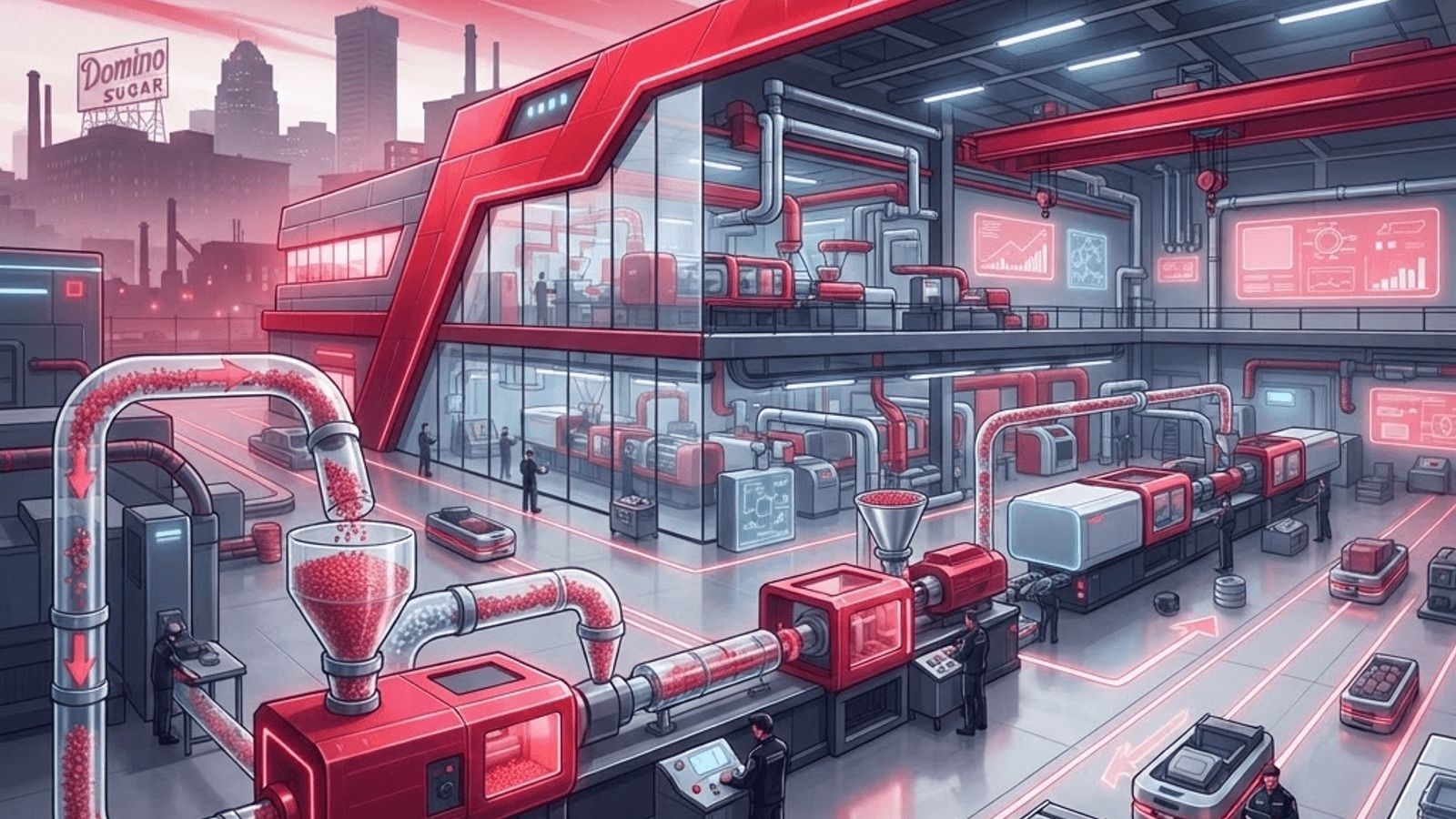
Why Plastics Manufacturing Thrives in Baltimore
Plastics manufacturing rewards proximity to end markets, because molded and extruded products are often bulky relative to their value and expensive to ship long distances. Baltimore's location within a day's drive of a large share of the East Coast population, combined with substantial industrial space and port access for resin imports, makes it a sensible place to produce plastic components and packaging.
The regional demand base is diverse and resilient. Medical device and life-science companies clustered around Baltimore and the Washington corridor need precision molded components and sterile packaging. Food and beverage producers need containers and closures. Construction and infrastructure projects need piping, sheet, and profile extrusions. Industrial manufacturers need machined plastic components, guards, and fixtures. This diversity insulates the local sector from downturns in any single market.
Understanding Plastics Processing Methods
Choosing a manufacturer starts with understanding processes, because each suits different geometry and volume. Injection molding forces molten resin into a steel mold, delivering excellent repeatability and fine detail at moderate to high volumes, with significant tooling cost. Extrusion produces continuous profiles, sheet, tube, and film, ideal for long products with a constant cross-section. Thermoforming heats sheet and forms it over a mold, economical for large, shallow parts at lower volumes. Rotational molding creates large hollow parts such as tanks. Blow molding produces bottles and hollow containers. Plastic machining and fabrication cut, weld, and assemble stock shapes for low volumes and prototypes.
The most expensive mistake buyers make is selecting a process before evaluating volume. A part needing two hundred units annually should almost never be injection molded, and a part needing two hundred thousand should almost never be machined.
The Top Plastic Manufacturers Serving Baltimore
Bel Air Plastics provides injection molding services for industrial and consumer components in the Maryland region. Its differentiators are tooling support, in-house mold maintenance, and willingness to serve mid-volume programs that larger molders decline.
Chesapeake Plastic Fabrication specializes in machining, welding, and fabricating acrylic, polycarbonate, and engineering plastics into guards, tanks, enclosures, and displays. Plant engineers rely on it for one-off and low-volume needs where tooling cannot be justified.
Patapsco Medical Molding focuses on precision molded components under quality systems suited to medical and diagnostic products, including controlled environment molding and validated processes. In this segment, documentation and process control outweigh unit price.
Harbor Packaging Solutions produces containers, closures, and packaging components for food, beverage, and consumer clients. Its strengths are food-contact compliance, decoration capability, and inventory programs that smooth seasonal demand.
Locust Point Extrusions manufactures custom profiles, tubing, and sheet for construction and industrial applications. Custom extrusion requires die design expertise, and shops with in-house die capability iterate far faster.
Bmore Thermoforming serves clients needing large formed parts, trays, and protective covers, offering lower tooling investment than injection molding. Equipment manufacturers frequently use this route for enclosures produced in the hundreds.
Sparrows Point Polymer Recycling operates in the circular economy, reprocessing post-industrial and post-consumer plastic into usable regrind and pellets. As brands commit to recycled content targets, reliable regional reprocessors have become strategic suppliers rather than waste handlers.
Maryland Rotational Molding produces large hollow products such as tanks, containers, and marine components. Rotational molding tooling is comparatively inexpensive, making it attractive for large parts at modest volumes.
Federal Hill Composites and Plastics works with reinforced plastics and composite materials for marine, transportation, and infrastructure applications, where strength-to-weight performance and corrosion resistance justify higher material costs.
Charm City Plastic Products serves industrial distribution with stock shapes, sheet, rod, and cut-to-size services, along with light fabrication. Fast local access to material keeps maintenance and prototyping projects moving.
Trends Transforming the Plastics Industry
Recycled content is the defining trend. Brand commitments and emerging regulation are driving demand for post-consumer resin, and the constraint is supply quality rather than willingness to buy. Manufacturers that can process variable feedstock while holding dimensional and cosmetic standards enjoy a real advantage, and reprocessors with strong sorting and washing capability are increasingly valuable.
Material substitution is the second trend, moving in both directions. Some applications are replacing plastic with fiber or metal in response to consumer sentiment, while others are replacing metal with engineering plastics to reduce weight and corrosion. The net effect favors manufacturers with genuine materials expertise rather than single-material shops.
Automation and monitoring form the third trend. Modern molding cells use robotic part removal, automated inspection, and process monitoring that flags drift before scrap accumulates. This has raised quality baselines and reduced the labor cost gap with offshore production.
Design for recyclability is emerging as a fourth force. Mono-material packaging, elimination of mixed-material laminates, and easier disassembly are becoming design requirements, and manufacturers that advise on these choices add value early.
How to Select a Plastics Manufacturing Partner
Share your annual volume, tolerance requirements, cosmetic expectations, regulatory context, and target cost. Ask the manufacturer to recommend a process rather than confirming your assumption. Request a design-for-manufacturability review, since small geometry changes such as adding draft, uniform wall thickness, and proper radii can dramatically reduce cost and defect rates.
Clarify tooling ownership and storage terms in writing. Understand who pays for mold maintenance and what happens if you move production. Ask about material certification, lot traceability, and inspection methods. For regulated products, confirm quality system certification and validation experience.
Finally, discuss capacity and contingency honestly. Ask what press sizes are available, how much spare capacity exists during your season, and what happens if a mold fails. The answers reveal far more than a quoted piece price.
Final Thoughts
Baltimore's plastic manufacturers cover injection molding, extrusion, thermoforming, rotational molding, fabrication, composites, and recycling, serving markets from medical devices to construction. The sector's regional advantage is proximity combined with process diversity, allowing buyers to match a part to the right process without leaving the metro area. As recycled content and design-for-circularity requirements grow, these local capabilities will matter more, not less.
