
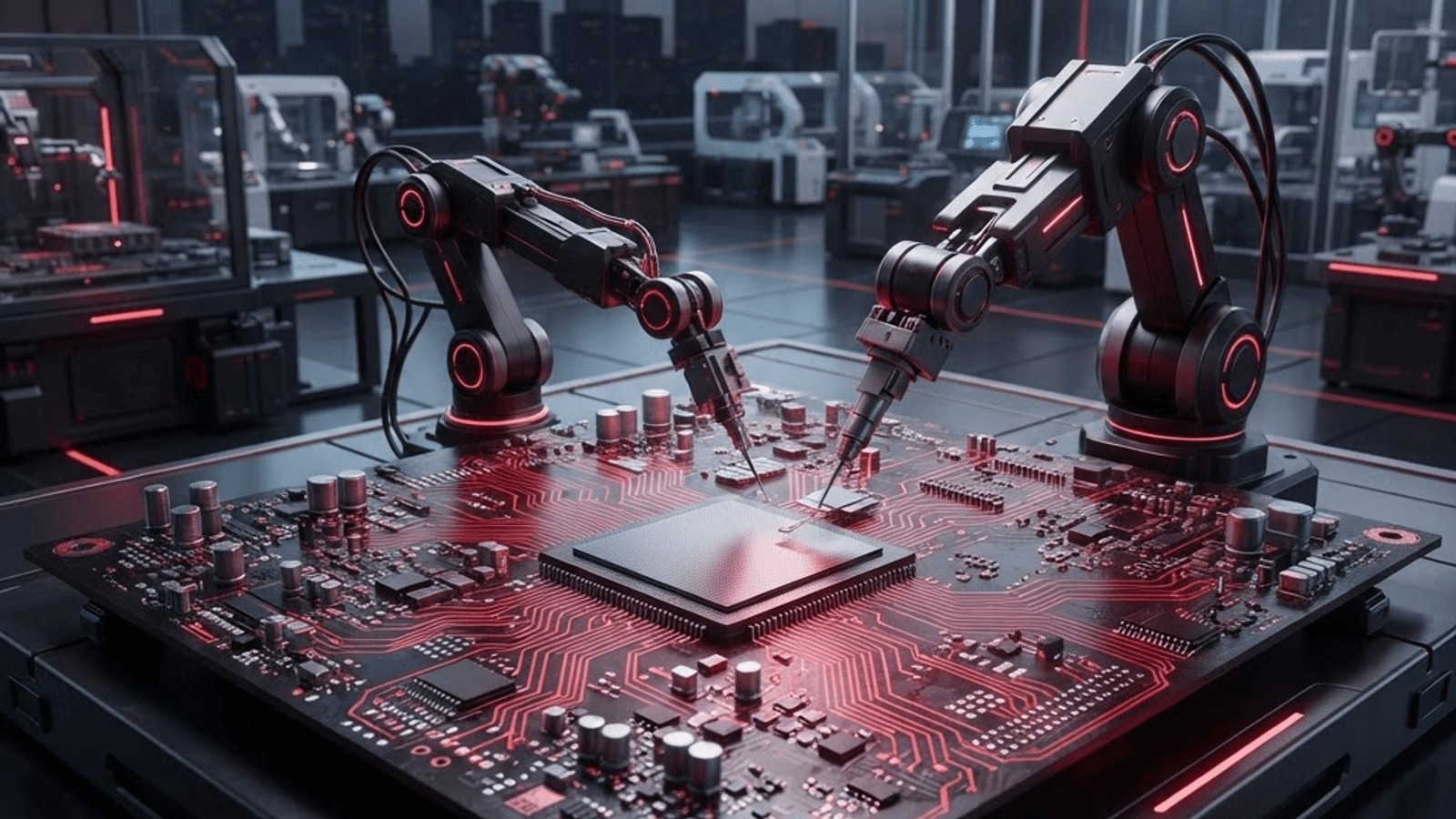
Boston Still Builds Things
It is easy to associate Boston exclusively with software, biotechnology, and finance, but the region has never stopped manufacturing sophisticated physical products. Along Route 128 and Interstate 495, and in industrial districts closer to the city, companies produce semiconductors, precision instruments, robotics platforms, machine vision systems, and audio hardware sold worldwide. This is not commodity assembly; it is high-mix, high-complexity manufacturing where engineering and production sit close together by design.
That proximity is the region's competitive advantage. When designers, process engineers, and production staff work in the same facility, iteration cycles compress dramatically. For products with tight tolerances or complicated calibration requirements, keeping manufacturing local is often a deliberate technical decision rather than a nostalgic one.
1. Analog Devices
Analog Devices is a cornerstone of the Massachusetts technology economy, designing and manufacturing high-performance analog, mixed-signal, and power management semiconductors. Its components convert real-world signals into digital form inside medical devices, industrial equipment, vehicles, and communications infrastructure. Analog design remains a craft discipline where experienced engineers are irreplaceable, which helps explain the company's deep local roots.
2. Teradyne
Teradyne, headquartered north of Boston, builds automated test equipment that verifies semiconductors and electronics before they reach customers. Test systems are among the most demanding products in electronics because they must be more precise than everything they measure. Through its robotics businesses, Teradyne has also become a significant force in collaborative automation for smaller manufacturers.
3. Bose
Bose, based in Framingham, has shaped consumer and professional audio for decades through research in acoustics, signal processing, and noise cancellation. Its engineering culture has historically emphasized long-horizon research and rigorous psychoacoustic testing, and its influence extends into automotive audio systems and professional installations worldwide.
4. Boston Dynamics
Boston Dynamics, in Waltham, is among the most recognized robotics companies on earth, known for legged and mobile platforms with remarkable dynamic balance. Beyond the widely shared demonstration videos, the company has moved into commercial products for industrial inspection and warehouse handling, requiring the transition from research prototypes to serviceable manufactured hardware.
5. MKS Instruments
MKS Instruments supplies subsystems and instruments essential to semiconductor fabrication and advanced manufacturing, including vacuum, pressure control, photonics, and laser technologies. Its products are largely invisible to consumers yet indispensable to chip production, placing the company at a critical point in the global electronics supply chain.
6. Waters Corporation
Waters, based in Milford, manufactures analytical instruments including liquid chromatography and mass spectrometry systems used in pharmaceutical development, food safety, and environmental testing. Its instruments demand extreme precision in fluidics and detection, and its proximity to the region's pharmaceutical cluster creates a productive feedback loop with customers.
7. Cognex
Cognex, headquartered in Natick, is a leader in machine vision and industrial barcode reading. Its systems inspect products, guide robots, and track goods across factories and logistics networks globally. Increasingly its products incorporate learned vision models, illustrating how established hardware manufacturers absorb artificial intelligence into existing platforms.
8. Skyworks Solutions
Skyworks, based in Woburn, designs and manufactures radio frequency semiconductors that enable wireless connectivity in phones, vehicles, and connected devices. Radio frequency engineering is notoriously difficult, involving physical effects that resist simple simulation, and sustained expertise in the discipline forms a genuine competitive barrier.
9. Draper
Draper, in Cambridge, is a nonprofit research and development organization with substantial precision engineering and prototype manufacturing capability. Its heritage in guidance and navigation systems continues through work in microelectronics, biomedical devices, and autonomous systems, and it functions as an important bridge between academic research and manufacturable hardware.
10. Thermo Fisher Scientific
Thermo Fisher, headquartered in Waltham, manufactures laboratory instruments, reagents, and equipment used throughout research and clinical environments. Its scale and its position adjacent to the region's life sciences cluster make it one of the most consequential hardware organizations in Massachusetts, and its local operations span both engineering and production.
Supply Chain Realities
Boston manufacturers navigated severe component shortages in recent years and responded by qualifying alternate suppliers, redesigning boards for part flexibility, holding strategic inventory, and in some cases reshoring production of critical subassemblies. The prevailing lesson was that single-source dependencies for inexpensive components can halt an entire product line, so resilience now competes with unit cost in design reviews.
Workforce and Skills
The region's hardware employers draw on strong engineering programs alongside community college and vocational training pipelines that produce technicians, machinists, and process specialists. Demand for skilled technicians consistently outpaces supply, and many companies now run apprenticeship and internal training programs rather than waiting for experienced candidates to appear on the market.
Why Local Manufacturing Persists
Products with rapid design iteration, stringent quality documentation, low volume with high complexity, or sensitive intellectual property are frequently better built close to their engineering teams. Massachusetts specializes in exactly those categories. Combined with an unusual density of contract manufacturers, machine shops, and test laboratories within driving distance, the region offers a hardware ecosystem few metropolitan areas can match.
Looking Forward
Semiconductor investment, medical device growth, robotics adoption among smaller manufacturers, and energy technology are all expanding locally. The constraints are physical space and skilled labor rather than demand or capital, and companies that address workforce development seriously are likely to define the next decade of Boston hardware manufacturing.
