
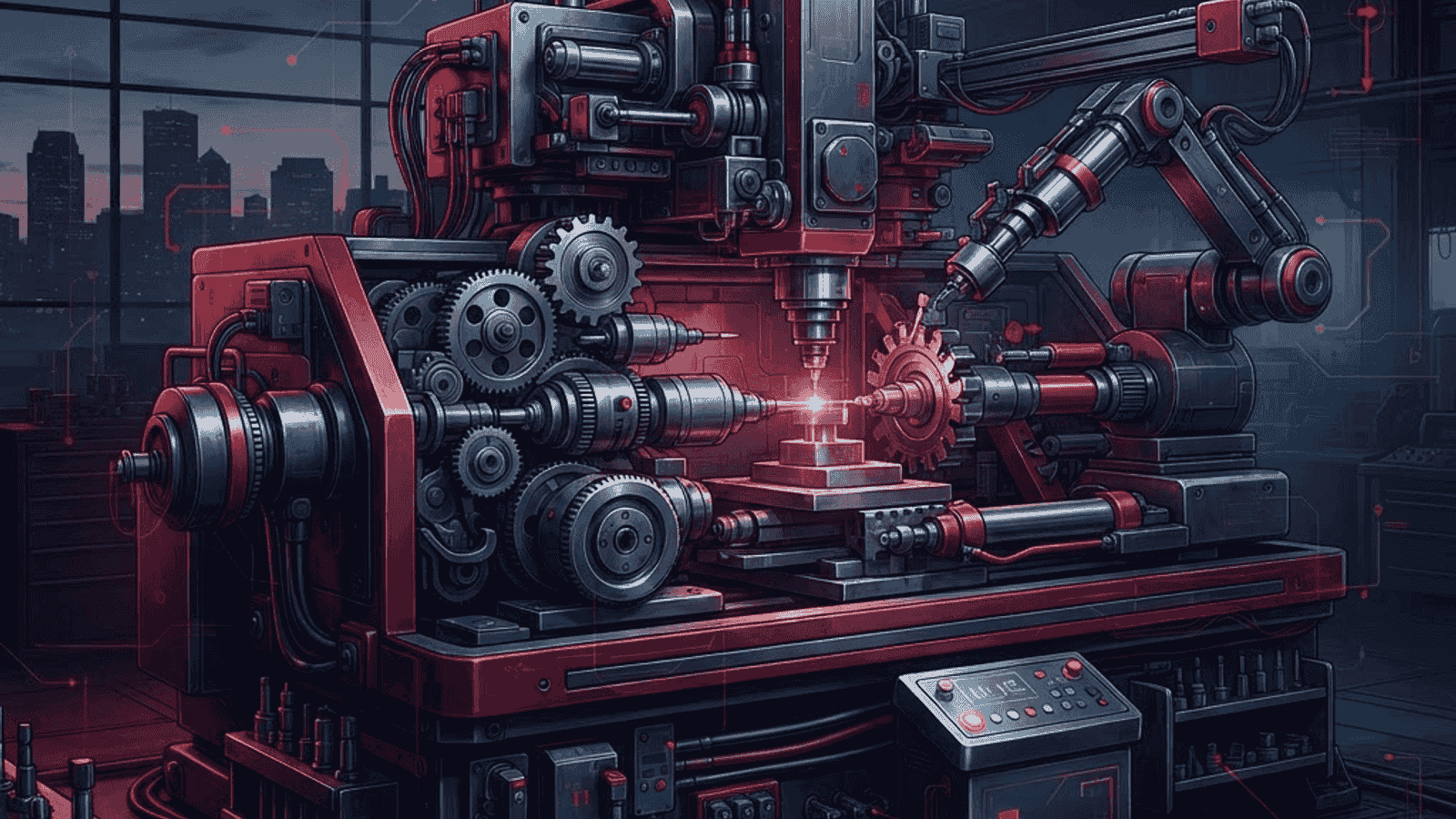
The Machinery Tradition in New England
Machine building has a longer continuous history in New England than almost any other American industry. The precision machining culture that emerged from nineteenth century armory practice and textile machinery production established engineering standards, apprenticeship traditions, and supplier networks that persist today. Boston's machinery sector inherited that foundation and redirected it toward automation, semiconductor equipment, packaging systems, and scientific instrumentation.
The modern regional profile emphasizes machines that are complex rather than large, and that serve industries requiring extreme precision or process control. Semiconductor capital equipment, life sciences automation, packaging machinery for regulated products, and specialized test systems characterize the market. These are products where engineering content dominates material cost, which suits a high-wage region well.
Teradyne
Teradyne builds automated test equipment that verifies semiconductors and electronic systems during manufacturing, operating from Massachusetts. Their machines represent some of the most sophisticated production equipment in existence, performing millions of precise electrical measurements per device at production speeds.
The company's expansion into industrial automation through collaborative robots and autonomous mobile robots has broadened their machinery portfolio considerably. Those product lines address labor-constrained manufacturing environments where flexible automation delivers value that fixed automation cannot.
Waters Corporation
Waters Corporation manufactures analytical instrumentation from its Massachusetts operations, producing liquid chromatography systems, mass spectrometers, and thermal analysis equipment. These are precision machines integrating fluidics, high-voltage electronics, vacuum systems, optics, and sophisticated software.
Waters serves pharmaceutical, food safety, environmental, and materials testing laboratories worldwide. Their machinery must deliver reproducible quantitative results across years of operation, a reliability requirement that shapes every engineering decision from pump design to software validation.
Thermo Fisher Scientific
Thermo Fisher Scientific maintains substantial Massachusetts manufacturing operations producing laboratory instruments, analytical systems, and bioprocessing equipment. Their machinery spans electron microscopes, spectrometers, chromatography systems, and automated sample handling platforms.
The company's scale allows integration across instrument, consumable, and software layers, giving laboratory customers complete workflow solutions. For research and clinical environments, that integration reduces the validation burden compared to assembling equipment from multiple vendors.
Entegris and Semiconductor Equipment Suppliers
Massachusetts hosts significant semiconductor equipment and materials handling companies producing the specialized machinery and subsystems that wafer fabrication requires. This includes filtration systems, fluid handling equipment, wafer transport automation, and contamination control apparatus.
Semiconductor manufacturing operates at cleanliness and precision levels unmatched in industry, and equipment suppliers must engineer to correspondingly extreme specifications. Regional suppliers have built durable positions by mastering those requirements over decades of fab generation transitions.
Barry-Wehmiller Packaging and Packaging Machinery Builders
Packaging machinery builders serving the Northeast produce filling, capping, labeling, cartoning, and case packing equipment for food, beverage, pharmaceutical, and consumer products manufacturers. New England's concentration of food producers and pharmaceutical companies creates strong regional demand.
Pharmaceutical packaging machinery in particular demands validation documentation, serialization capability, and change control discipline that general industrial equipment does not. Builders serving that market differentiate through regulatory competence as much as mechanical design.
Precision Machine Tool and Automation Integrators
The Boston region supports numerous custom automation integrators and machine builders producing purpose-designed production equipment: assembly stations, test fixtures, material handling systems, and inspection machines. These firms build one-off or short-run machines tailored to a specific customer process.
Their value lies in translating a manufacturing requirement into a working machine, encompassing mechanical design, controls programming, vision system integration, and safety engineering. For manufacturers with unique processes, custom machinery is often the only path to automation.
Bruker and Scientific Instrument Manufacturers
Scientific instrument manufacturers with Massachusetts operations produce nuclear magnetic resonance systems, X-ray analysis equipment, surface metrology instruments, and specialized research apparatus. These machines serve academic research, pharmaceutical discovery, and industrial materials analysis.
Building research instrumentation requires tolerating low production volumes and high configuration variability while maintaining performance at physical measurement limits. That combination favors regions with deep engineering talent and established precision supplier networks.
Industrial Pump and Fluid Handling Manufacturers
New England machinery manufacturers produce pumps, valves, mixers, and fluid handling systems for process industries including chemical, pharmaceutical, food, and water treatment. Many specialize in sanitary designs or corrosion-resistant materials for demanding service.
Sanitary fluid handling for biopharmaceutical manufacturing has been a particular growth area, driven by the region's biotech concentration. Single-use systems, clean-in-place capability, and validated material traceability distinguish this equipment from general industrial fluid handling.
Material Handling and Conveyor System Builders
Regional manufacturers build conveyor systems, sortation equipment, palletizing systems, and warehouse automation for distribution and manufacturing facilities. Growth in fulfillment operations across the Northeast has increased demand substantially.
Modern material handling integrates mechanical conveyance with controls, warehouse management software, robotics, and increasingly machine learning for item recognition. Builders capable of delivering integrated systems rather than isolated equipment hold clear advantage.
Custom Machine Shops and Fabrication Specialists
Supporting the entire machinery ecosystem, Boston-area machine shops and metal fabricators provide precision components, weldments, and assemblies that machine builders require. Many maintain multi-axis CNC capability, wire EDM, grinding, and coordinate measuring machine inspection.
This supplier depth is a genuine regional asset. A machine builder can source complex precision components locally with short lead times, enabling development iteration speeds that geographically isolated builders cannot achieve.
Trends in Machinery Manufacturing
Automation demand has intensified due to persistent manufacturing labor constraints, pushing adoption of collaborative robots and flexible automation into applications and company sizes that previously could not justify it. Falling robot costs and improved programming interfaces have expanded the addressable market considerably.
Connectivity and predictive maintenance have become standard expectations. Machines now ship with sensor instrumentation, edge computing, and remote monitoring that enable condition-based service rather than fixed-interval maintenance, reducing unplanned downtime meaningfully.
Modularity has also gained importance. Customers increasingly want machines that can be reconfigured for product changes rather than dedicated equipment obsoleted by a product revision, shifting design philosophy toward platform architectures.
How to Choose a Machinery Manufacturer
Assess application experience specifically rather than general capability. A builder who has solved a problem closely resembling yours will deliver faster and with fewer surprises than one approaching it fresh, regardless of overall engineering strength.
Evaluate lifecycle support seriously. Industrial machinery operates for decades, and spare parts availability, controls platform longevity, and service technician access matter enormously over an asset's life. Ask directly how long parts support is guaranteed.
For regulated industries, confirm validation documentation capability and change control practices before contracting. Retrofitting compliance documentation onto a completed machine is expensive and sometimes impossible.
Request reference installations you can actually visit. Seeing a comparable machine running in a production environment reveals more than any specification document.
Final Thoughts
Boston's machinery manufacturers carry forward a precision engineering tradition while serving thoroughly modern markets in semiconductors, life sciences, and automation. The companies profiled here compete through engineering depth and application expertise rather than price. For manufacturers needing equipment that must work precisely and reliably for decades, this regional cluster offers unusual concentration of relevant capability.
