
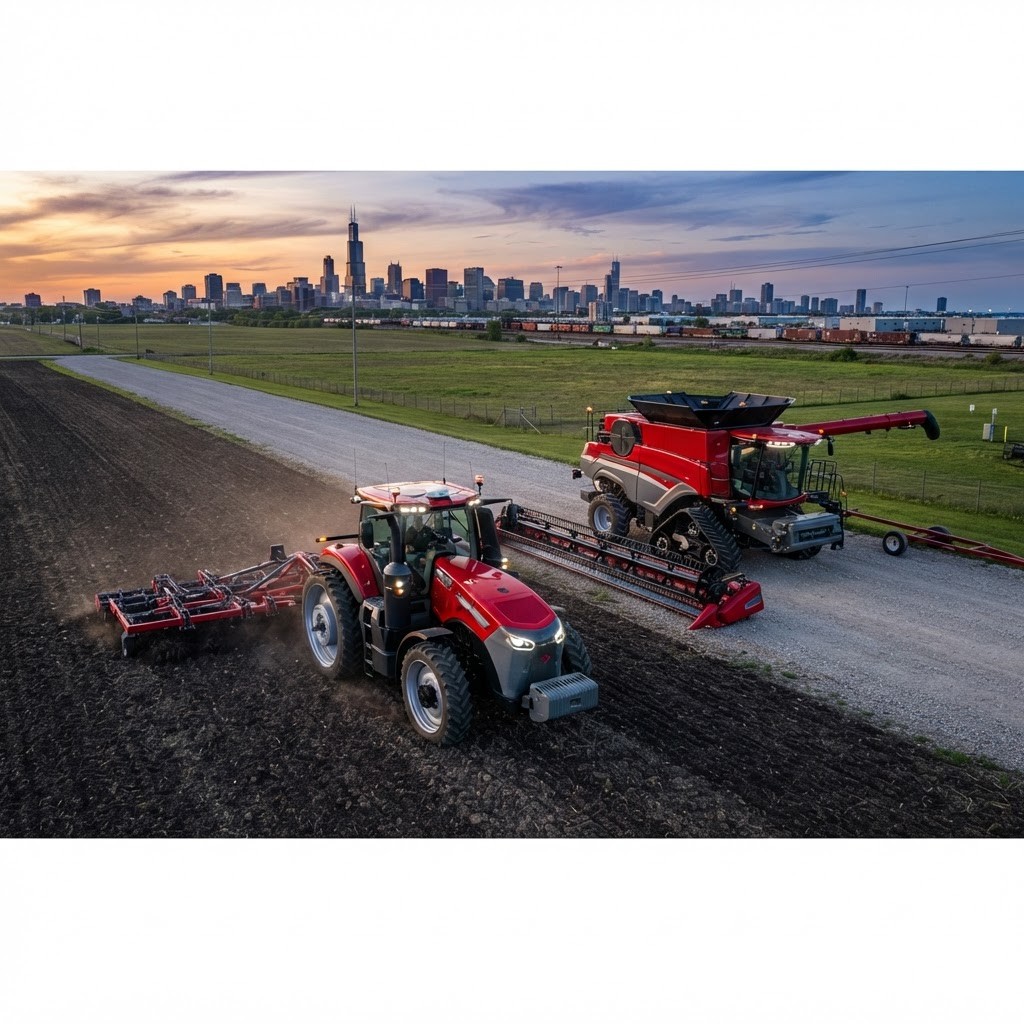
Agricultural Machinery for Northern Illinois
The Chicago metropolitan area sits beside one of the country’s most productive agricultural regions. Corn, soybeans, specialty crops, livestock operations, landscaping businesses, and municipal users all depend on durable equipment. Brand choice matters, but local dealer support, parts availability, operator familiarity, resale value, and compatibility with existing implements can matter even more.
Before purchasing, calculate annual hours, field size, transport distances, soil conditions, crop system, labor availability, and technology needs. Demonstrate machines in realistic conditions and compare warranty coverage, service response, telematics ownership terms, and total cost per acre.
1. John Deere
John Deere is deeply established across Illinois, with tractors, combines, planters, sprayers, hay tools, compact equipment, and precision systems. Its dealer network, parts availability, integrated technology, and resale strength make it a leading choice for many operations.
2. Case IH
Case IH has strong Illinois roots and offers high-horsepower tractors, combines, planting equipment, tillage tools, and application machinery. The brand is known for productive field systems and precision options designed for large commercial farms.
3. New Holland Agriculture
New Holland provides tractors, combines, balers, forage equipment, and compact machines. Its breadth is useful to mixed farms, hay producers, municipalities, and property managers. Buyers should assess the strength of the specific local dealer serving their county.
4. AGCO
AGCO’s portfolio includes agricultural machinery and technologies serving a wide range of producers. Its brands and dealer channels provide tractors, harvesting systems, application equipment, and precision solutions. Product fit varies by operation, so service access should be investigated early.
5. Fendt
Fendt is recognized for premium tractors, combines, planters, and advanced controls. Features emphasizing efficiency, operator comfort, and precision appeal to high-utilization farms. Buyers should weigh the productivity gains against acquisition cost and confirm trained local technical support.
6. Massey Ferguson
Massey Ferguson offers practical tractors, hay equipment, and farm machinery across compact and utility categories. The brand can suit smaller farms, livestock operations, and property maintenance where straightforward operation and versatility are priorities.
7. Kubota
Kubota is strong in compact and utility tractors, mowers, loaders, hay tools, and construction-adjacent equipment. Around Chicago, its machines are relevant to specialty farms, landscapers, municipalities, equestrian properties, and operations working in confined spaces.
8. CLAAS
CLAAS is respected for forage harvesters, combines, hay equipment, and tractors. Livestock and custom-harvesting businesses often focus on throughput, chop quality, grain handling, and seasonal uptime. Dealer parts planning is critical during narrow harvest windows.
9. Kinze Manufacturing
Kinze is known for planters and grain carts designed for productive row-crop operations. Illinois growers value equipment that supports accurate seed placement and efficient harvest logistics. Compatibility with tractors, guidance systems, and farm data platforms should be confirmed.
10. Great Plains
Great Plains manufactures planting, seeding, and tillage equipment suited to varied conservation and field-management strategies. Buyers should match opener design, residue handling, downforce, width, and transport configuration to their soils and cropping practices.
Technology and Ownership Trends
Precision agriculture now influences nearly every major equipment decision. Guidance, section control, variable-rate application, yield mapping, and remote diagnostics can reduce overlap and improve decisions, but only when data is accurate and teams are trained. Ask who owns machine data, how it can be exported, what subscriptions continue after purchase, and whether systems connect with other brands already on the farm.
Electric and alternative-fuel equipment is emerging first in smaller or controlled applications, while high-power field work still faces range and infrastructure challenges. Autonomous features are expanding, but supervision, safety, connectivity, and regulation remain important. For farms near Chicago, road transport dimensions, suburban traffic, winter storage, and rapid access to parts deserve special attention. A trusted dealer with skilled technicians and a well-stocked parts department can make a well-matched machine far more productive over its working life.
