
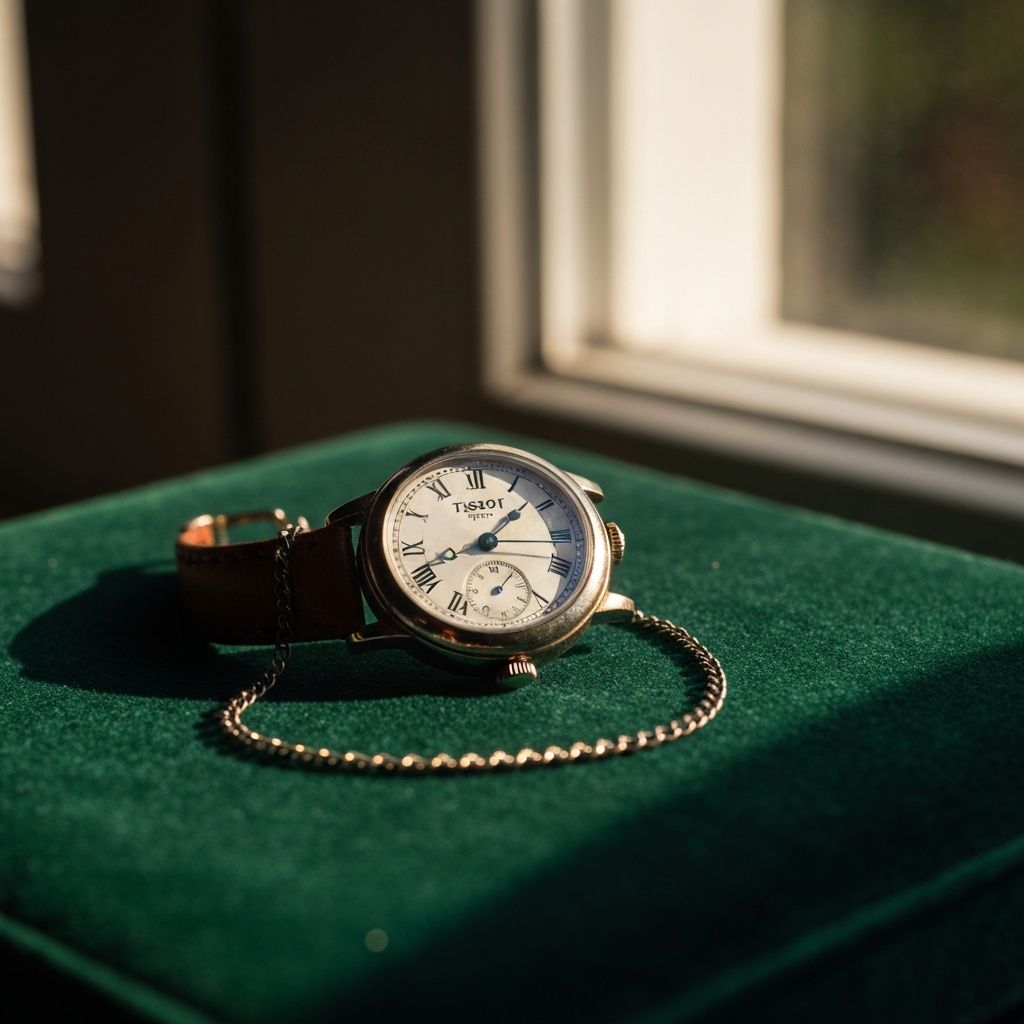
The Heritage of Tissot
Tissot is a Swiss watchmaker with a rich heritage that dates back to 1853 when Charles-Félicien Tissot and his son Charles-Émile Tissot founded the company in Le Locle, Switzerland. Le Locle is situated in the heart of the Swiss Jura mountains, a region that has been synonymous with fine watchmaking for centuries. From its inception, Tissot has been committed to producing high-quality timepieces that combine Swiss craftsmanship with innovation and accessibility.
Throughout its more than 170-year history, Tissot has achieved numerous milestones in watchmaking. The company produced one of the first mass-produced pocket watches, introduced one of the first plastic watches, and developed innovative tactile technology with its T-Touch line. Tissot has also served as the official timekeeper for numerous international sporting events, including the NBA, MotoGP, Tour de France, and various Olympic sports, reinforcing its association with precision and reliability.
Tissot's Position in the Watch Market
To understand whether Tissot is a luxury brand, it is helpful to examine how the watch industry categorizes its brands. The Swiss watch industry is often divided into tiers, with brands grouped by price point, prestige, and craftsmanship. The most commonly referenced hierarchy, though not officially standardized, places brands into categories such as entry-level, mid-range, premium, luxury, and haute horlogerie (high watchmaking).
Tissot is generally classified as a premium or upper-mid-range brand, sitting above fashion watches and entry-level Swiss brands but below established luxury brands like Omega, Rolex, and Patek Philippe. Tissot is part of the Swatch Group, the world's largest watch conglomerate, which also owns brands across the entire spectrum, including Omega, Longines, Breguet, and Blancpain. Within the Swatch Group's brand hierarchy, Tissot is positioned as a "mid-range traditional" brand.
Craftsmanship and Quality
Tissot watches are manufactured in Switzerland and carry the "Swiss Made" designation, which guarantees a certain level of quality and craftsmanship. The "Swiss Made" label requires that at least 60% of the watch's production costs are incurred in Switzerland, and the movement must be Swiss-made and cased in Switzerland. This designation is a mark of quality that is respected worldwide and is a common feature of luxury watches.
The build quality of Tissot watches is generally excellent for their price point. The brand uses high-grade stainless steel, sapphire crystal glass, and quality leather or metal bracelets in its timepieces. The finishing and attention to detail, while not at the level of haute horlogerie brands, are consistently praised by watch enthusiasts and reviewers as being impressive relative to the price.
Tissot's case construction, dial design, and overall aesthetic demonstrate a level of care and refinement that elevates the brand above mass-market fashion watches. The brand offers a wide range of designs, from classic dress watches to sporty chronographs and modern smartwatches, catering to diverse tastes and preferences.
Movement Technology
The movement, or caliber, of a watch is the engine that drives its timekeeping functions and is a key factor in determining a watch's quality and prestige. Tissot uses a variety of movements in its watches, including mechanical (both hand-wound and automatic) and quartz movements sourced primarily from ETA, a movement manufacturer also owned by the Swatch Group.
Tissot's mechanical watches feature ETA movements that are known for their reliability, accuracy, and ease of service. The brand's Powermatic 80 movement, which offers an impressive 80-hour power reserve, is a standout feature that provides excellent value. An 80-hour power reserve means that the watch can continue to run for over three days without being wound or worn, which is a feature typically found in more expensive watches.
While Tissot's movements are well-made and reliable, they are not in-house movements in the way that brands like Rolex, Omega, or Patek Philippe develop and manufacture their own calibers. The use of ETA movements, while common among Swiss brands at this price point, is one factor that distinguishes Tissot from higher-tier luxury brands that invest in proprietary movement development.
Pricing and Value Proposition
Tissot watches are priced in the range of approximately $250 to $2,500, with most popular models falling between $300 and $1,000. This pricing places Tissot well below traditional luxury brands like Rolex (typically $5,000 and above), Omega ($3,000 and above), and Cartier ($3,000 and above). However, Tissot's pricing is above that of fashion watches from brands like Fossil, Michael Kors, and Daniel Wellington, which typically retail for under $300.
The value proposition of Tissot is one of its greatest strengths. For the price, Tissot offers Swiss-made quality, reliable movements, sapphire crystal glass, and attractive designs that compete favorably with watches costing two to three times as much from other brands. Many watch enthusiasts consider Tissot to be one of the best values in Swiss watchmaking, offering a genuine luxury experience at an accessible price point.
Tissot vs. Luxury Watch Brands
When compared to established luxury watch brands, Tissot occupies a distinctly different segment of the market. Brands like Rolex, Omega, Cartier, and IWC command premium prices not only for their craftsmanship but also for their brand prestige, exclusivity, and investment potential. These luxury brands often feature in-house movements, precious materials, and limited production runs that contribute to their elevated status.
Tissot, while offering excellent quality and craftsmanship, does not carry the same level of brand prestige or exclusivity as these luxury competitors. A Tissot watch, no matter how well-made, does not convey the same status as a Rolex or Patek Philippe. However, for consumers who prioritize substance over status, Tissot delivers a compelling package that includes Swiss quality, innovative features, and timeless design without the luxury markup.
Within its own price segment, Tissot competes with brands like Hamilton, Seiko Presage, Mido, and Certina. Against these competitors, Tissot holds its own and often leads in brand recognition, design diversity, and overall market presence.
The Perception of Luxury
Whether Tissot is considered a luxury brand depends largely on how one defines luxury. If luxury is defined strictly by price, exclusivity, and brand prestige, then Tissot falls short of the luxury designation. It is accessible, widely available, and priced within reach of most consumers, which is contrary to the exclusivity that typically characterizes luxury goods.
However, if luxury is defined more broadly to include quality craftsmanship, heritage, Swiss manufacturing, and an elevated experience compared to mass-market alternatives, then Tissot can reasonably be described as an accessible luxury or entry-level luxury brand. The brand's Swiss heritage, commitment to quality, and association with precision timekeeping lend it a sense of luxury that distinguishes it from non-Swiss and fashion watch brands.
Conclusion
Tissot is not a luxury brand in the traditional haute horlogerie sense, but it is a premium Swiss watchmaker that offers an exceptional blend of quality, heritage, and value. Positioned as an accessible entry point into Swiss watchmaking, Tissot provides consumers with the craftsmanship and prestige associated with Swiss-made timepieces at prices that are far more attainable than those of established luxury brands. For anyone seeking a well-made Swiss watch without the five-figure price tag, Tissot represents one of the finest options available in the market today. Its 170-year legacy, innovative spirit, and unwavering commitment to quality make Tissot a brand that, while not strictly luxury, commands respect and admiration in the global watch community.
