
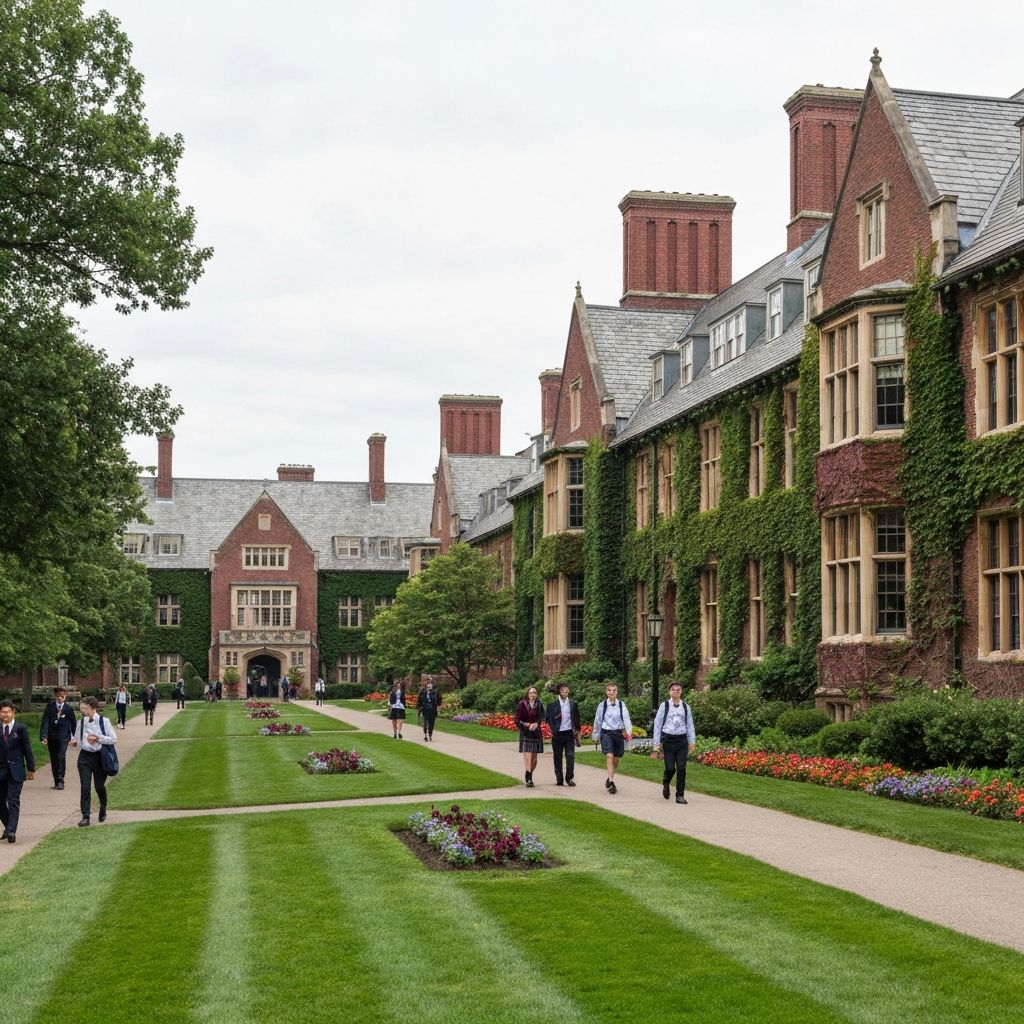
Defining the Prep School
A prep school, short for preparatory school, is a private educational institution designed to prepare students for admission to and success at selective colleges and universities. The term has its roots in the concept of "preparing" young people for the rigors of higher education, and prep schools have played a significant role in the educational landscape of the United States, the United Kingdom, and several other countries for centuries.
In the United States, prep schools typically serve students in grades 9 through 12, equivalent to high school, though some include middle school grades as well. In the United Kingdom, the term "prep school" traditionally refers to schools for younger children ages 7 to 13 who are being prepared for entrance exams to prestigious secondary schools known as public schools (confusingly, in the British system, "public schools" like Eton and Harrow are actually private institutions). For the purposes of this article, we'll focus primarily on the American understanding of prep schools as secondary-level institutions.
A Brief History of Prep Schools
The prep school tradition in America dates back to the colonial era. Some of the oldest and most prestigious prep schools in the country were founded in the 18th and early 19th centuries. Phillips Academy in Andover, Massachusetts, was founded in 1778, making it one of the oldest incorporated academies in the United States. Phillips Exeter Academy in New Hampshire followed in 1781. These institutions were established with the explicit mission of preparing young men (and eventually young women) for college study, particularly at Ivy League universities.
During the 19th century, the prep school movement expanded significantly. Schools like St. Paul's School in New Hampshire (1856), Groton School in Massachusetts (1884), and Choate Rosemary Hall in Connecticut (1890) were founded during this period. These schools were modeled in part on the English public school tradition and emphasized a rigorous classical education along with character development, physical fitness, and social refinement.
For much of their history, prep schools were exclusively available to wealthy, white, Protestant families, and they served as important social institutions for the American upper class. The connections formed at prep schools often extended into college, careers, and social life, creating networks of influence that shaped American business, politics, and culture. While this exclusivity has diminished significantly in recent decades, the historical association between prep schools and social privilege continues to influence public perception.
What Makes a Prep School Different from Public School
The differences between prep schools and public schools are numerous and significant. Perhaps the most obvious difference is cost. Prep school tuition can range from $30,000 to over $60,000 per year for day students, and boarding students may pay $50,000 to $80,000 or more annually. This places prep school education firmly in the realm of families with significant financial resources, though many schools offer substantial financial aid programs that make attendance possible for students from diverse economic backgrounds.
Class size is another major differentiator. While public school classes may have 25 to 35 students, prep school classes typically have 10 to 15 students, and some seminar-style classes may have as few as 6 to 8 students. This smaller class size allows for more individualized attention from teachers, more in-depth discussion, and more opportunities for each student to participate actively in the learning process.
The student-to-teacher ratio at prep schools is generally much lower than at public schools. A typical prep school might have a ratio of 6:1 or 8:1, compared to 15:1 or 20:1 at most public schools. This means that teachers can provide more personalized feedback, identify struggling students more quickly, and offer more challenging material to advanced learners.
Curriculum is another area of significant difference. Prep schools typically offer a more rigorous and extensive curriculum than public schools, including a wider range of Advanced Placement (AP) courses, honors courses, and electives in subjects like philosophy, economics, art history, and foreign languages that may not be available at smaller public schools. Many prep schools also have the flexibility to design their own courses outside of state-mandated curricula, allowing them to offer unique and innovative educational experiences.
Boarding vs. Day Prep Schools
Prep schools come in two main varieties: boarding schools, where students live on campus during the school year, and day schools, where students commute from home. Some schools offer both options, allowing students to choose the arrangement that best suits their family's needs and preferences.
Boarding prep schools provide a total immersion educational experience. Students live in dormitories supervised by faculty members, eat their meals in communal dining halls, and participate in supervised study halls, extracurricular activities, and social events. This residential model creates a tightly knit community and provides students with a high degree of structure and support. Many graduates of boarding schools describe the experience as transformative, citing the independence, self-discipline, and lifelong friendships they developed.
Day prep schools offer the academic rigor and small class sizes of the prep school experience without requiring students to live away from home. This option appeals to families who value the prep school educational model but prefer to have their children at home during evenings and weekends. Day schools also tend to have lower tuition costs than boarding schools since room and board are not included.
The Academic Experience at a Prep School
Academics at prep schools are characterized by rigor, depth, and breadth. Students are expected to maintain high academic standards and are pushed to engage deeply with their coursework. The Harkness method, pioneered at Phillips Exeter Academy, is used at many prep schools and involves students and teachers sitting around an oval table for discussion-based learning rather than traditional lectures. This method encourages critical thinking, active participation, and collaborative learning.
Prep schools typically require students to take a wide range of courses across humanities, sciences, mathematics, foreign languages, and the arts. This liberal arts approach ensures that students develop broad intellectual foundations rather than specializing too early. Many prep schools require students to study at least two years of a foreign language, with some requiring three or four years and offering languages like Mandarin, Arabic, and Japanese alongside more traditional offerings like French, Spanish, and Latin.
Advanced research opportunities, independent study projects, and senior capstone experiences are common at prep schools. Students may have the opportunity to conduct original research under the guidance of faculty mentors, present their findings at academic conferences, and publish their work. These experiences provide valuable preparation for the kind of independent intellectual work expected at selective colleges and universities.
Extracurricular Activities and Athletics
Prep schools are known for their extensive extracurricular programs. The range of clubs, organizations, and activities available at a typical prep school far exceeds what most public schools can offer. Students can participate in everything from debate and Model United Nations to robotics, theater, community service, and student government. Many prep schools also have well-funded arts programs with dedicated studios, performance spaces, and professional-caliber equipment.
Athletics play a significant role in the prep school experience. Most prep schools field teams in a wide range of sports, and athletic participation is often encouraged or even required. The facilities at prep schools are typically outstanding, with dedicated gymnasiums, swimming pools, tennis courts, ice rinks, boathouses, and playing fields that rival those of small colleges. Prep school athletic leagues, such as the New England Preparatory School Athletic Council (NEPSAC), are highly competitive, and some prep school athletes go on to compete at the collegiate and professional levels.
College Placement and Outcomes
One of the primary reasons families choose prep schools is the strong track record of college placement. The best prep schools regularly send large percentages of their graduates to Ivy League universities, Stanford, MIT, and other highly selective institutions. College counseling at prep schools is typically a more intensive and personalized process than what's available at public schools, with dedicated counselors who maintain close relationships with admissions officers at top colleges.
Prep school students often benefit from the reputation and network of their school. Admissions officers at selective colleges are familiar with the rigor of top prep schools' curricula and may give additional consideration to applicants from these institutions. This familiarity, combined with strong college counseling, comprehensive recommendation letters from faculty who know students well, and the resources to provide impressive extracurricular experiences, gives prep school students tangible advantages in the college admissions process.
Financial Aid and Accessibility
Recognizing the need for greater diversity and accessibility, many prep schools have significantly expanded their financial aid programs in recent decades. Top prep schools like Andover, Exeter, and Deerfield now offer need-blind or need-aware admissions and provide financial aid to a substantial portion of their student body. At some schools, over 40 percent of students receive financial aid, and some families with incomes below certain thresholds pay no tuition at all.
These financial aid efforts have meaningfully diversified the student bodies at many prep schools, though critics argue that prep schools remain disproportionately accessible to wealthy families. The reality is that while financial aid has opened doors for many talented students who could not otherwise afford the experience, the prep school world remains one where socioeconomic privilege plays a significant role.
Conclusion: Is a Prep School Right for Your Family?
Prep schools offer an educational experience that is distinctly different from public schools: smaller classes, more rigorous academics, extensive extracurricular opportunities, and strong college placement outcomes. However, they also come with significant costs, potential social pressures, and the challenge of navigating an environment that has historically been associated with privilege and exclusivity. For families considering a prep school education, the key is to visit multiple schools, talk to current students and alumni, carefully evaluate financial aid options, and determine whether the prep school model aligns with their child's learning style, personality, and educational goals.
