
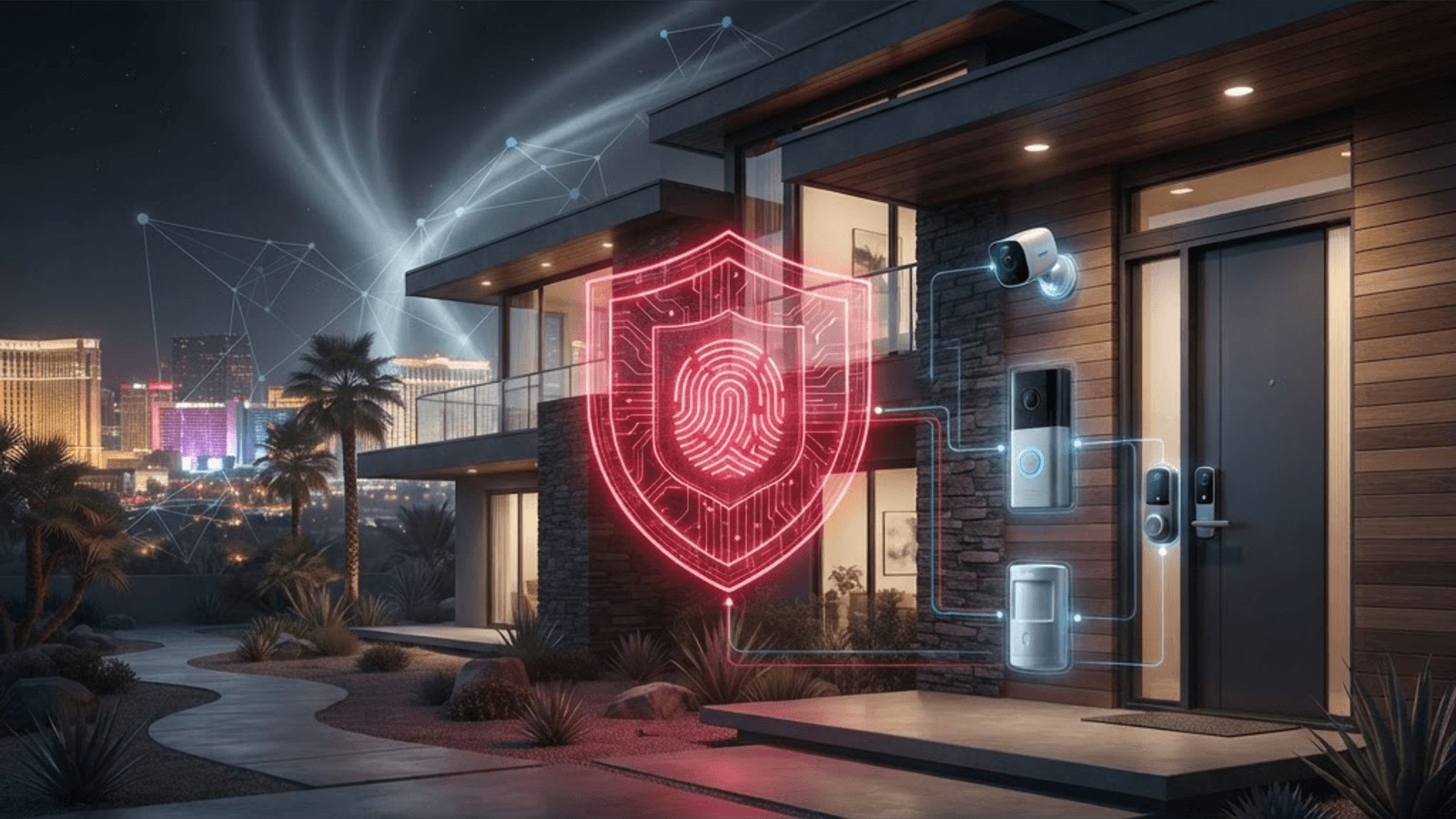
Why Home Security Gets Serious Attention in Las Vegas
Las Vegas has a distinctive residential profile. The valley hosts an enormous visitor population, a significant number of seasonal and part-time residents, a large stock of short-term rentals, and fast-growing suburban communities where neighbors may not yet know each other well. Add a workforce that operates around the clock across hospitality and gaming, meaning homes are occupied and vacant at unusual hours, and the case for a well-designed security system becomes clear.
Local conditions also shape the technology. Extreme summer heat affects batteries, adhesives, outdoor cameras, and wireless sensors. Bright, high-contrast sunlight challenges camera dynamic range, producing washed-out footage from cameras that perform well elsewhere. Dust accumulates on lenses and can trigger false motion alerts. The best local providers account for all of this rather than installing a generic package.
The Leading Home Security Companies in the Valley
1. Desert Guardian Security is known for professionally designed and monitored systems tailored to each property, beginning with a walkthrough that identifies actual entry vulnerabilities rather than selling a fixed sensor count. Their heat-rated outdoor equipment selection is a notable strength.
2. Vegas Home Watch Systems focuses on households with irregular schedules and part-time residents, offering remote monitoring, water and temperature sensors, and scheduled property checks. For homes left vacant during peak summer, environmental monitoring often prevents more loss than intrusion detection.
3. Silver State Alarm provides traditional professionally monitored alarm service with cellular and dual-path communication, which avoids the vulnerability of systems that rely solely on internet connectivity. Their central station response protocols are well documented.
4. Mojave Smart Home Security specializes in integrated smart home and security installations, combining locks, cameras, lighting, garage control, and thermostats into a single reliable platform. Their emphasis on network reliability separates them from providers that install devices and hope for the best.
5. Red Rock Surveillance concentrates on camera systems, including wired network video recorders with proper storage planning, high dynamic range cameras suited to desert glare, and thoughtful placement that captures faces and license plates rather than rooftops.
6. Summerlin Protective Services serves larger properties with layered systems: perimeter detection, gate intercoms, exterior lighting integration, and interior zones, along with attention to discreet installation that does not compromise architecture.
7. Henderson Security Solutions has a strong reputation for straightforward pricing and honest contract terms, including month-to-month monitoring options that appeal to homeowners wary of long commitments.
8. Neon City Access Control focuses on locks and access, including smart locks, keypad entry, and access management for short-term rentals where credentials must change between guests. Their audit logging is valuable for hosts and property managers.
9. Sunrise Mountain Alarm and Camera offers a practical mix of DIY-friendly and professionally installed options, helping cost-conscious homeowners build a capable system in phases rather than all at once.
10. Canyon Gate Security completes the list as a smaller local company praised for responsive service, thorough training on system use, and willingness to service and expand existing equipment rather than insisting on full replacement.
Professional Monitoring Versus Self-Monitoring
The central decision for most households is whether to pay for professional monitoring. Professionally monitored systems route alarms to a central station staffed continuously, which then verifies and dispatches. The advantage is that response does not depend on the homeowner noticing a notification. This matters for people who work long shifts, travel frequently, or sleep during the day.
Self-monitored systems send alerts directly to a phone, eliminating monthly fees. They work well for attentive homeowners who want visibility, and modern devices provide excellent video and notification quality. The weakness is obvious: if the phone is silenced, out of signal, or the owner is asleep, nothing happens.
A hybrid approach is increasingly common, pairing self-monitored cameras with professionally monitored intrusion, smoke, and environmental sensors. Whichever path is chosen, cellular backup communication is worth prioritizing, since cutting internet service or a router power failure should not disable the system.
Designing Coverage That Actually Works
Effective security is layered. The outer layer is deterrence: visible cameras, good exterior lighting, trimmed landscaping that eliminates concealment, and secure gates. Most opportunistic intrusion is discouraged before it starts.
The next layer is entry detection on doors and accessible windows, including the frequently overlooked side gate, garage service door, and rear slider. Garages deserve particular attention in the valley, since attached garages often contain a direct unlocked path into the home.
Interior detection provides a second chance if perimeter sensors are bypassed, using motion sensors positioned to cover main circulation paths rather than aimed at windows where sunlight and heat cause false alarms. Video verification then supplies evidence and reduces false dispatch. Cameras should be mounted at heights that capture faces, avoid pointing directly into afternoon sun, and cover approach paths rather than only the door itself.
Environmental sensors complete the design. Water leak detectors near water heaters and laundry areas, high temperature alerts that reveal an air conditioning failure in a vacant home, and interconnected smoke and carbon monoxide detection frequently prevent losses larger than any burglary.
Equipment Considerations for Desert Heat
Heat is hard on security hardware. Lithium batteries in wireless sensors and cameras degrade faster at elevated temperatures, so devices in direct sun need shade or a wired option. Adhesive mounts fail on hot surfaces, making mechanical fastening preferable outdoors. Cameras should carry a temperature rating appropriate for surfaces that can far exceed air temperature, and installing under eaves extends life while reducing lens dust.
Video quality in this environment depends heavily on dynamic range. A camera facing a bright driveway with a shaded entry will lose detail in one or the other unless it handles contrast well. Local installers who have tested equipment through a Las Vegas summer offer real value here.
How to Evaluate a Security Provider
Confirm licensing and insurance, and ask whether installation is performed by employees or subcontractors. Review contract length, monitoring rates, price escalation terms, cancellation policy, and equipment ownership, since some agreements leave the homeowner with hardware they cannot use elsewhere. Ask about central station redundancy and average response times, and confirm cellular backup is included.
Request a written coverage plan showing sensor and camera locations with reasoning. A provider that cannot explain why a specific window is protected is selling a package rather than designing a system. Finally, insist on training. A well-designed system that residents find confusing gets disarmed and left off.
Final Thoughts
Home security in Las Vegas works best as a layered, climate-aware system rather than a collection of gadgets. Deterrence, entry detection, interior backup, video verification, and environmental monitoring together protect against the losses homeowners here actually experience. Choose a provider that designs before it sells, specifies heat-tolerant equipment, and explains contract terms plainly, and the result is genuine peace of mind whether the home is occupied or empty.
