
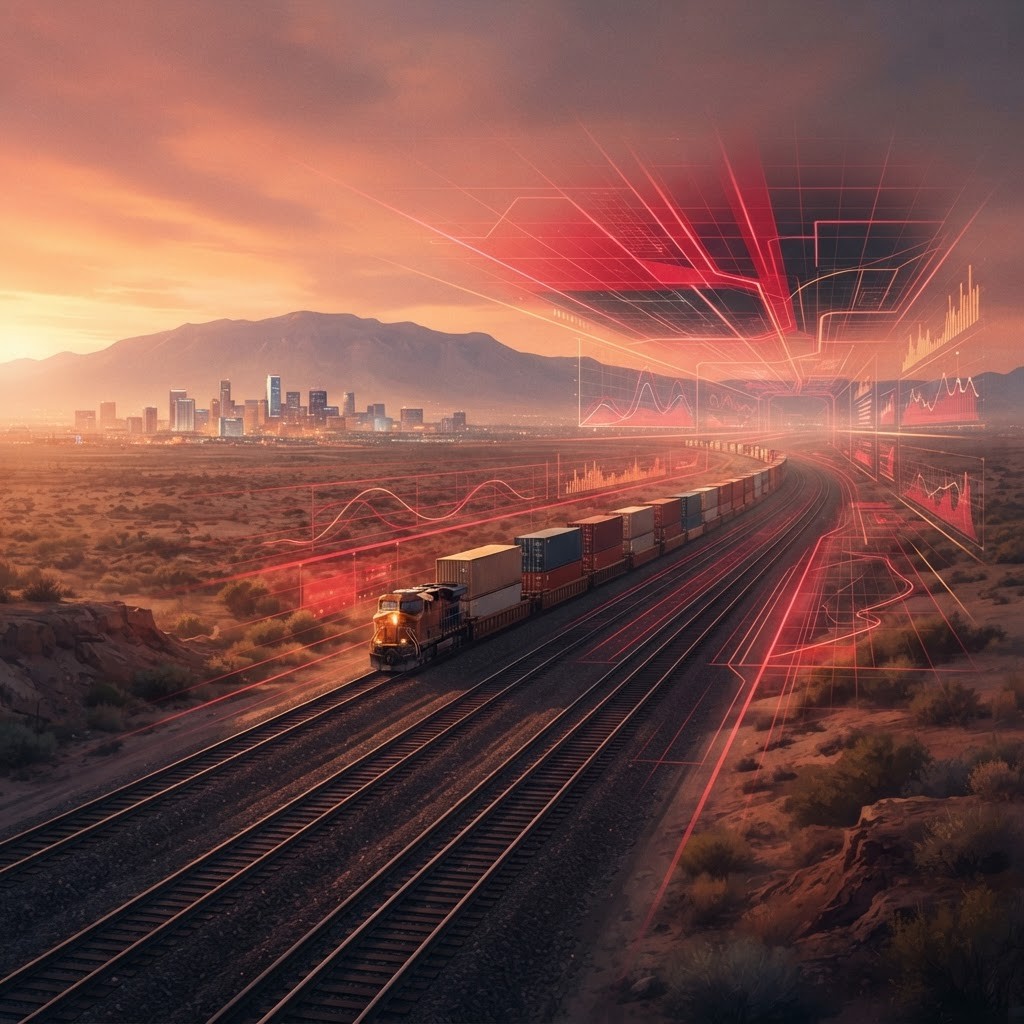
Railroads made modern El Paso. When transcontinental lines converged here in 1881, a dusty border settlement became a commercial hub almost overnight, and the historic Union Depot still stands as evidence of that transformation. More than a century later, rail remains fundamental to the city's economy, now as the crucial interchange point between United States Class I networks and the Mexican rail system.
Why El Paso Matters in North American Rail
Rail's advantage is cost per ton-mile over long distances, and El Paso sits at the intersection of exactly the right corridors. Freight moving from Mexican manufacturing centers toward Chicago, the Southeast, and the Pacific ports passes through or near this junction. Intermodal traffic combining rail linehaul with truck delivery has grown substantially as shippers pursue lower emissions and insulation from truck driver capacity constraints.
Cross-border rail interchange is the defining local specialty. Mexican and United States railroads exchange traffic at border gateways, with customs inspection and documentation adding complexity that pure domestic rail movements never encounter.
Top 10 Railway Operators and Rail Organizations in El Paso
1. Union Pacific Railroad
Union Pacific is the dominant railroad in El Paso and one of the largest in North America, operating across the western two-thirds of the United States. Its Sunset Route through El Paso is a primary transcontinental corridor connecting the Los Angeles and Long Beach port complex with Texas and the Gulf. The railroad operates classification and intermodal facilities in the region, handles substantial cross-border interchange, and offers services spanning intermodal, automotive, agricultural products, chemicals, and industrial goods. For most shippers considering rail in El Paso, Union Pacific is the starting point.
2. BNSF Railway
BNSF is the other western Class I giant, with an extensive network reaching the Pacific Northwest, Midwest, and Gulf. Its presence in the broader El Paso and southern New Mexico region, including significant operations at the Santa Teresa intermodal and logistics facility just across the state line, gives shippers a genuine competitive alternative. The Santa Teresa complex has become a major driver of industrial development in the borderplex.
3. Ferromex
Ferrocarril Mexicano, universally known as Ferromex, is the largest railroad in Mexico by network size and the principal interchange partner for freight crossing at the El Paso and Ciudad Juarez gateway. It connects Mexican Pacific ports, northern industrial centers, and central Mexico to the United States network. Understanding Ferromex operations is essential for anyone shipping rail freight into or out of Mexico through this corridor.
4. Canadian Pacific Kansas City
CPKC created the first single-line railway connecting Canada, the United States, and Mexico, fundamentally reshaping North American rail strategy. While its primary Mexican gateway lies further east, its network integration has intensified competition for cross-border traffic and expanded routing options for shippers throughout the border region.
5. Amtrak
Amtrak provides El Paso's only intercity passenger rail service. The Sunset Limited connects New Orleans and Los Angeles, passing through El Paso several times weekly, and the Texas Eagle links Chicago and San Antonio with through service to Los Angeles. Trains call at the historic downtown depot area, offering sleeping accommodations, dining service, and observation cars. For travelers who value scenery and comfort over speed, the desert segment through West Texas is genuinely spectacular.
6. Texas Pacifico Transportation
Texas Pacifico operates the South Orient rail line across a wide stretch of West Texas, connecting the border region with the broader network and serving agricultural, aggregate, and industrial customers. As a subsidiary within the Grupo Mexico rail family, it plays an important role in linking rural West Texas shippers to national and Mexican markets.
7. Southwestern Railroad
Short line railroads perform the essential first and last mile work that Class I carriers cannot economically serve. Southwestern Railroad and similar operators in southern New Mexico and West Texas handle local switching, industrial spur service, and interchange with the major carriers, supporting mining, agriculture, and manufacturing customers throughout the region.
8. Border Pacific Railroad and Regional Short Lines
The wider borderland region hosts several short line and regional operators that aggregate local traffic, provide transloading services, and maintain infrastructure serving specific industrial districts. These operators are often the most flexible partners for customers with modest volumes or unusual commodity requirements, and they frequently offer storage-in-transit capacity.
9. OmniTRAX and Rail-Served Industrial Park Operators
Companies that operate rail-served industrial parks and provide switching, transloading, and site development services are increasingly central to the borderplex logistics story. Transloading between rail and truck allows shippers without direct rail access to capture rail economics on the long haul, which is transformative for mid-sized manufacturers in Juarez and El Paso.
10. Sun Metro Streetcar
Not a railway in the freight sense, but genuinely rail transport: El Paso's streetcar system operates meticulously restored PCC cars on a downtown and university loop. It is both a functional transit service and a heritage attraction, connecting the entertainment district, the historic core, and the UTEP area. For visitors, it is the most enjoyable way to see downtown.
Intermodal and Transloading Opportunities
Most shippers in this market do not have private rail sidings, which makes intermodal and transload services the practical path to rail economics. Containers or trailers move by truck to a nearby ramp, travel by rail for the long haul, then complete delivery by truck. On lanes exceeding roughly seven hundred miles, this typically reduces cost meaningfully while cutting emissions per ton-mile substantially compared with over-the-road trucking.
Transloading bulk commodities such as plastics, aggregates, lumber, and chemicals from railcars to trucks at El Paso area facilities is another growth area, driven by Juarez manufacturing demand for inbound raw materials.
Cross-Border Rail Considerations
Rail freight crossing the border requires customs documentation, inspection compliance, and coordination between United States and Mexican carriers with different operating practices and equipment standards. Transit time variability is higher than domestic rail, so shippers should build realistic buffers and work with brokers experienced in rail entries specifically, since the process differs from truck clearance.
Final Thoughts
Rail in El Paso is a story of scale and connection. Union Pacific and BNSF provide transcontinental reach, Ferromex and CPKC extend that reach deep into Mexico, regional and short line operators handle local execution, and Amtrak plus the downtown streetcar keep passengers on the rails as well. For shippers moving substantial volume over long distances, the El Paso rail junction remains one of the most cost-effective and strategically positioned assets in North American logistics.
