
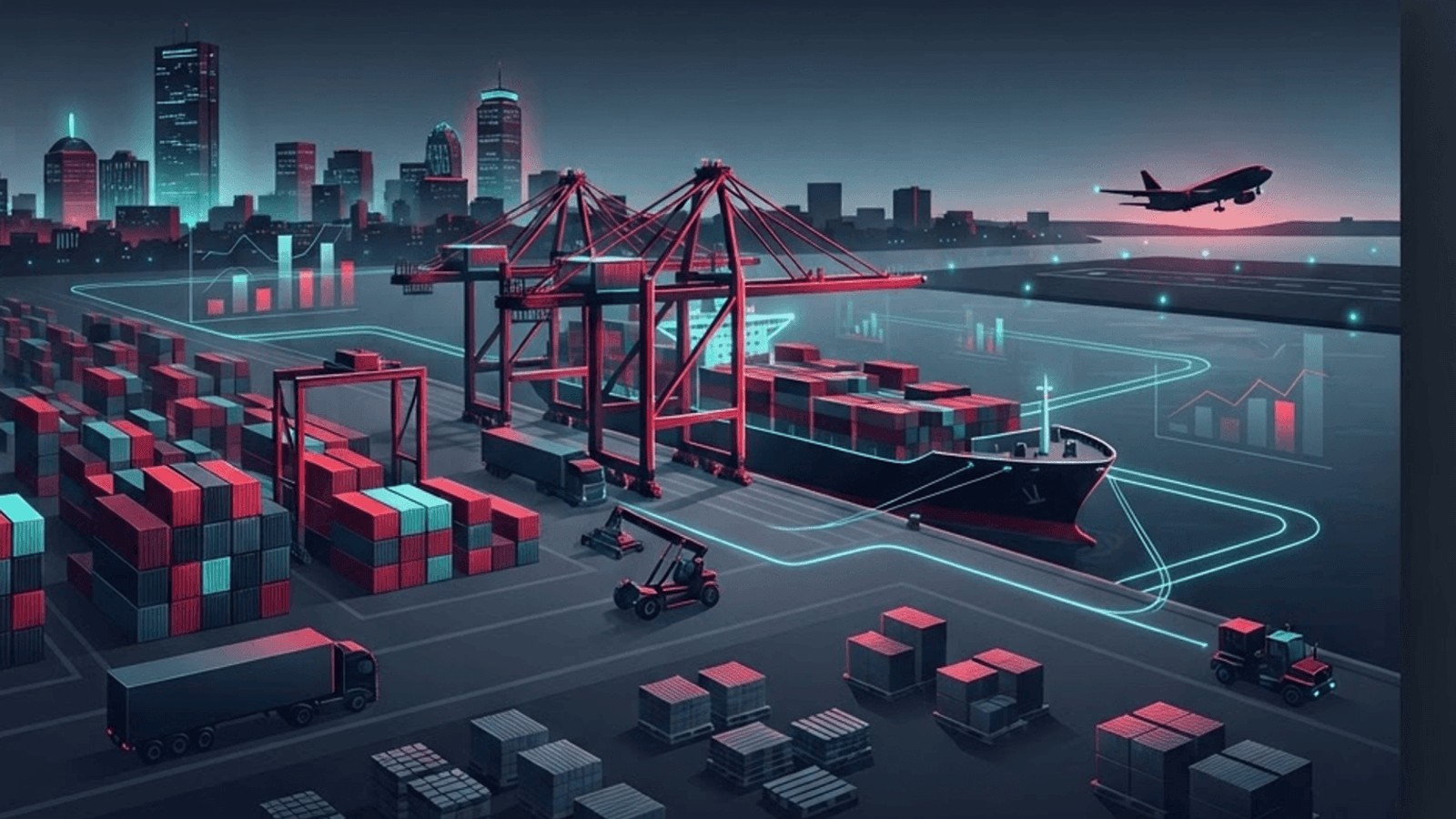
Boston's Freight and Logistics Environment
Boston's freight economy is shaped by a distinctive combination of assets and constraints. The Port of Boston, operated by the Massachusetts Port Authority, handles containerised cargo, automobiles, liquefied natural gas, bulk commodities, and cruise traffic. Conley Terminal in South Boston has been dredged to accommodate larger container vessels, allowing direct calls from ships that previously could not reach the harbour. Logan International Airport supports substantial air cargo volumes, particularly for high-value and time-critical shipments.
At the same time, the region presents real logistical difficulty. Streets in the urban core are narrow and often restricted for large vehicles. Warehouse space near the city commands premium rates, pushing distribution facilities outward along the interstate corridors. Winter weather regularly disrupts schedules. Freight providers operating successfully in Boston are those that have adapted to these conditions rather than applying generic national playbooks.
The Sectors Driving Boston Freight Demand
Understanding local demand helps in selecting a provider. The life sciences cluster in Cambridge, the Seaport, and the suburban belt generates enormous volumes of temperature-controlled and hazardous materials shipments, along with sensitive laboratory equipment requiring specialist handling. Higher education drives seasonal surges in furniture, laboratory supplies, and student household goods. Healthcare systems require reliable medical supply distribution. Retail, food service, seafood processing, and construction each contribute distinct freight profiles with their own equipment and timing requirements.
Global Freight Forwarders
The largest tier consists of international freight forwarders with Boston offices, managing ocean and air shipments worldwide. These organisations do not typically own the vessels or aircraft carrying the cargo. Instead, they contract capacity at scale, consolidate shipments, handle customs documentation, and provide end-to-end visibility platforms. Their value lies in negotiating power, global agent networks, and expertise in trade compliance. Companies with regular import or export activity, particularly across multiple countries, generally benefit from this tier despite higher management fees.
Customs Brokerage Specialists
Because Boston is a port of entry with both sea and air customs operations, licensed customs brokerage is a significant local service category. Brokers classify goods under tariff schedules, calculate duties, file entry documentation electronically, and manage compliance with the many federal agencies that regulate specific commodities, including food, pharmaceuticals, medical devices, and chemicals. Errors in this area produce delays, storage charges, and penalties. Importers handling regulated products should prioritise brokers with demonstrated experience in their specific commodity category.
Less-Than-Truckload Carriers
Less-than-truckload carriers move shipments too large for parcel service but too small to fill a trailer, consolidating freight from multiple shippers onto shared equipment. Boston is served by all the major national and regional networks in this segment, with terminals positioned along the interstate ring outside the urban core. Selection factors include transit time to key lanes, damage claim rates, accessorial charge transparency, and pickup reliability. For businesses shipping pallets regularly, the difference between a well-run and poorly run carrier shows up quickly in claims and missed appointments.
Full Truckload and Dedicated Carriers
For high-volume shippers, full truckload service dedicates an entire trailer to a single consignment, reducing handling and damage risk while improving transit predictability. Boston-area operators serve regional lanes throughout New England and the Mid-Atlantic as well as transcontinental routes. Dedicated contract carriage, in which a carrier assigns specific equipment and drivers to one customer, suits manufacturers and distributors with consistent daily volumes and tight delivery windows.
Regional New England Carriers
A distinct group of carriers focuses exclusively on New England, and their local knowledge is genuinely valuable. These operators understand which Boston streets accommodate a fifty-three-foot trailer, which loading docks require smaller straight trucks, how delivery appointment systems work at the city's hospitals and universities, and how to route around predictable congestion points. During winter storms, regional carriers with local yards typically recover faster than national networks managing disruption remotely.
Cold Chain and Life Sciences Logistics
Temperature-controlled logistics is arguably Boston's most sophisticated freight specialisation, driven by the region's biotechnology and pharmaceutical concentration. Providers in this space handle refrigerated, frozen, cryogenic, and controlled-room-temperature shipments with continuous monitoring, validated packaging, and documented chain of custody. Requirements include qualified equipment, contingency planning for excursions, and compliance with good distribution practice standards. Clinical trial logistics adds further complexity, involving time-critical delivery to investigator sites worldwide. Shippers in this category should scrutinise validation documentation and excursion response protocols closely.
Final Mile and Urban Delivery Providers
Final mile delivery has become a critical capability as commercial and residential expectations have tightened. Boston's geography makes this genuinely hard. Providers use smaller vehicles, cargo bicycles in the densest districts, and micro-fulfilment locations closer to the core. Services include white glove delivery with assembly and packaging removal, appointment-based residential delivery, and scheduled replenishment for retail and hospitality clients. Operators that have invested in route optimisation and driver familiarity with the city consistently outperform those that have not.
Warehousing and Third-Party Logistics
Third-party logistics providers combine warehousing, inventory management, order fulfilment, kitting, returns processing, and transportation coordination under one contract. In Greater Boston, warehouse capacity clusters along the interstate corridors and toward the Worcester and Providence markets, where land economics are more favourable. Businesses selecting a provider should evaluate warehouse management system capability, integration with their own commerce and enterprise systems, accuracy metrics, and scalability during seasonal peaks.
Air Freight and Expedited Services
Logan Airport's cargo operations support both scheduled airline freight and integrated express carriers. Air freight suits high-value, low-weight, and time-critical consignments, which describes a large share of the region's pharmaceutical, medical device, and electronics output. Expedited ground services complement this for regional urgency, using dedicated vehicles and team drivers to meet deadlines that scheduled networks cannot. Costs are substantially higher than standard freight, so these services are best reserved for genuine time criticality.
Ocean Carriers and Port Services
Container lines calling at Conley Terminal connect Boston directly to Europe and Asia, supported by a local ecosystem of drayage operators, container yards, chassis providers, and marine terminal services. Direct calls reduce reliance on transloading through larger ports, saving days of transit and reducing cost for New England importers. Shippers should coordinate closely with drayage providers, since terminal appointment systems and chassis availability drive much of the real-world cost and delay in container movement.
How to Select a Freight Partner in Boston
Begin with your actual shipment profile: commodity type, weight, volume, temperature requirements, and time sensitivity. Verify operating authority, insurance coverage, and cargo liability limits, and confirm that liability limits genuinely cover your goods rather than a nominal per-pound figure. Review published safety ratings for motor carriers. Ask for performance data on the specific lanes you use rather than network averages. Establish clear expectations for exception reporting, since knowing about a delay early is often worth more than the delay itself. Finally, discuss winter contingency planning explicitly, because in New England it will be tested.
Trends Reshaping the Sector
Several developments are changing Boston freight. Port infrastructure investment continues, expanding capacity for larger vessels. Fleet electrification is advancing in urban delivery, where duty cycles suit battery range. Visibility technology has become an expectation, with real-time tracking and predictive arrival estimates standard among competitive providers. Warehouse automation is spreading as labour costs rise. Finally, resilience planning has moved to the centre of logistics strategy, with shippers building redundancy into carrier selection rather than optimising purely for cost.
Final Thoughts
Boston's freight market rewards specialisation. Global forwarders and customs brokers handle international complexity, regional carriers navigate the city's physical constraints, cold chain providers serve one of the world's densest life sciences clusters, and final mile operators solve the hardest last few miles. Define your requirements precisely, verify credentials and lane-specific performance, and build a provider mix rather than relying on a single partner.
