
How Plants Store Food for Survival
Plants are remarkable organisms that have evolved sophisticated methods for producing, transporting, and storing food to sustain themselves through periods of growth, dormancy, and environmental stress. Unlike animals that must actively seek out food, plants manufacture their own energy through photosynthesis, a process that converts sunlight, water, and carbon dioxide into glucose and oxygen. However, the glucose produced during photosynthesis is not always used immediately. Plants have developed specialized storage organs and mechanisms to stockpile excess food for later use, ensuring their survival even when conditions are not favorable for active photosynthesis.
Understanding how plants store food is not just an academic exercise. It has profound implications for agriculture, food science, nutrition, and even medicine. The very foods that form the foundation of the human diet, including potatoes, rice, wheat, corn, and countless fruits and vegetables, are essentially the storage organs of plants that we have learned to cultivate and harvest for our own nutritional needs. By exploring the biology of food storage in plants, we gain a deeper appreciation for the natural processes that sustain life on Earth.
Photosynthesis: The Starting Point of Food Production
Before we can understand food storage, we must first understand food production in plants. Photosynthesis is the fundamental process by which green plants, algae, and certain bacteria convert light energy into chemical energy stored in the bonds of glucose molecules. This process occurs primarily in the leaves, where specialized cell structures called chloroplasts contain the green pigment chlorophyll that captures light energy from the sun.
During photosynthesis, plants absorb carbon dioxide from the atmosphere through tiny pores called stomata on their leaf surfaces and draw water up from the soil through their root systems. Using the energy from sunlight, chlorophyll drives a series of chemical reactions that combine carbon dioxide and water to produce glucose and release oxygen as a byproduct. The simplified equation for this process is six molecules of carbon dioxide plus six molecules of water, in the presence of light energy, yielding one molecule of glucose and six molecules of oxygen.
The glucose produced through photosynthesis serves as the primary energy currency of the plant. It can be used immediately to fuel cellular respiration, which provides the energy needed for growth, reproduction, and maintenance of cellular functions. However, when a plant produces more glucose than it needs for immediate use, the excess is converted into storage forms and transported to specialized storage organs throughout the plant body.
Starch: The Primary Storage Carbohydrate
The most common form of food storage in plants is starch, a complex carbohydrate composed of long chains of glucose molecules linked together. When plants have surplus glucose from photosynthesis, enzymes convert the simple sugar into starch through a process called starch synthesis or polymerization. Starch is an ideal storage molecule because it is insoluble in water, compact, and chemically stable, meaning it can be stored in large quantities without affecting the osmotic balance of plant cells.
Starch exists in two structural forms within plants: amylose and amylopectin. Amylose consists of long, unbranched chains of glucose molecules connected by alpha-1,4-glycosidic bonds, forming a helical structure. Amylopectin, on the other hand, has a highly branched structure with alpha-1,6-glycosidic bonds occurring approximately every 24 to 30 glucose units along the chain. Most plant starches contain a mixture of about 20 to 30 percent amylose and 70 to 80 percent amylopectin, though the exact ratio varies by species.
When the plant needs energy, enzymes called amylases break down the stored starch back into glucose molecules, which can then enter cellular respiration pathways to produce ATP, the universal energy molecule that powers cellular processes. This conversion happens rapidly and efficiently, allowing plants to mobilize their energy reserves quickly in response to growth demands or environmental stresses.
Roots and Tubers: Underground Storage Powerhouses
Many plants store food in their root systems, which swell with accumulated starch and other nutrients to form specialized storage organs. These underground storage structures are among the most important food sources for humans and have been cultivated for thousands of years across virtually every culture on Earth.
Tubers are perhaps the most well-known root storage organs. The potato is the classic example of a stem tuber, which is technically a swollen underground stem rather than a true root. Potato tubers develop at the tips of underground stems called stolons and accumulate massive amounts of starch as the plant grows. A single potato can contain up to 80 percent water and 20 percent dry matter, with starch comprising about 60 to 80 percent of that dry matter. Sweet potatoes, by contrast, are true root tubers that develop from the swelling of adventitious roots rather than stems.
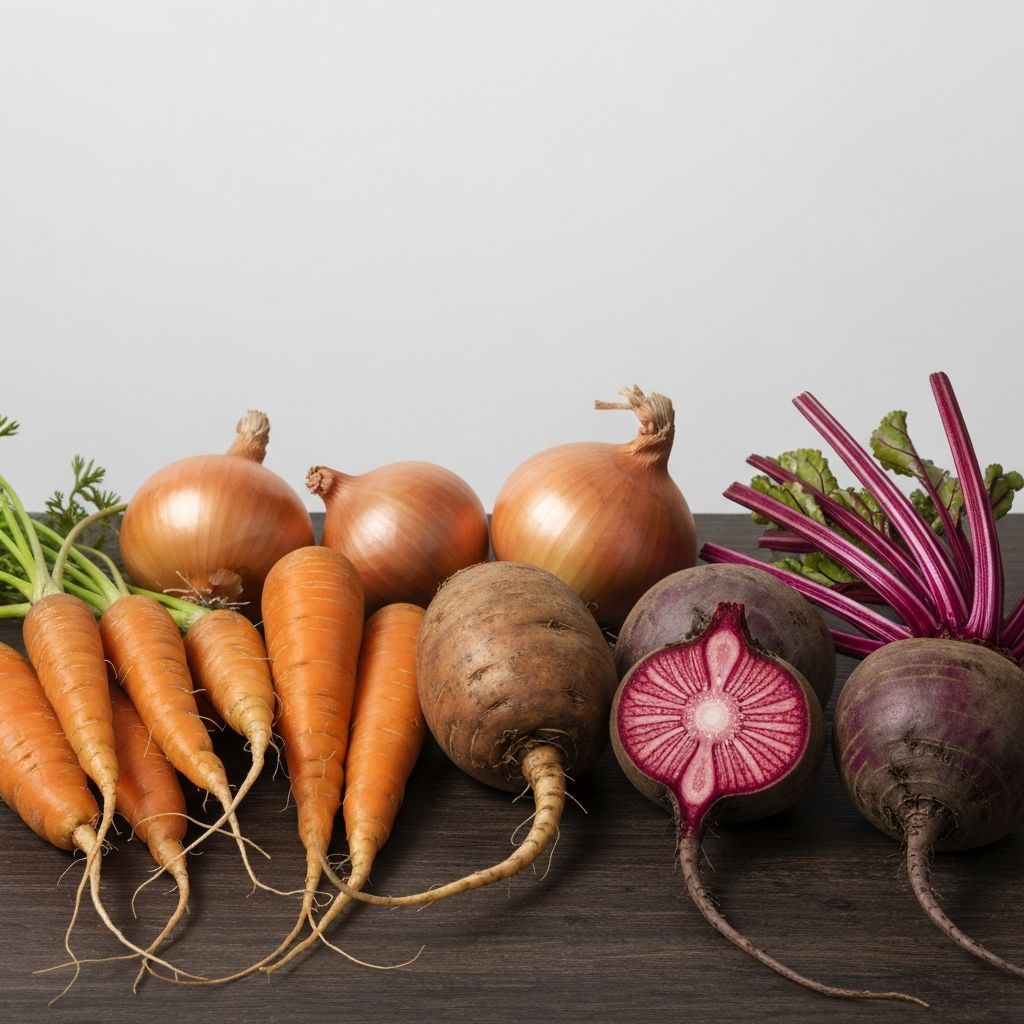
Taproots are another major category of food-storing roots. Carrots, beets, turnips, radishes, and parsnips all store food in their enlarged taproots, which serve as the primary root of the plant. These roots accumulate not only starch but also significant amounts of sugars, vitamins, and minerals, making them nutritionally dense food sources. Carrots, for example, are rich in beta-carotene, which gives them their orange color and is converted to vitamin A in the human body.
Tuberous roots like cassava and dahlia represent yet another variation. Cassava, also known as tapioca, is one of the most important food crops in tropical regions and stores vast quantities of starch in its tuberous roots. It serves as a primary calorie source for hundreds of millions of people in Africa, Asia, and South America.
Stems and Bulbs: Above and Below Ground Storage
While roots are the most obvious storage organs, many plants also store food in their stems. Modified stems have evolved various forms to serve as efficient food storage structures, each adapted to the specific needs and environments of different plant species.
Bulbs are specialized underground storage structures composed of modified leaves called scales that are attached to a short, compact stem base called a basal plate. Onions, garlic, tulips, and lilies are all examples of bulb-forming plants. The fleshy scales of a bulb store carbohydrates, water, and nutrients that the plant uses to fuel rapid growth when conditions become favorable. When you cut an onion in half, the concentric rings you see are the individual leaf scales packed with stored food.
Corms are solid, swollen underground stems that store food in their dense, starchy tissue. Unlike bulbs, which store food primarily in modified leaves, corms store food directly in the stem tissue itself. Taro, a staple food crop in many Pacific Island and Asian cultures, is a corm that stores large amounts of starch. Gladiolus and crocus are ornamental plants that also form corms.
Rhizomes are horizontal underground stems that grow laterally through the soil and store food along their length. Ginger is one of the most familiar rhizomes, storing not only starch but also the aromatic compounds that give it its distinctive flavor and medicinal properties. Turmeric, another widely used spice, is also a rhizome. Bamboo spreads through extensive rhizome networks that store the energy needed to fuel the plant's famously rapid growth.
Seeds and Fruits: Portable Food Packages
Seeds represent one of the most important and widespread forms of food storage in the plant kingdom. Every seed contains a concentrated package of stored food that provides the energy and nutrients needed to fuel germination and early seedling growth before the young plant can begin photosynthesizing on its own.
The primary storage tissues in seeds vary by plant type. In many dicotyledonous plants like beans, peas, and peanuts, food is stored in the cotyledons, which are the embryonic seed leaves. When you split open a bean seed, the two halves you see are the cotyledons, packed with proteins, starches, and oils. In monocotyledonous plants like corn, wheat, and rice, food is stored primarily in a tissue called the endosperm, which surrounds the embryo and provides nourishment during germination.
The type of food stored in seeds varies as well. Cereal grains like wheat, rice, and corn store food primarily as starch, making them the world's most important source of dietary carbohydrates. Legumes like soybeans, lentils, and chickpeas store significant amounts of protein in addition to carbohydrates. Oilseeds like sunflower, flax, and sesame store food predominantly as lipids or fats, which contain more than twice the energy per gram compared to carbohydrates.
Fruits also serve as food storage organs, though their primary biological function is to protect and disperse seeds. Fleshy fruits like apples, mangoes, and berries accumulate sugars, organic acids, vitamins, and water as they ripen, making them attractive to animals that eat the fruit and disperse the seeds. The sugars in ripe fruit are primarily glucose, fructose, and sucrose, all derived from the photosynthetic products stored by the parent plant.
Why Plant Food Storage Matters for Agriculture
Understanding the mechanisms of food storage in plants has enormous practical implications for agriculture and food security. Crop scientists and breeders use knowledge of storage biology to develop plant varieties that produce larger, more nutritious storage organs, resist diseases and pests that target stored food, and maintain quality during post-harvest storage and transportation.
The Green Revolution of the mid-20th century, which dramatically increased global food production, was built largely on developing crop varieties with enhanced food storage capabilities. Semi-dwarf wheat and rice varieties, for example, directed more of the plant's photosynthetic energy into grain production rather than vegetative growth, resulting in higher yields of the edible storage organs that feed billions of people.
Modern agricultural research continues to focus on improving food storage in plants. Scientists are working on developing potatoes with higher starch content, rice with enhanced nutritional profiles including increased iron and vitamin A, and cassava varieties that are more resistant to post-harvest deterioration. These efforts are critical for addressing global food security challenges, particularly in developing nations where root and tuber crops are dietary staples.
Climate change adds another dimension to the importance of understanding plant food storage. As temperatures rise and weather patterns become more unpredictable, plants that can efficiently store food during favorable periods and survive on those reserves during stress periods will become increasingly valuable. Research into the genetic and molecular mechanisms controlling food storage is helping scientists develop climate-resilient crop varieties that can maintain productivity under challenging conditions.
