
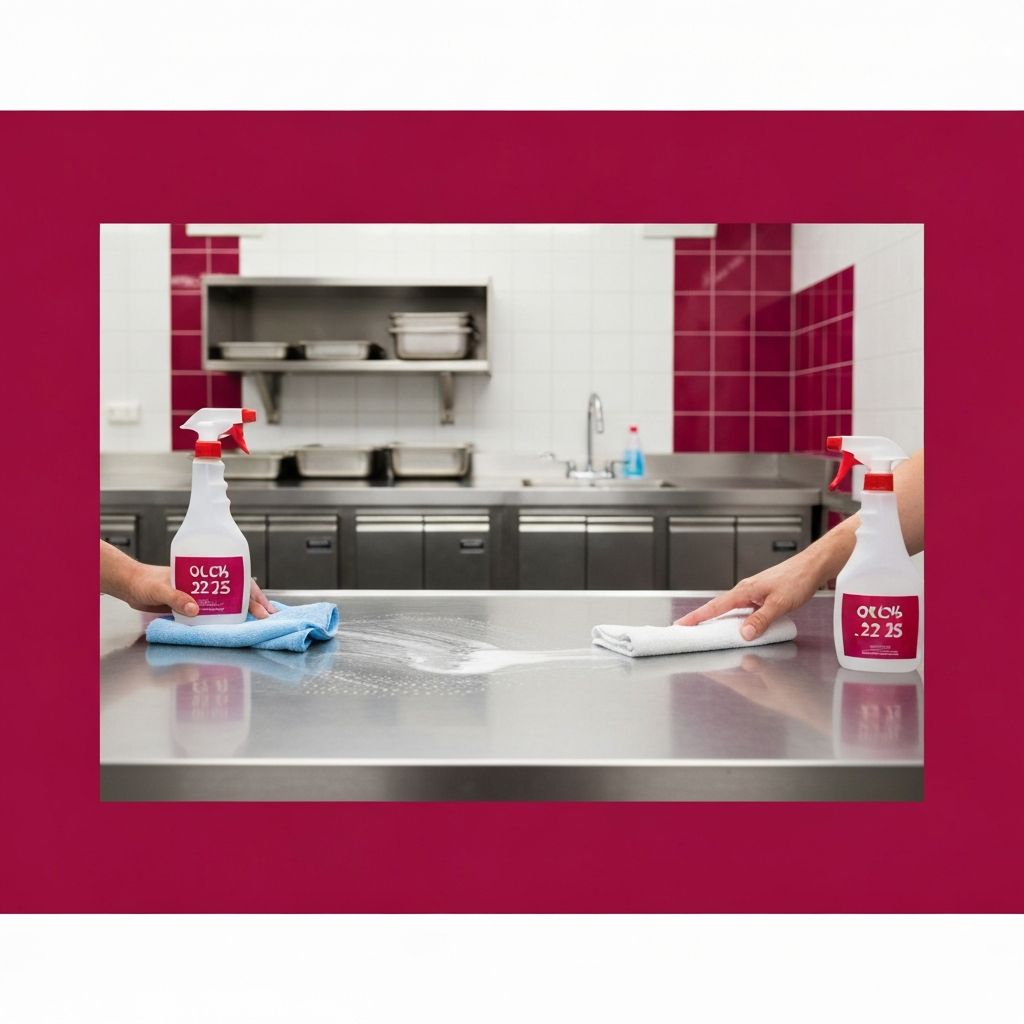
Understanding Food Contact Surfaces
Food contact surfaces are any surfaces that come into direct contact with food during preparation, processing, serving, or storage. These include cutting boards, countertops, knives, slicers, mixers, prep tables, serving utensils, plates, bowls, food storage containers, and the interior surfaces of equipment like ovens, grills, and refrigerators. Properly cleaning and sanitizing these surfaces is one of the most fundamental practices in food safety, directly preventing the transmission of harmful bacteria, viruses, and other pathogens that cause foodborne illness.
The distinction between cleaning and sanitizing is important to understand, as these are two separate processes that serve different purposes. Cleaning refers to the physical removal of food residue, dirt, grease, and other visible contaminants from a surface using soap, detergent, and water. Sanitizing is a chemical or heat process that reduces the number of disease-causing microorganisms on a surface to safe levels. Both steps are necessary because sanitizing agents cannot effectively reach and kill pathogens that are buried under layers of food residue and grease.
The FDA Food Code and state health departments establish specific requirements for when food contact surfaces must be cleaned and sanitized. These requirements are based on scientific understanding of how pathogens grow and spread in food service environments. Violations of these requirements are typically classified as critical violations during health inspections because of the direct risk they pose to public health. Understanding and following these requirements is essential for any food service operation.
After Each Use with a Different Type of Food
One of the most important times when food contact surfaces must be cleaned and sanitized is when switching between different types of food, particularly when transitioning between raw animal proteins and ready-to-eat foods. This requirement exists to prevent cross-contamination, which is one of the leading causes of foodborne illness outbreaks in food service establishments.
Cross-contamination occurs when harmful pathogens from one food item are transferred to another food item through a shared surface, utensil, or piece of equipment. The most dangerous form of cross-contamination involves the transfer of pathogens from raw animal products, such as chicken, beef, pork, fish, and eggs, to foods that will be consumed without further cooking. Raw chicken, for example, frequently carries Salmonella and Campylobacter bacteria, and if a cutting board used to cut raw chicken is then used to slice tomatoes for a salad without proper cleaning and sanitizing, those pathogens can be transferred to the salad and cause illness.
Food workers must clean and sanitize cutting boards, knives, countertops, and any other food contact surfaces every time they switch between raw meats and other foods, between different types of raw animal proteins such as from poultry to seafood, and between any allergen-containing food and allergen-free food. This practice is non-negotiable in professional food service and should be equally rigorous in home kitchens.
At Least Every Four Hours During Continuous Use
The FDA Food Code requires that food contact surfaces that are in continuous use be cleaned and sanitized at least every four hours. This requirement applies to surfaces and utensils that are used repeatedly throughout a service period without a natural break that would prompt cleaning. Examples include slicers that are used throughout the day to cut deli meats, prep tables where multiple items are prepared over the course of a shift, and utensils at a buffet or salad bar.
The four-hour rule is based on the understanding that bacteria can multiply rapidly at room temperature, doubling in number approximately every 20 minutes under ideal conditions. Over a four-hour period, a single bacterium could theoretically multiply to over four thousand organisms if conditions are favorable. By requiring cleaning and sanitizing at least every four hours, the FDA Food Code ensures that bacterial populations are periodically reduced to safe levels even on surfaces that are in constant use.
Many food service establishments choose to exceed this minimum requirement, cleaning and sanitizing high-use surfaces every two hours or even more frequently during busy periods. This more aggressive schedule provides an additional margin of safety and is particularly recommended for surfaces used to prepare high-risk foods such as raw seafood, poultry, and foods intended for vulnerable populations like young children, elderly individuals, and immunocompromised persons.
Food workers should be trained to track the time since the last cleaning and sanitizing of continuously used surfaces. Some establishments use timer systems or color-coded cleaning schedules posted in prep areas to help workers comply with this requirement. Whatever system is used, it should be consistent, easy to follow, and verifiable by managers during routine supervision.
When Contamination May Have Occurred
Food contact surfaces must be cleaned and sanitized immediately whenever there is any reason to suspect that contamination may have occurred, regardless of how recently the surface was last cleaned. Contamination events can include a utensil falling on the floor, a worker sneezing or coughing near a prep surface, a pest sighting in the food preparation area, or any accidental contact between a food contact surface and a non-food contact surface or contaminated item.
If a food worker touches their face, hair, or body and then touches a food contact surface without washing their hands, that surface should be considered contaminated and must be cleaned and sanitized before food contact resumes. Similarly, if a food contact surface comes into contact with raw meat drippings, dirty dishwater, cleaning chemicals, or any other potential contaminant, it must be cleaned and sanitized immediately.
The key principle here is that the four-hour rule is a maximum interval, not a guarantee of safety. Any event that introduces or could potentially introduce pathogens or contaminants to a food contact surface triggers an immediate requirement for cleaning and sanitizing, regardless of the time elapsed since the last scheduled cleaning. Food workers should be empowered and expected to clean and sanitize surfaces whenever they identify a potential contamination risk, without waiting for a scheduled cleaning time.
At the Beginning and End of Each Shift
Cleaning and sanitizing all food contact surfaces at the beginning and end of each work shift or operational period is a standard practice in food service that serves several important purposes. At the beginning of a shift, cleaning and sanitizing ensures that surfaces are safe and ready for use, even if they were properly cleaned at the end of the previous shift. Dust, airborne contaminants, and pest activity during non-operational hours can compromise surfaces that were clean when the previous shift ended.
End-of-shift cleaning and sanitizing prevents food residue from drying and hardening on surfaces, which makes it more difficult to clean and provides a food source for bacteria and pests during non-operational hours. Dried food residue can harbor pathogens that survive for extended periods on surfaces and can contaminate food the next time the surface is used. Thorough end-of-shift cleaning also helps control odors and maintain a professional, hygienic appearance.
Many establishments incorporate a detailed cleaning checklist for shift changes that specifies every surface and piece of equipment that must be cleaned and sanitized. These checklists help ensure that nothing is overlooked during the busy transition between shifts and provide documentation that cleaning was performed. Checklists should be initialed by the responsible worker and reviewed by a manager or supervisor to verify compliance.
The Proper Cleaning and Sanitizing Procedure
Understanding when to clean and sanitize food contact surfaces is only part of the equation; knowing how to do it properly is equally important. The standard procedure for cleaning and sanitizing food contact surfaces follows a specific sequence that must be performed in order for maximum effectiveness.
The first step is to scrape or remove any visible food debris from the surface. Next, wash the surface with hot water and an approved detergent or soap, using a clean cloth, brush, or sponge. The washing step physically removes food residue, grease, and dirt that could shield bacteria from the sanitizing agent. Rinse the surface with clean water to remove all traces of detergent, as residual soap can interfere with the effectiveness of sanitizing chemicals.
Apply the sanitizing solution according to the manufacturer's instructions, paying careful attention to concentration and contact time. The three most common sanitizers used in food service are chlorine bleach solutions, quaternary ammonium solutions, and iodine solutions. Each has specific concentration requirements and minimum contact times that must be followed for effective pathogen reduction. For chlorine bleach solutions, the typical concentration is 50 to 100 parts per million with a contact time of at least seven seconds. Quaternary ammonium solutions typically require 200 parts per million with a minimum contact time of 30 seconds.
After the appropriate contact time, allow the surface to air dry. Do not wipe or towel dry sanitized surfaces, as this can recontaminate them and reduce the effectiveness of the sanitizing treatment. Air drying allows the sanitizer to continue working and avoids introducing bacteria from cloth towels. The cleaned and sanitized surface is then ready for food contact use.
Consequences of Non-Compliance
Failure to properly clean and sanitize food contact surfaces at the required intervals can have serious consequences for food service establishments, their employees, and their customers. From a public health perspective, inadequate cleaning and sanitizing increases the risk of foodborne illness outbreaks that can sicken dozens or even hundreds of people. Certain vulnerable populations, including young children, pregnant women, elderly adults, and immunocompromised individuals, face particularly severe risks from foodborne pathogens.
From a regulatory perspective, failure to meet cleaning and sanitizing requirements results in critical violations during health inspections. Accumulation of critical violations can lead to increased inspection frequency, mandatory corrective action plans, public posting of violation notices, monetary fines, and in the most severe cases, suspension or revocation of the establishment's food service permit. In some jurisdictions, health inspection scores are publicly posted and available online, meaning that poor cleaning practices can directly impact an establishment's reputation and customer traffic.
Legal liability is another significant concern. If a foodborne illness outbreak is traced to inadequate cleaning and sanitizing practices at a food service establishment, the establishment and its owners may face civil lawsuits from affected individuals, class action lawsuits in the case of large outbreaks, and potential criminal charges in cases of gross negligence. The financial costs of defending against these legal actions, combined with potential settlements and judgments, can be devastating for any food service business.
