
Understanding Decomposers and Their Role in Nature
In every ecosystem on Earth, from dense tropical rainforests to frozen tundra, a remarkable group of organisms works tirelessly behind the scenes to keep the cycle of life turning. These organisms are called decomposers, and their role in the food chain is as vital as that of any predator, herbivore, or plant. Without decomposers, dead organic matter would accumulate indefinitely, nutrients would become locked away in lifeless tissue, and the ecosystems we depend on would eventually collapse under the weight of their own waste.
A decomposer is any organism that breaks down dead or decaying organic matter, including dead plants, animals, and waste products, into simpler chemical compounds. In doing so, decomposers release essential nutrients like nitrogen, phosphorus, and carbon back into the soil, water, and atmosphere, making them available for living organisms to use. This process of decomposition is the final and perhaps most important step in the food chain, completing the cycle that begins with producers (plants) and moves through various levels of consumers.
Where Decomposers Fit in the Food Chain
The food chain is a simplified representation of how energy and nutrients flow through an ecosystem. At the base are producers, primarily plants and photosynthetic organisms, which convert sunlight into chemical energy through photosynthesis. Primary consumers (herbivores) eat the producers, secondary consumers (carnivores) eat the herbivores, and tertiary consumers (top predators) eat the secondary consumers. At each level, energy is transferred from one organism to the next.
Decomposers occupy a unique position in this hierarchy. Rather than fitting neatly into a single trophic level, decomposers interact with every level of the food chain. They break down dead organisms from all trophic levels, whether it's a fallen tree (producer), a dead rabbit (primary consumer), a deceased fox (secondary consumer), or the waste products of any living organism. In this sense, decomposers serve as the food chain's recycling system, processing what other organisms leave behind and returning valuable nutrients to the ecosystem.
Some ecologists place decomposers at the very bottom of the food chain, while others position them alongside or below the producers. In food web diagrams, which provide a more accurate and complex representation of energy flow than simple food chains, decomposers are typically shown with connections to every other level, reflecting their universal role in breaking down dead matter from all sources.
Types of Decomposers
Decomposers come in many forms, ranging from microscopic bacteria to visible fungi and invertebrates. Each type plays a specific role in the decomposition process, and together they form a diverse community that can break down virtually any organic material.
Bacteria are the most numerous and versatile decomposers on Earth. Found in virtually every environment, from deep ocean trenches to the upper atmosphere, bacteria break down organic matter at the molecular level, converting complex organic compounds into simpler inorganic molecules through chemical processes. Different species of bacteria specialize in decomposing different types of organic matter, and they can operate in both aerobic (oxygen-rich) and anaerobic (oxygen-poor) conditions, making them effective decomposers in nearly any environment.
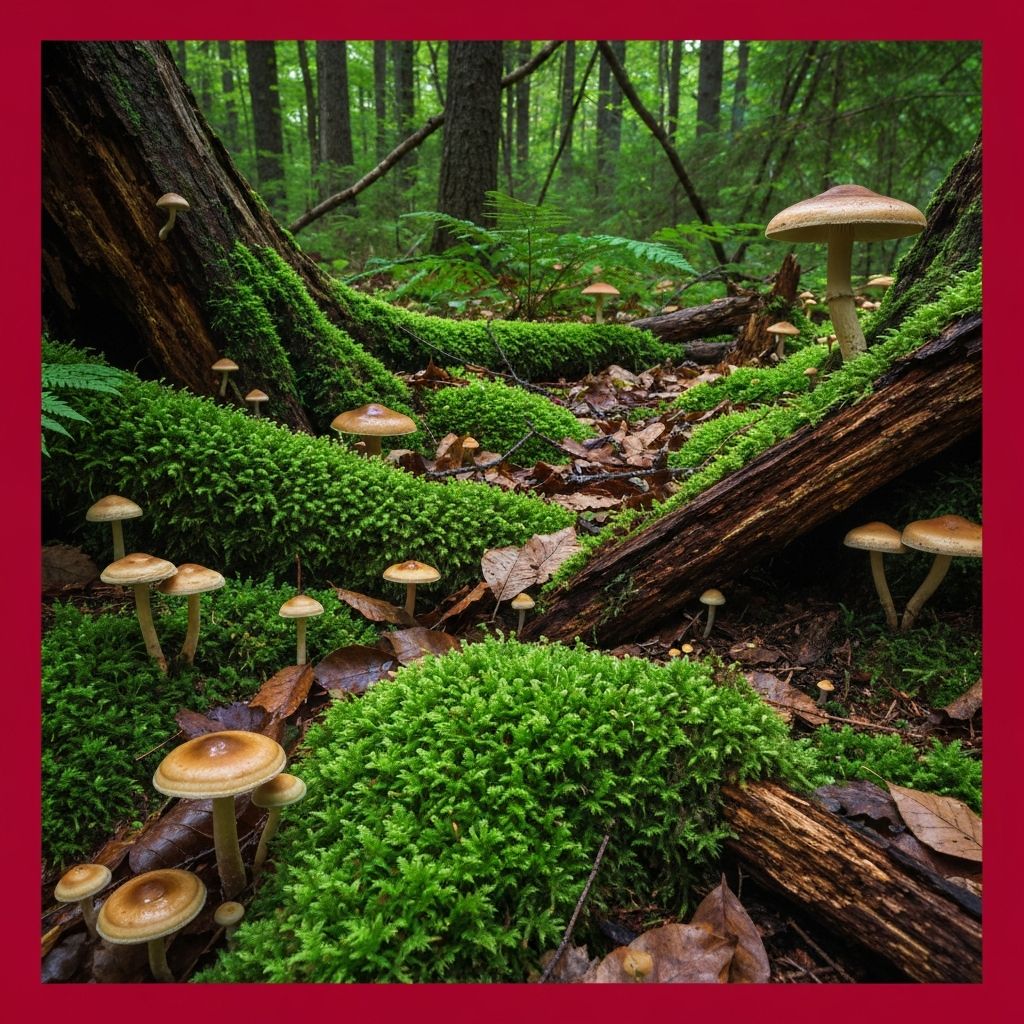
Fungi, including mushrooms, molds, and yeasts, are another major group of decomposers. Fungi are particularly important in forest ecosystems, where they break down tough materials like wood, bark, and leaf litter that bacteria alone struggle to decompose. Fungi secrete powerful enzymes that break down cellulose and lignin, the structural components of plant cell walls, converting them into nutrients that can be absorbed by the fungal network and eventually released into the soil.
Invertebrate decomposers, sometimes called detritivores, include organisms like earthworms, millipedes, woodlice, dung beetles, and fly larvae. These organisms physically break down large pieces of dead organic matter into smaller fragments, increasing the surface area available for bacterial and fungal decomposition. Earthworms, in particular, are celebrated for their role in soil health, as they consume decaying plant material and excrete nutrient-rich castings that enhance soil fertility and structure.
The Decomposition Process Explained
Decomposition is a complex, multi-stage process that involves both physical and chemical transformations of organic matter. The process begins almost immediately after an organism dies, and under optimal conditions, it can reduce a large animal carcass to bones and soil within weeks or a complex leaf to humus within months.
The first stage of decomposition involves the action of enzymes within the dead organism itself, a process called autolysis or self-digestion. Cells begin to break down from the inside as digestive enzymes are released from ruptured lysosomes and other cellular compartments. This internal breakdown softens tissues and begins the process of converting complex molecules into simpler ones.
The second stage involves the colonization of the dead matter by bacteria, fungi, and invertebrates. Bacteria are typically the first external decomposers to arrive, as they can detect and colonize dead matter within hours. Fungi follow soon after, particularly for plant material, extending their thread-like hyphae into the organic matter and secreting enzymes that break down tough structural molecules. Invertebrate decomposers like fly larvae, beetles, and worms arrive at various stages, physically consuming and fragmenting the dead matter.
As decomposition progresses, the organic matter is gradually broken down into simpler and simpler compounds. Proteins are broken down into amino acids and then into ammonia and nitrates. Carbohydrates are converted into simple sugars and then into carbon dioxide and water. Fats are broken down into fatty acids and glycerol. These simple compounds are either absorbed by the decomposers themselves or released into the environment, where they become available for uptake by plants and other producers, completing the nutrient cycle.
Why Decomposers Are Essential for Ecosystem Health
The importance of decomposers to ecosystem health cannot be overstated. Without decomposers, the nutrients locked in dead organic matter would never be returned to the soil, and the supply of essential elements like nitrogen, phosphorus, potassium, and carbon would gradually become depleted. Plants would be unable to grow, and the entire food chain would eventually collapse as the foundational producers ran out of the nutrients they need to photosynthesize and grow.
Decomposers also play a crucial role in soil formation and maintenance. The humus produced through decomposition is a rich, dark organic material that improves soil structure, water retention, and nutrient availability. Healthy soils teeming with decomposers are more fertile, more resistant to erosion, and better able to support diverse plant communities than soils with depleted decomposer populations.
In aquatic ecosystems, decomposers are equally important. Bacteria and fungi in lakes, rivers, and oceans break down dead organisms, fallen leaves, and other organic matter that enters the water. This decomposition process releases nutrients that support the growth of algae and aquatic plants, which in turn provide food and habitat for fish and other aquatic organisms.
Decomposers and the Carbon Cycle
Decomposers play a pivotal role in the global carbon cycle, one of the most important biogeochemical cycles on Earth. When decomposers break down organic matter, they release carbon dioxide (CO2) back into the atmosphere through cellular respiration. This CO2 is then available for uptake by plants during photosynthesis, completing the carbon cycle and ensuring that carbon continues to flow between living organisms and the environment.
The rate at which decomposers release carbon has significant implications for climate change. In warm, moist environments, decomposition occurs rapidly, releasing carbon quickly. In cold or dry environments, decomposition slows dramatically, and carbon can remain locked in dead organic matter for extended periods. This is why carbon-rich peat bogs, permafrost, and deep ocean sediments represent significant carbon sinks, and why the thawing of permafrost due to global warming is a concern, as it could accelerate the decomposition of stored organic matter and release large quantities of CO2 and methane into the atmosphere.
Human Impact on Decomposer Communities
Human activities have both positive and negative effects on decomposer communities worldwide. Agriculture, urbanization, and pollution can disrupt decomposer populations by altering soil chemistry, reducing habitat availability, and introducing toxic substances. Pesticides, herbicides, and heavy metals can kill or inhibit soil bacteria, fungi, and invertebrates, reducing decomposition rates and impairing nutrient cycling.
Conversely, practices like composting harness the power of decomposers for human benefit. Composting creates optimal conditions for bacterial and fungal decomposition of food scraps, yard waste, and other organic materials, producing nutrient-rich compost that can be used to enrich garden soil and reduce reliance on synthetic fertilizers. Understanding and supporting decomposer communities is essential for sustainable agriculture, waste management, and environmental conservation.
From the tiniest bacterium to the most visible mushroom, decomposers represent one of nature's most elegant solutions to the challenge of sustainability. By breaking down the dead and returning their nutrients to the living, these unsung heroes of the food chain ensure that the cycle of life continues unbroken, generation after generation, in every ecosystem on our remarkable planet.
