
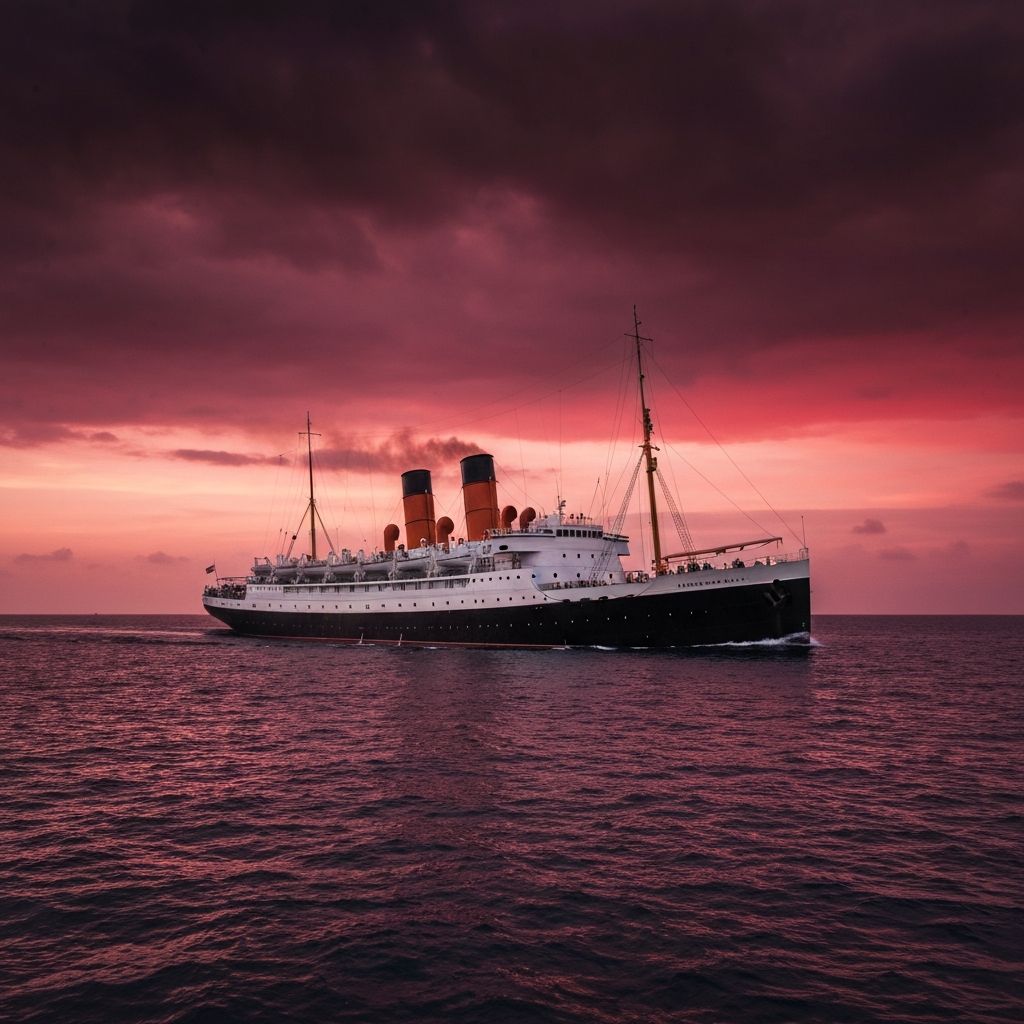
The Meaning Behind SS on a Ship
If you've ever seen a ship's name preceded by the letters "SS," you've encountered one of the most recognizable maritime naming conventions in history. SS stands for "Steamship" (or sometimes "Screw Steamer"), and it designates a vessel that is powered by steam propulsion. This prefix has been used for well over a century and remains one of the most famous examples of the ship naming prefix system that helps identify the type and function of a vessel at a glance.
The SS designation became common during the 19th century as steam-powered ships began to replace sailing vessels as the primary means of ocean transportation. Adding this prefix to a ship's name served a practical purpose: in an era when both sailing ships and steamships shared the same ports and shipping lanes, the SS prefix immediately communicated to port authorities, other vessels, and passengers that the ship was steam-powered, which had implications for its speed, reliability, and the infrastructure it required at port.
The History of Steam-Powered Ships
The history of steamships is inextricably linked to the Industrial Revolution. While experimental steam-powered boats appeared as early as the late 18th century, it wasn't until the early 19th century that steam propulsion became practical for commercial use. Robert Fulton's Clermont, which began regular service on the Hudson River in 1807, is often cited as the first commercially successful steamship, though several earlier vessels had demonstrated the viability of steam power on water.
Early steamships used paddle wheels for propulsion, which were effective in calm waters but less reliable in rough seas. The development of the screw propeller in the 1840s marked a turning point, as propeller-driven ships were faster, more efficient, and more seaworthy than paddle wheelers. This is where the alternative interpretation of SS as "Screw Steamer" originates, distinguishing propeller-driven steamships from paddle-wheel steamships.
By the mid-19th century, steamships had begun to dominate transatlantic travel. The famous Cunard Line, White Star Line, and Hamburg America Line all operated fleets of SS-designated vessels that carried millions of passengers and enormous quantities of cargo across the world's oceans. The era of the great ocean liners, from the SS Great Eastern to the SS United States, represents the golden age of the SS designation.
Famous SS Ships in History
Some of the most legendary ships in maritime history carried the SS prefix. The SS Titanic, perhaps the most famous ship ever built, was a White Star Line vessel that sank on its maiden voyage in April 1912 after striking an iceberg in the North Atlantic. The disaster claimed over 1,500 lives and led to sweeping changes in maritime safety regulations, including requirements for sufficient lifeboats and 24-hour radio watch on passenger vessels.
The SS Normandie, a French ocean liner launched in 1932, was considered one of the most beautiful and technologically advanced ships of its era. Its Art Deco interiors were designed by some of France's finest artists and craftsmen, and it held the Blue Riband for the fastest Atlantic crossing. The SS United States, launched in 1952, still holds the record for the fastest transatlantic crossing by a passenger liner, completing the voyage in just 3 days, 10 hours, and 40 minutes at an average speed of over 35 knots.
In wartime, SS-designated ships played crucial roles. The SS Jeremiah O'Brien and other Liberty ships were mass-produced during World War II to carry supplies across the Atlantic despite the constant threat of German U-boats. Over 2,700 Liberty ships were built in just a few years, representing one of the most remarkable industrial achievements in history. Many of these ships carried the SS prefix as they were steam-powered cargo vessels.
Other Common Ship Prefixes and Their Meanings
The SS designation is just one of many prefixes used in the maritime naming system. Understanding these prefixes provides a window into the diverse world of naval and commercial shipping. HMS stands for "Her Majesty's Ship" (or "His Majesty's Ship") and is used by the Royal Navy of the United Kingdom and other Commonwealth nations. USS stands for "United States Ship" and is used exclusively by commissioned vessels of the United States Navy.
MV or M/V stands for "Motor Vessel" and designates a ship powered by internal combustion engines rather than steam. As diesel and other motor-powered propulsion systems replaced steam in the mid-20th century, many ships that would have previously been designated SS were instead given the MV prefix. Today, the vast majority of commercial ships are motor vessels, making MV the most common prefix for modern cargo and passenger ships.
RMS stands for "Royal Mail Ship" and was used for vessels contracted to carry mail on behalf of the British Royal Mail. The RMS Titanic is actually the more technically correct designation for the famous liner, as it was under contract to carry Royal Mail. Other prefixes include NS for "Nuclear Ship" (used for the very few nuclear-powered civilian vessels, such as the NS Savannah), SV for "Sailing Vessel," and FV for "Fishing Vessel."
Why We Still Use SS Today
Although the age of steam-powered ships has largely passed, the SS prefix remains in common use and cultural memory. Most large modern ships are powered by diesel engines, gas turbines, or even nuclear reactors, and they typically carry the MV, MT (Motor Tanker), or other appropriate prefixes. However, the SS designation continues to appear in several contexts.
Some historic ships that have been preserved as museums or memorials retain their SS prefix as a matter of historical accuracy. The SS Jeremiah O'Brien in San Francisco, the SS John W. Brown in Baltimore, and the SS American Victory in Tampa are all preserved World War II Liberty ships that maintain their original SS designations. These floating museums serve as tangible connections to the age of steam and the crucial role these ships played in history.
The SS prefix also remains in popular culture as a kind of default ship designation. Movies, books, and television shows often use SS as a generic prefix for fictional ships, even when the vessel in question would logically carry a different designation. This cultural usage has made SS the most widely recognized ship prefix, even among people with no particular knowledge of maritime conventions.
The Transition from Steam to Motor Power
The decline of the SS designation mirrors the broader transition from steam to diesel power in the maritime industry. This transition began in the early 20th century and accelerated after World War II. Diesel engines offered several advantages over steam propulsion: they were more fuel-efficient, required fewer crew members to operate, had lower maintenance costs, and could be started and stopped more quickly than steam boilers.
By the 1960s and 1970s, new steamship construction had largely ceased for commercial vessels. The last major ocean liner built with steam propulsion was the SS United States in 1952, and even it was retired from service in 1969. Today, steam propulsion is used primarily in nuclear-powered vessels (both military and the handful of civilian nuclear ships) and in a few specialty applications.
The shift from SS to MV in the world's commercial fleet happened gradually but comprehensively. Today, if you visit any major port in the world, you'll see hundreds of ships, nearly all of them motor vessels. The few remaining steamships are either museum pieces, specialty vessels, or historical curiosities that are maintained by dedicated preservation organizations.
Ship Naming Conventions Around the World
While the SS prefix originated in English-speaking maritime traditions, similar naming conventions exist in other languages and naval traditions. German ships might use the prefix DS for "Dampfschiff" (steamship) or MS for "Motorschiff" (motor ship). French vessels use various prefixes including FS for "French Ship" in naval contexts. Japanese naval vessels are designated with JS for "Japanese Ship" in English contexts.
The International Maritime Organization (IMO) has standardized many aspects of ship identification, but naming prefixes remain largely traditional and voluntary. Ships are required to display their name and port of registry, and they are assigned a unique IMO number for tracking purposes, but the use of prefixes like SS, MV, or HMS is governed by tradition rather than international regulation.
Conclusion: A Legacy Written on the Waves
The SS prefix represents far more than just a technical designation for steam-powered vessels. It's a window into a transformative era in human history when steam technology revolutionized global transportation, connected distant continents, and enabled the movement of people and goods on a scale never before imagined. From the great ocean liners that carried millions of immigrants to new lives in America to the Liberty ships that helped win World War II, SS-designated vessels have played pivotal roles in shaping the modern world. While the age of steam has passed, the legacy of the SS prefix endures as one of the most recognizable symbols of maritime heritage.
