
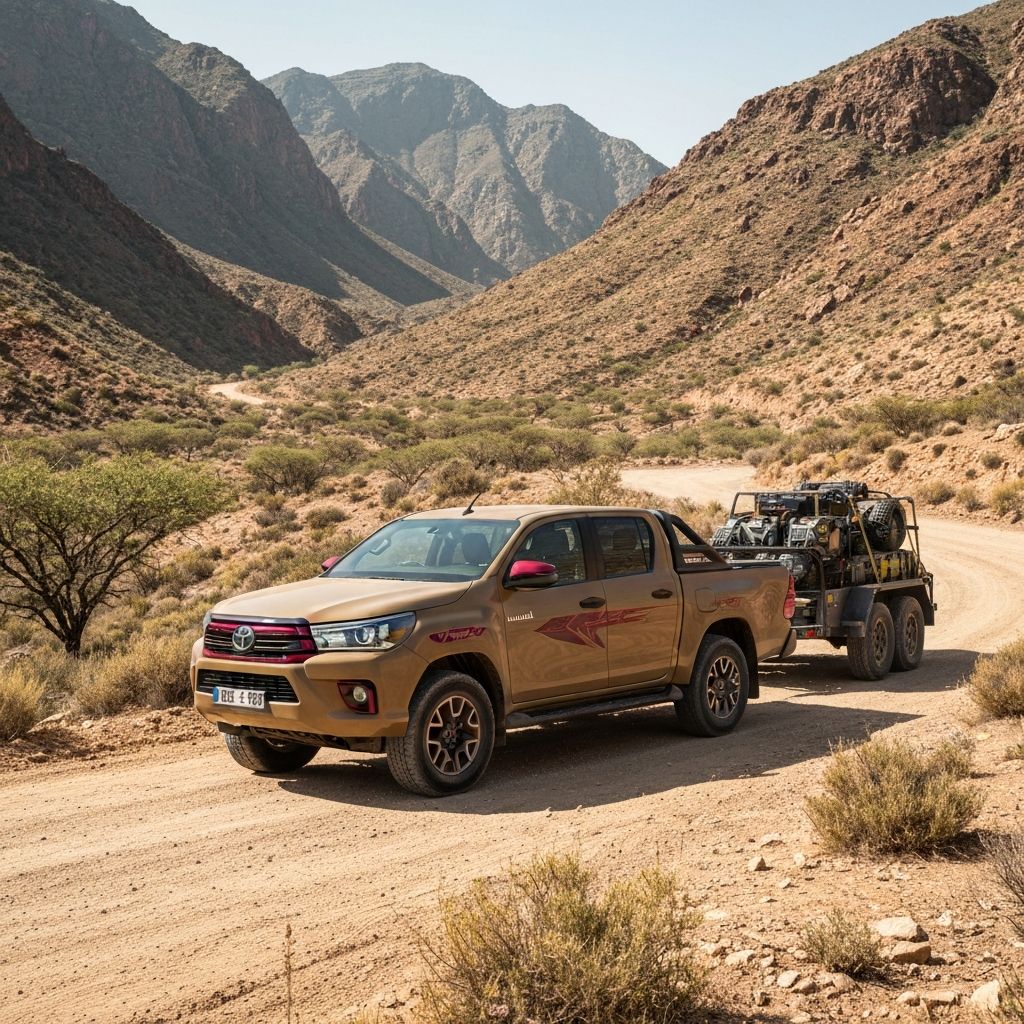
The Toyota Hilux: A Global Towing Powerhouse
The Toyota Hilux is one of the most recognized and respected pickup trucks in the world, renowned for its durability, reliability, and impressive towing capabilities. While not officially sold in the United States market, the Hilux dominates roads across Australia, Europe, Asia, Africa, and South America. For anyone considering a Hilux for towing duties, understanding its towing capacity across various configurations is essential for making an informed purchase decision and ensuring safe operation on the road.
The modern Toyota Hilux offers a maximum braked towing capacity of up to 3,500 kilograms (approximately 7,716 pounds), depending on the variant and powertrain. This impressive figure makes it one of the most capable midsize trucks available globally, capable of handling everything from boat trailers and horse floats to construction equipment and caravans. However, the actual towing capacity varies based on several factors including engine choice, transmission type, cab configuration, and the specific market variant.
Engine Options and Their Impact on Towing
The Toyota Hilux is available with several engine options across different markets, and each significantly impacts towing capacity. The most popular choice for towing is the 2.8-liter four-cylinder turbodiesel engine, which produces approximately 204 horsepower and an impressive 500 Nm (369 lb-ft) of torque. This engine provides the best towing capacity in the Hilux lineup, reaching the maximum 3,500 kg braked towing figure when paired with the automatic transmission.
The 2.4-liter four-cylinder turbodiesel is another common option, producing around 150 horsepower and 400 Nm (295 lb-ft) of torque. While this engine offers slightly lower towing capacity, typically around 3,200 kilograms, it remains a highly capable option for most towing applications. The lower output engine is often preferred for its better fuel economy during everyday driving when not towing. In some markets, a 2.7-liter four-cylinder petrol engine is also available, though this option is generally considered less suitable for heavy towing due to its lower torque output.
Cab Configurations and Towing Capacity
The Toyota Hilux is available in three primary cab configurations: single cab, extra cab (also known as Xtra Cab), and double cab. Each configuration has a different curb weight, which directly affects the vehicle's towing capacity. Single cab models, being the lightest, typically offer the highest towing capacity. They are the preferred choice for commercial operators who prioritize towing and payload capacity over passenger accommodation.
Double cab models, while heavier due to their four full-size doors and larger passenger compartment, remain highly capable towers. The difference in towing capacity between a single cab and double cab is usually between 100 and 300 kilograms, depending on the specific trim and equipment level. For many buyers, the double cab's versatility as both a work vehicle and family transport makes the slight reduction in towing capacity an acceptable trade-off.
Manual vs. Automatic Transmission for Towing
An interesting aspect of the Hilux's towing capacity is the impact of transmission choice. In many configurations, the automatic transmission-equipped models actually offer higher towing capacity than their manual counterparts. This may seem counterintuitive, but the automatic transmission's torque converter provides additional torque multiplication at low speeds, making it easier to get a heavy load moving from a standstill.
The six-speed automatic transmission also provides smoother and more consistent power delivery during towing, reducing the risk of jerky movements that could destabilize a trailer. Additionally, the automatic transmission allows the driver to focus more on traffic and road conditions rather than gear selection, which is particularly beneficial when towing in stop-and-go traffic or on hilly terrain. For serious towing applications, most experts recommend the automatic transmission option.
Two-Wheel Drive vs. Four-Wheel Drive
Like most pickup trucks, the Toyota Hilux is available in both two-wheel drive (4x2) and four-wheel drive (4x4) configurations. Two-wheel drive models are lighter and therefore generally offer slightly higher towing capacity. However, four-wheel drive models provide significantly better traction in adverse conditions, which can be crucial when towing on wet, muddy, or gravel surfaces.
The 4x4 models feature Toyota's part-time four-wheel drive system with a two-speed transfer case, allowing the driver to switch between 2H, 4H, and 4L modes. When towing on paved roads in good conditions, the 4x4 model can be operated in 2H mode, which reduces drivetrain friction and improves fuel economy. The ability to engage 4WD when needed, such as when launching a boat at a slippery boat ramp, makes the 4x4 model a versatile choice for recreational towing.
Understanding Braked vs. Unbraked Towing Capacity
When examining the Hilux's towing specifications, it's important to understand the distinction between braked and unbraked towing capacity. Braked towing capacity refers to the maximum weight the vehicle can tow when the trailer is equipped with its own braking system. For the Hilux, the maximum braked towing capacity is 3,500 kilograms with the right configuration.
Unbraked towing capacity, on the other hand, is the maximum weight the vehicle can tow when the trailer does not have its own brakes. This figure is significantly lower, typically around 750 kilograms for the Hilux. This means that for any trailer weighing more than 750 kilograms, the trailer must be equipped with its own braking system. Understanding this distinction is critical for legal compliance and safety, as exceeding unbraked towing limits can result in fines and dangerously long stopping distances.
Towing Accessories and Upgrades
To maximize your Hilux's towing capabilities and ensure safe operation, several accessories and upgrades are worth considering. A high-quality aftermarket exhaust system can improve exhaust gas flow, reducing engine strain during heavy towing. Upgraded suspension components, such as heavy-duty rear leaf springs or aftermarket airbag suspension, can help maintain proper ride height and vehicle stability when the hitch is loaded.
A transmission cooler is another worthwhile investment for frequent towers. While the Hilux's automatic transmission includes an integrated cooler, an additional aftermarket cooler can help maintain lower transmission temperatures during extended towing, particularly in hot climates or mountainous terrain. Extended towing mirrors are also essential when towing wide trailers, as they provide the visibility needed to safely change lanes and navigate parking areas.
Legal Requirements for Towing with a Hilux
Towing regulations vary significantly between countries and even between states or provinces within a country. In Australia, for example, trailers weighing more than 750 kilograms GVM must be equipped with brakes, and trailers over 2,000 kilograms GVM must have electric brakes. Many regions also require a specific class of driver's license for towing heavy trailers, and weight distribution hitches may be mandatory when the trailer weight exceeds a certain percentage of the tow vehicle's weight.
It's essential to familiarize yourself with the towing regulations in your specific region before hitting the road. This includes understanding requirements for safety chains, trailer lighting, registration, and any speed restrictions that may apply when towing. Failure to comply with these regulations can result in significant fines, insurance complications, and most importantly, unsafe towing conditions that put you and other road users at risk.
Real-World Towing Performance
In real-world conditions, the Toyota Hilux consistently impresses with its towing stability and engine performance. The 2.8-liter turbodiesel engine provides strong acceleration even when towing near the maximum capacity, and the automatic transmission selects appropriate gears without unnecessary hunting. The rigid ladder-frame chassis provides a solid platform for towing, and the rear leaf spring suspension, while not the most comfortable for everyday driving, provides excellent stability under load.
Fuel consumption during towing is another area where the Hilux performs well compared to competitors. The efficient turbodiesel engines typically consume between 12 and 16 liters per 100 kilometers when towing moderate loads, depending on terrain and driving conditions. This efficiency, combined with the Hilux's reputation for mechanical reliability and low maintenance costs, makes it one of the most cost-effective towing vehicles in the midsize truck segment worldwide.
