
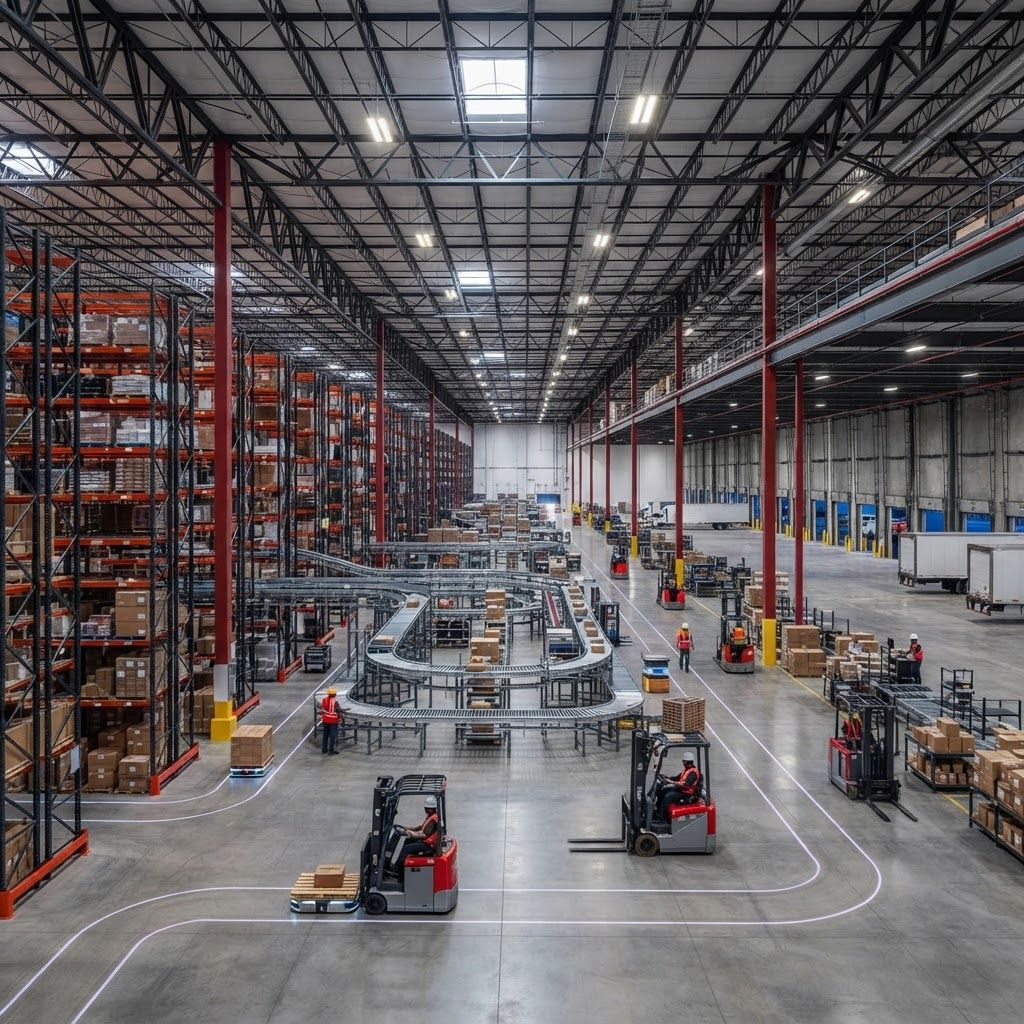
Fort Worth's Strategic Warehousing Advantage
Fort Worth is one of the country's most compelling distribution locations. Interstates and major highways connect the city to Texas and national markets, while BNSF rail infrastructure, Perot Field Fort Worth Alliance Airport, and nearby DFW Airport support multimodal logistics. The region also offers a deep labor pool and a large consumer market, making it attractive for retail, industrial, aerospace, food, and ecommerce operations.
Warehousing companies differ substantially. Some focus on public storage and transportation, others operate sophisticated fulfillment networks, and several design dedicated facilities for major clients. Businesses should confirm local building availability and service fit rather than assuming every provider offers every capability in Fort Worth.
1. Ryder Supply Chain Solutions
Ryder provides warehousing, distribution, transportation, and dedicated fleet services. Its integrated model is useful for companies seeking one partner to manage inventory and outbound delivery. Technology, labor planning, and network design support larger or more complex operations. Fort Worth businesses can evaluate Ryder for retail distribution, industrial logistics, and scalable multiclient or dedicated solutions.
2. DHL Supply Chain
DHL Supply Chain is a global contract logistics provider with expertise across consumer, retail, healthcare, automotive, and technology sectors. Its strengths include process engineering, automation, and international supply-chain perspective. Companies with demanding compliance, high throughput, or multiple distribution nodes may benefit from its enterprise capabilities.
3. GXO Logistics
GXO emphasizes technology-enabled contract logistics, including automation, robotics, and advanced warehouse management. It supports large retailers and manufacturers with fulfillment, returns, and value-added services. The company is particularly relevant for businesses whose growth requires engineered operations rather than simple pallet storage.
4. GEODIS
GEODIS provides contract logistics, freight forwarding, transportation management, and ecommerce fulfillment. This breadth can simplify coordination between inbound international freight and domestic distribution. Fort Worth's location makes the region a logical node for clients serving Texas and the broader Southwest. Companies should evaluate system integration and peak-season capacity.
5. Kuehne+Nagel
Kuehne+Nagel combines global forwarding with contract logistics and industry-specific services. Its network can support importers that need customs coordination, inbound transportation, storage, and distribution under a broader logistics strategy. Healthcare, aerospace, and high-tech companies may value specialized processes, subject to facility-level certifications and capabilities.
6. CEVA Logistics
CEVA offers contract logistics, freight management, and transportation across a global network. Warehousing solutions can include inbound logistics, order fulfillment, inventory management, and returns. It is a candidate for Fort Worth companies seeking regional distribution linked to international supply chains or sector-specific operational expertise.
7. Penske Logistics
Penske Logistics is known for dedicated transportation, distribution center management, and supply-chain planning. Its ability to connect warehousing with fleets and transportation management is valuable for time-sensitive replenishment. Manufacturers and retailers can consider Penske when delivery performance depends on close coordination between the building and the road network.
8. NFI Industries
NFI Industries provides distribution, dedicated transportation, brokerage, and real estate services. Its integrated approach supports companies that need warehouse capacity plus transportation execution. Retail, food, consumer, and industrial supply chains can benefit from a provider able to scale space and fleet resources, depending on local availability.
9. Saddle Creek Logistics Services
Saddle Creek specializes in omnichannel fulfillment, warehousing, transportation, and packaging. It is particularly relevant for growing brands that serve retail, direct-to-consumer, and marketplace channels simultaneously. Services such as kitting, subscription assembly, and returns can reduce the number of vendors involved in fulfillment.
10. AllianceTexas Logistics Providers
AllianceTexas hosts a large ecosystem of third-party logistics firms, distributors, carriers, and real estate operators rather than one single warehouse company. Businesses locating there gain proximity to air cargo, intermodal rail, highways, and modern industrial facilities. Comparing multiple operators within the development can reveal options suited to bulk storage, ecommerce, cold chain, and manufacturing support.
How to Select a Warehouse Partner
Translate business needs into measurable requirements: pallet positions, stock-keeping units, order lines, peak volume, temperature range, inventory turns, and shipping cutoffs. Ask for demonstrated inventory accuracy, receiving turnaround, order accuracy, and on-time shipment performance. The warehouse management system should integrate with the company's ecommerce, enterprise resource planning, or order platform without excessive manual work.
Total cost includes more than storage. Model receiving, putaway, pick and pack, materials, account management, system integration, returns, long-term storage, and peak surcharges. Minimum monthly charges can matter for smaller clients. For regulated or sensitive products, verify food-grade practices, temperature monitoring, security, certifications, lot tracking, and recall procedures at the specific facility.
Trends Shaping Fort Worth Warehousing
Automation is expanding, but the best solution is not always the most robotic. Flexible systems, accurate data, trained teams, and resilient transportation often create greater value. Ecommerce is driving later order cutoffs and faster returns, while manufacturers are holding strategic inventory closer to customers. Sustainability efforts increasingly include efficient buildings, reduced packaging, route optimization, and electric material-handling equipment.
Fort Worth's logistics infrastructure gives companies room to build resilient networks. A strong warehousing partner should provide transparent metrics, disciplined inventory control, and a credible plan for peak demand. Touring the actual facility and meeting the operating team remain essential before signing a long-term agreement.
