
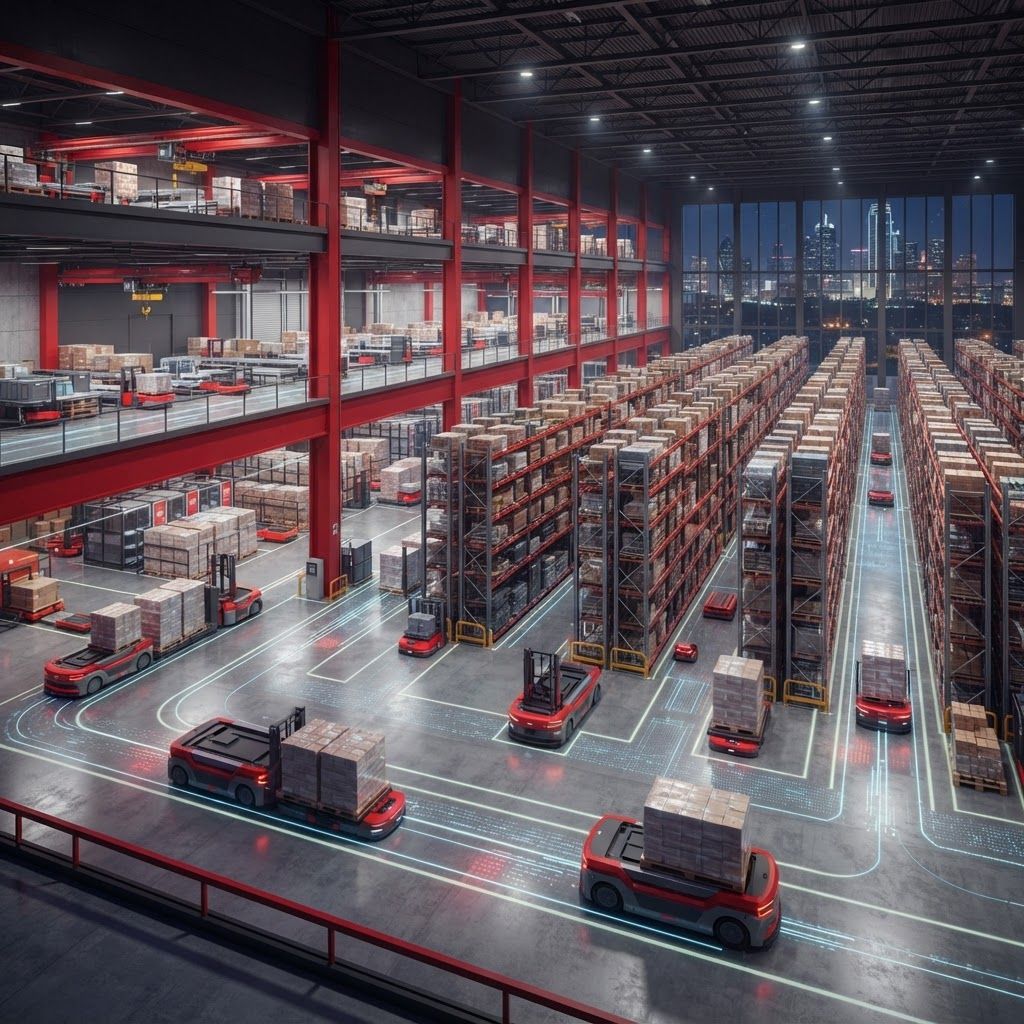
Why Dallas Is a Warehousing Hub
Dallas-Fort Worth sits at the center of major interstate, rail, air cargo, and population networks, making it one of the country's most important distribution markets. Companies can reach a large share of the United States within a short transit window, while Dallas Fort Worth International Airport and the region's intermodal infrastructure support global supply chains.
The ideal warehouse is not simply the nearest building with open space. Shippers should compare inventory accuracy, system integrations, labor capacity, security, dock configuration, transportation access, value-added services, scalability, and industry compliance. The providers below represent well-known options with operations serving the Dallas market.
1. Geodis
Geodis provides contract logistics, warehousing, transportation, and e-commerce fulfillment at global scale. It is a strong candidate for complex networks that require process engineering, technology integration, and high-volume distribution. Prospective clients should assess facility fit, implementation resources, and performance metrics for their exact product category.
2. DHL Supply Chain
DHL Supply Chain offers large-scale contract logistics across consumer, retail, healthcare, automotive, and industrial sectors. Its strengths include operational design, automation experience, and global supply-chain reach. It is generally best suited to substantial or sophisticated programs rather than businesses seeking only a few pallet positions.
3. Ryder Supply Chain Solutions
Ryder combines warehousing, distribution, transportation, and fleet expertise. This integration is valuable when storage and delivery must be designed together. Dallas companies can consider Ryder for dedicated operations, multiclient solutions, and network optimization, particularly where transportation cost strongly influences the warehouse decision.
4. NFI Industries
NFI Industries provides distribution, transportation, port services, and real estate capabilities. Its range supports customers that need both physical capacity and ongoing logistics management. Businesses should compare dedicated and shared environments, system connectivity, labor planning, and the provider's experience with similar inventory profiles.
5. CEVA Logistics
CEVA Logistics operates a broad global network covering contract logistics and freight management. It can serve multinational companies that need Dallas warehousing integrated with air, ocean, ground, or cross-border transportation. Global reach is most valuable when governance and shipment visibility remain consistent across regions.
6. GXO Logistics
GXO specializes in contract logistics and is recognized for automation, analytics, and high-throughput operations. It is relevant to e-commerce, retail, technology, and other sectors where speed and inventory precision are central. Automation should be evaluated against volume stability, product characteristics, implementation cost, and expected growth.
7. Kuehne+Nagel
Kuehne+Nagel combines contract logistics with international freight forwarding. Dallas importers and exporters may benefit from connecting inbound transportation, customs-related coordination, storage, and distribution. Ask how systems share data between forwarding and warehouse operations and how exceptions are managed.
8. DB Schenker
DB Schenker supports land transport, air and ocean freight, and contract logistics. Its international capabilities make it suitable for businesses using Dallas as a regional node within a larger network. Facility selection should consider cargo type, service requirements, customs status where applicable, and final-mile plans.
9. Saddle Creek Logistics Services
Saddle Creek focuses on omnichannel fulfillment, warehousing, and transportation. Its multiclient model can be attractive to growing brands that need professional operations without building a dedicated facility. Evaluate order accuracy, same-day cutoff times, returns handling, parcel rates, peak-season capacity, and integration support.
10. Lineage Logistics
Lineage Logistics is a major temperature-controlled warehousing provider. Food producers, distributors, and other cold-chain users may value its specialized infrastructure and network. Temperature ranges, monitoring, sanitation, traceability, inventory rotation, backup power, and transportation coordination are essential discussion points.
Capabilities That Matter
For e-commerce, examine receiving speed, item-level accuracy, pick methods, packaging customization, returns, and parcel-carrier relationships. Business-to-business distribution may depend more on pallet handling, appointment compliance, labeling, lot control, and retailer routing guides. Food, pharmaceutical, chemical, and regulated goods require additional certifications and documented processes.
Warehouse management systems should provide useful, timely inventory data and connect with the customer's commerce or planning systems. Ask how integrations are tested, how cycle counts work, and how errors are investigated. A polished dashboard means little without disciplined floor processes and accountable reporting.
Selecting a Dallas Warehouse
Model total landed cost rather than comparing storage rates alone. Receiving, handling, order processing, materials, minimums, projects, transportation, technology, and peak surcharges can materially change the result. Tour the actual proposed facility, meet operational leaders, and review business-continuity plans for severe weather, power interruption, labor shortages, and volume spikes.
Dallas offers deep logistics capacity, but popular submarkets can create tradeoffs between rent, labor, and transportation. The best warehousing partner aligns facility location and operating design with customer demand, communicates measurable results, and has enough flexibility to support growth without sacrificing accuracy.
Practical Next Steps
Before making a final decision, create a short list of priorities and compare each option using the same questions. Confirm current services, availability, policies, and costs directly, because offerings can change over time. Recent customer experiences can reveal useful patterns, but they should be considered alongside verified capabilities and personal fit. A thoughtful comparison helps Dallas residents and businesses choose confidently, avoid preventable surprises, and find a provider or program that supports both immediate needs and longer-term goals.
