
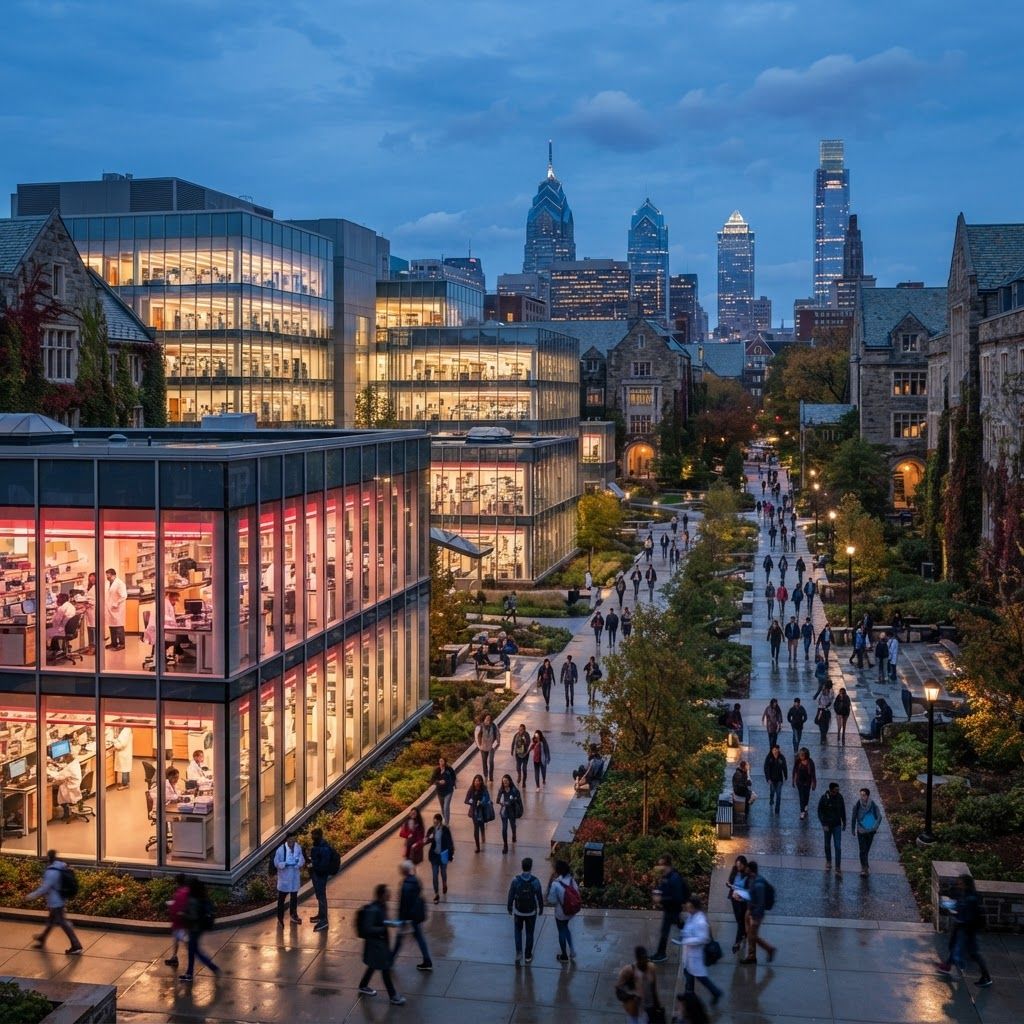
Why Study at a Philadelphia University?
Few American cities offer such concentrated access to universities, teaching hospitals, cultural institutions, and employers. Students can study biomedical innovation in University City, public policy near Center City, or design amid a thriving creative community. The institutions below differ greatly, so applicants should compare specific departments, affordability, research access, campus culture, and career support.
1. University of Pennsylvania
The University of Pennsylvania combines Ivy League scholarship with a strongly interdisciplinary and professional orientation. Wharton, Penn Engineering, Nursing, and the College of Arts and Sciences operate within a major research ecosystem. Its West Philadelphia location encourages connections with healthcare, entrepreneurship, public service, and neighborhood initiatives.
2. Drexel University
Drexel is widely known for cooperative education, through which many students alternate coursework with substantial paid professional experience. Engineering, computing, business, design, and health sciences are prominent strengths. Its fast-paced quarter system rewards organization and appeals to students who want practical experience integrated into a degree.
3. Temple University
Temple is a large public research university with extensive offerings across business, media, arts, science, education, law, and healthcare. Students benefit from the energy and diversity of its North Philadelphia campus. Its size creates tremendous choice, while successful students learn to use advising, faculty access, and campus resources proactively.
4. Thomas Jefferson University
Thomas Jefferson University is strongly associated with healthcare and medical education while also offering architecture, design, engineering, business, and other fields. Its Center City clinical environment provides valuable exposure for health-focused students. Interprofessional education reflects the collaborative reality of modern patient care.
5. Villanova University
Villanova, located in the nearby Main Line suburbs, provides an Augustinian Catholic education with nationally recognized programs. Business, engineering, nursing, liberal arts, and law are major areas. Strong school spirit, Division I athletics, and an engaged alumni community complement rigorous academics.
6. University of the Arts
Philadelphia's creative higher-education landscape has long been shaped by specialized arts training and the legacy of University of the Arts. Because institutional status and program availability can change, prospective students should verify current offerings and consider how successor programs, archives, and the wider arts community support their goals.
7. Philadelphia College of Osteopathic Medicine
PCOM specializes in graduate education across osteopathic medicine, psychology, pharmacy, and health sciences. Its training emphasizes whole-person care and practical clinical preparation. Applicants should evaluate program accreditation, rotation structures, licensing outcomes, and the demands of specialized professional study.
8. Arcadia University
Arcadia is based in nearby Glenside and is recognized for global learning, health sciences, and a close campus community. Study-abroad opportunities are deeply embedded in its identity. Physical therapy, physician assistant studies, arts, sciences, and education are among areas of interest.
9. Widener University
Widener, in nearby Chester, combines professional programs with experiential learning and civic engagement. Engineering, nursing, business, and human services are notable areas, while its law school adds a professional dimension. The university emphasizes leadership development and applied education.
10. Eastern University
Eastern offers a Christian university experience in suburban St. Davids. Programs in education, business, nursing, social sciences, and the liberal arts connect academic learning with faith and social responsibility. Students seeking a values-centered community may appreciate its mission and campus setting.
Choosing with Confidence
Start at the department level: faculty, curriculum, facilities, accreditation, and graduate outcomes can matter more than an institution's overall reputation. Compare net price after aid and ask how easily students obtain internships, research roles, and advising. A campus visit should include the surrounding neighborhood because transportation, housing, and access to Philadelphia are important parts of the university experience.
