
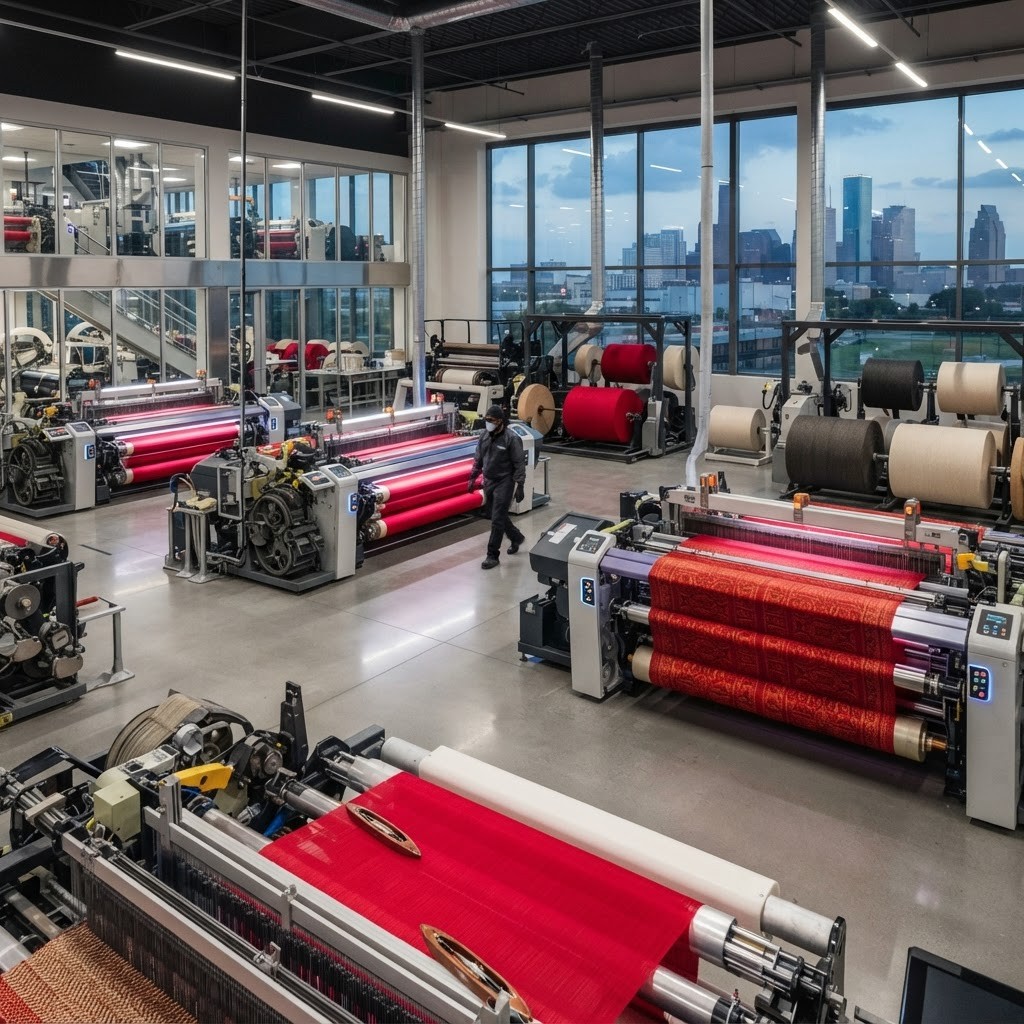
Houston’s Diverse Textile Market
Houston is not traditionally viewed as a textile capital, yet its size, port access, entrepreneurial community, and energy-centered industrial base support a varied fabric and sewn-products ecosystem. Local businesses produce or customize uniforms, linens, branded goods, protective products, apparel, upholstery, and technical materials. Proximity can shorten development cycles and make quality conversations easier.
The companies below represent different segments of manufacturing and textile production in the Houston area. Some focus on fabric creation or finishing, while others specialize in cut-and-sew, uniforms, printing, or industrial applications. Buyers should confirm current production location and capabilities because many suppliers combine local work with domestic or international sourcing.
1. American Textile Recycling Service
Houston-based American Textile Recycling Service collects and redirects used clothing, footwear, and household textiles. Although it is not a conventional mill, its role in textile recovery makes it significant to a more circular manufacturing economy. Reuse and fiber recovery are increasingly important as brands seek to reduce waste.
2. Alanic Clothing
Alanic Clothing serves apparel and private-label buyers with activewear, sportswear, and fashion manufacturing capabilities. Houston businesses may use providers of this type for design development, customization, and volume production. Minimum quantities, sample approval, material certification, and production location should be clarified at the outset.
3. Oasis Shirts
Oasis Shirts supplies customizable shirts and apparel for wholesale and private-label programs. Its focus on style variety and branded production can serve retailers, event businesses, and promotional distributors. Buyers should examine fabric weight, colorfastness, sizing consistency, decoration methods, and reorder continuity.
4. ApparelnBags
ApparelnBags supports businesses with blank apparel, uniforms, embroidery, and screen-printing services. For Houston companies, consolidated sourcing and decoration can simplify branded apparel programs. The strongest project briefs specify garment model, placement, thread or ink requirements, quantities, packaging, and delivery dates.
5. Houston Embroidery Service
Houston Embroidery Service specializes in decorating apparel and accessories for local organizations. Embroidery is well suited to uniforms, polos, caps, and durable corporate branding. Digitization quality, stitch density, backing, placement, and sample approval determine whether the final result looks professional.
6. Scrappy Apparel
Scrappy Apparel works with brands on custom apparel development and manufacturing. Services of this kind can bridge creative concepts and production-ready garments through specifications, sourcing, sampling, and cut-and-sew coordination. Emerging Houston labels should prioritize clear tech packs and realistic volume expectations.
7. Specialty Textile Services
Specialty textile and linen service providers support Houston hospitality, healthcare, food service, and industrial customers with managed inventory, cleaning, and replacement. While service differs from manufacturing, these companies influence textile selection and lifecycle performance. Durability, sanitation, delivery reliability, and loss controls matter as much as initial unit cost.
8. Cintas
Cintas has major Houston-area operations supporting uniforms, work apparel, facility textiles, and managed service programs. Its scale is useful for businesses with multiple locations or recurring requirements. Industrial buyers may value garment tracking, maintenance, safety-oriented options, and predictable replenishment.
9. UniFirst
UniFirst serves Houston employers with workwear, uniforms, protective garments, and textile service programs. The company is relevant to the region’s manufacturing, logistics, food, and energy sectors. Buyers should assess garment suitability, service schedule, wearer changes, repair standards, and total contract cost.
10. Standard Textile
Standard Textile supplies engineered textile products to healthcare and hospitality organizations and serves customers nationally, including the Houston market. Its product development and performance focus are important for demanding institutional settings. Infection control, laundering durability, patient comfort, and lifecycle cost guide purchasing decisions.
How to Select a Textile Partner
Begin with end use. A fashion garment, hospital sheet, flame-resistant uniform, and outdoor banner require entirely different materials and standards. Provide specifications for fiber content, weave or knit, weight, color, dimensions, tolerances, finishing, testing, labeling, packaging, and target volume. Request samples that reflect production materials rather than relying only on digital renderings.
Evaluate capacity and quality systems. Ask where cutting, sewing, dyeing, printing, embroidery, and finishing occur and whether subcontractors are involved. Determine how incoming materials and finished goods are inspected. For regulated or protective products, verify applicable testing and certification rather than accepting broad performance claims.
Trends Affecting Houston Buyers
Demand is growing for recycled fibers, traceable inputs, smaller production runs, and faster customization. Digital printing can support complex designs and reduced setup, while automation improves cutting and inventory control. Nearshoring and dual sourcing are gaining attention as companies manage freight and geopolitical risk. Houston’s port and logistics network provide advantages, but resilience still requires realistic lead times and backup plans.
The best textile manufacturer is not merely the lowest bidder. A valuable partner translates requirements into repeatable production, communicates early about constraints, and protects quality from sample through reorder. Houston buyers can use the city’s broad industrial and creative base to find suppliers suited to both practical workwear and ambitious consumer products.
