
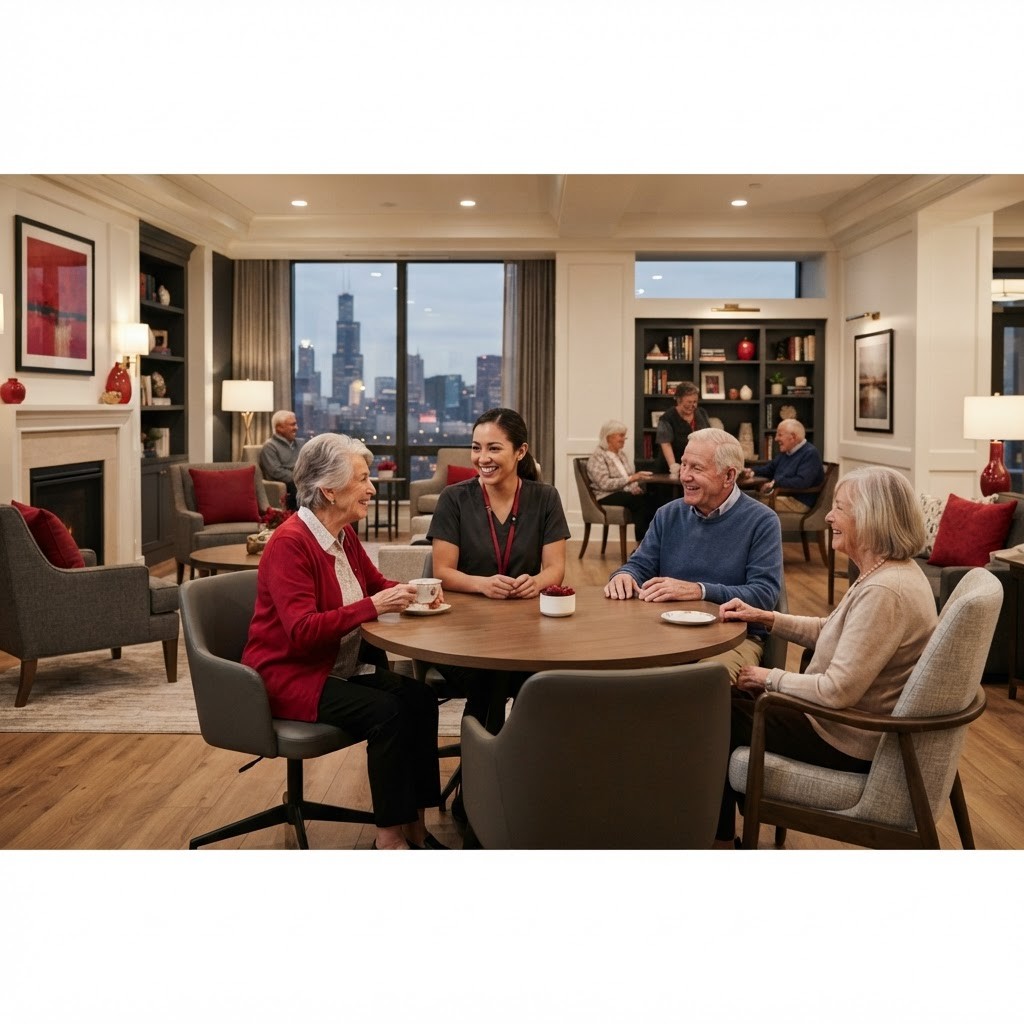
Approaching Senior Living Decisions
Choosing an elderly care home is both practical and emotional. Families must balance independence, safety, health needs, finances, location, and personal preference. Chicago options range from independent living with optional services to assisted living, memory care, skilled nursing, and continuing-care communities. Begin with an honest needs assessment and involve the older adult as fully as possible. Licensure, inspection history, staffing, emergency procedures, and care planning matter more than an impressive lobby.
1. The Admiral at the Lake
The Admiral at the Lake is a continuing-care retirement community near Foster Beach. Its location offers access to the lakefront and North Side cultural life. The continuing-care model allows residents to begin with independent living and access higher support levels as needs change. Families should review contract structure, entrance fees, monthly costs, and exactly which future services are included.
2. Montgomery Place
Montgomery Place in Hyde Park offers senior living in a neighborhood rich with parks, cultural institutions, and university connections. It provides a continuum that can include independent living, assisted support, memory services, and skilled care. The setting may be especially attractive to South Side residents who want to remain near established relationships and familiar institutions.
3. The Clare
The Clare is a high-rise continuing-care community in the Gold Coast. Its urban location gives residents proximity to downtown arts, dining, healthcare, and shopping. The residence combines independent living with access to additional care. It suits older adults who prefer city life over a suburban campus and can support the associated premium cost structure.
4. Smith Village
Smith Village is a continuing-care community in Beverly with deep neighborhood roots. It offers residential choices and increasing levels of support, helping South Side residents remain near family and community ties. A long local history can be reassuring, but families should still examine current staffing, programs, financial terms, and care outcomes.
5. Chicago Methodist Senior Services
Chicago Methodist Senior Services provides a range of older-adult services in the North Side, including residential care and community support. Its nonprofit mission and long experience are notable. Families may value an organization that understands transitions between home support and residential settings, although program availability and eligibility should be discussed directly.
6. Selfhelp Home
Selfhelp Home offers assisted living, skilled nursing, and rehabilitation in Chicago. It has a distinctive history serving the Jewish community while welcoming residents from varied backgrounds. Cultural programming, community continuity, and a range of support levels can be important for families seeking both clinical care and meaningful daily life.
7. Covenant Home of Chicago
Covenant Home of Chicago provides assisted living and memory support in a residential North Side setting. A smaller community can feel more personal than a large high-rise. Families considering memory care should observe staff interactions, secured outdoor access, activity adaptation, nighttime routines, and how behavioral changes are addressed without unnecessary restriction.
8. Sunrise of Lincoln Park
Sunrise of Lincoln Park offers assisted living and memory care within the city. Its location helps families in nearby neighborhoods visit more easily, an important quality-of-life factor. The broader Sunrise model emphasizes individualized support and structured activities. Compare the actual local staffing pattern, apartment layout, care charges, and clinical coverage.
9. Belmont Village Senior Living Lincoln Park
Belmont Village in Lincoln Park combines assisted living with programs for residents experiencing cognitive change. The contemporary building and urban location may appeal to families seeking modern amenities near major medical resources. Ask how residents are assessed, how care levels affect pricing, and how programming changes as memory needs advance.
10. Artis Senior Living of Lakeview
Artis Senior Living of Lakeview focuses on memory care. Purpose-built settings can reduce confusion and support safer movement for people living with dementia. Families should examine staff dementia training, personalized life-story work, family communication, medical coordination, and the balance between security and autonomy.
What to Look for During a Visit
Visit more than once, including during a meal or activity. Notice whether staff address residents by name, whether residents appear engaged, and whether call systems receive prompt responses. Smell, noise, lighting, cleanliness, food quality, outdoor access, and apartment safety all matter. Ask about staff turnover, overnight coverage, nurse availability, medication management, falls, hospital transfers, infection control, and emergency power.
Costs, Contracts, and Long-Term Fit
Request a complete written fee schedule covering rent, care levels, medication support, incontinence care, transportation, activities, and future increases. Understand whether the residence is private pay and how long-term care insurance or public benefits may apply. Have important continuing-care contracts reviewed professionally. Chicago families should also consider travel time: frequent visits are easier when the residence fits relatives’ real commuting patterns.
A More Person-Centered Future
Senior communities are shifting toward individualized routines, smaller memory-care neighborhoods, wellness programs, telehealth, and technology that supports safety without replacing human contact. The best home preserves identity and choice while providing dependable care. A thoughtful decision looks beyond amenities to relationships, dignity, clinical readiness, and whether the older adult can build a meaningful daily life there.
