
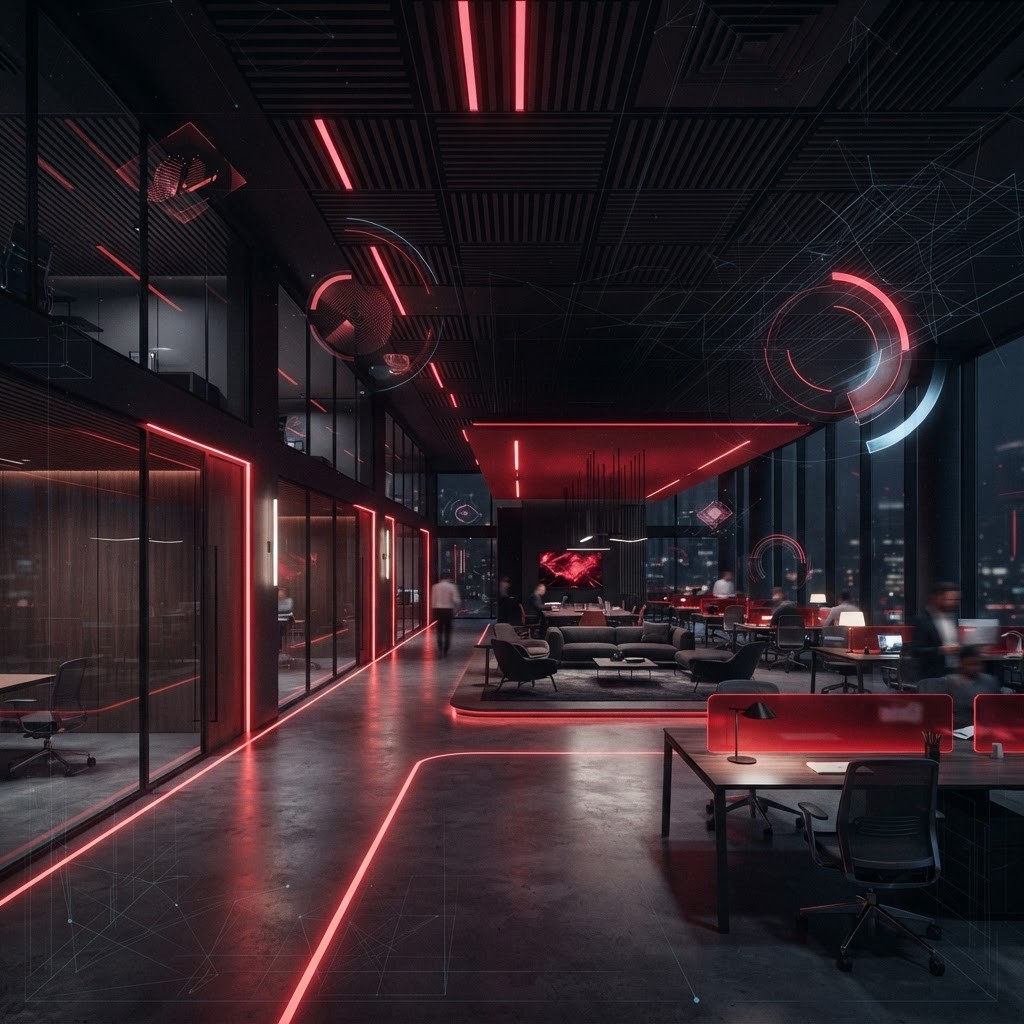
Interior Fitout: The Most Underrated Discipline in Construction
Interior fitout, often called tenant improvement work, is where buildings actually become usable. A warm shell delivered by a developer is only potential; the fitout contractor installs partitions, ceilings, mechanical and electrical distribution, specialty systems, casework, glazing and finishes that turn that potential into a working environment. In Washington, this sector is enormous. Technology and cloud companies reconfigure workplaces, life sciences tenants convert offices into laboratories, healthcare providers open clinics in retail centers, and hospitality groups build out restaurants and hotels in dense urban cores.
What makes fitout distinctive is compression. Schedules are short because rent commencement dates are fixed. Sites are frequently occupied, requiring after-hours work, noise and dust control, and careful coordination with building engineers. Long-lead items such as electrical switchgear, custom glass fronts, specialty lighting and mechanical equipment can dictate the entire program. And the tolerance for visible imperfection is minimal, because interiors are seen up close every day by the people who use them.
Ten Interior Fitout and Tenant Improvement Specialists
1. Schuchart
Schuchart is one of Seattle most recognized interior and specialty construction firms, delivering sophisticated corporate offices, showrooms, restaurants and cultural spaces. The company is known for exceptional finish quality, in-house craft capability and a willingness to execute unusual architectural details.
2. Foushee
Based on the Eastside, Foushee has a long history of tenant improvement and interior construction across the greater Seattle area. The firm strengths include fast-track delivery, strong subcontractor relationships and reliable performance in occupied office buildings.
3. RAFN Company
The RAFN Company handles interior improvements, healthcare fitouts and complex renovations, often within active facilities. Clients cite the firm collaborative approach and its ability to phase work so operations continue with minimal disruption.
4. Venture General Contracting
Venture has grown quickly by focusing on interiors, workplace, life sciences and hospitality projects throughout the Puget Sound region. The company is recognized for preconstruction transparency and for building teams that stay engaged through closeout and warranty.
5. Sierra Construction
Sierra Construction serves office, industrial, medical and technology clients with a strong tenant improvement practice. Its experience across both interiors and base building work helps when tenant scopes intersect with core systems and landlord infrastructure.
6. Metis Construction
Metis specializes in high-design interiors, retail, hospitality and adaptive reuse projects in Seattle. The firm has built a reputation for detail-driven execution and for partnering closely with architects and designers on custom fabrication.
7. Dowbuilt
Although widely known for custom residential work, Dowbuilt brings the same craft carpentry standards to commercial interiors, galleries and boutique retail. Projects requiring exacting millwork, seamless surfaces and unusual materials benefit from that fabrication expertise.
8. Bayley Construction
Bayley Construction delivers interior improvements alongside education, healthcare and commercial building work throughout Washington. The employee-owned firm is respected for dependable scheduling and clear cost management on tightly constrained scopes.
9. Charter Construction
Charter Construction focuses on renovation, envelope repair and interior improvements, frequently in occupied multifamily and commercial buildings. Its dual expertise in interiors and building enclosure is valuable when moisture or structural issues surface during a fitout.
10. Payne Construction Services
Payne Construction Services concentrates on tenant improvements and commercial interiors, including office, medical and retail environments. The company is known for responsiveness on smaller and mid-size projects that still demand professional-grade management.
The Fitout Process, Step by Step
Successful fitouts begin before a lease is signed. Test fits and feasibility studies confirm that a space can accommodate program needs, headroom, mechanical capacity and code egress. A contractor engaged during this phase can flag issues such as inadequate electrical service, insufficient ceiling cavity for ductwork, or structural limits on heavy equipment. Preconstruction then produces a detailed budget, a procurement plan for long-lead items and a permit strategy that accounts for review timelines in the applicable jurisdiction.
Construction itself relies on coordination. Mechanical, electrical, plumbing, fire protection and low-voltage systems must be modeled and sequenced above ceilings before framing progresses. Prefabricated wall panels, modular headwalls and preassembled overhead racks are increasingly used to compress schedule. Commissioning verifies that systems perform as designed, and a disciplined closeout process delivers warranties, as-builts and training so facilities teams can operate the space correctly from day one.
Trends Driving Washington Interior Construction
Workplace strategy continues to evolve, with employers investing in collaboration zones, acoustic separation, advanced video conferencing and amenity space rather than dense rows of desks. Life sciences conversions are one of the strongest growth areas, requiring higher air change rates, vibration control, specialty gases and robust structural loading. Healthcare is expanding into neighborhood locations, bringing strict infection control and regulatory requirements into ordinary commercial shells. Sustainability has also moved inside, with attention to embodied carbon in finishes, reuse of existing partitions and ceilings, low-emitting materials and circular procurement of furniture.
Selecting the Right Fitout Partner
Look for a contractor with direct experience in your specific environment, whether that is a laboratory, clinic, restaurant or corporate floor plate, and in buildings of similar type and age. Confirm familiarity with your landlord and the building rules that govern access, elevators and after-hours work. Evaluate the strength of the proposed superintendent, since day-to-day field leadership determines quality on interiors. Ask how the firm manages long-lead procurement and what it does when a critical item slips. In Washington competitive commercial market, a fitout partner who protects both the schedule and the design intent delivers value far beyond the construction contract.
