
Why Solar Works in Baltimore
Baltimore receives enough annual sunlight to make solar economically attractive, and the local policy environment strengthens the case considerably. Maryland maintains net energy metering that credits exported generation, operates a solar renewable energy credit market that produces ongoing income for system owners, offers state grants for residential installations, and exempts qualifying solar equipment from certain taxes. Combined with federal investment incentives and falling hardware prices, these factors have brought payback periods for well-designed systems into a range that many homeowners and businesses find acceptable.
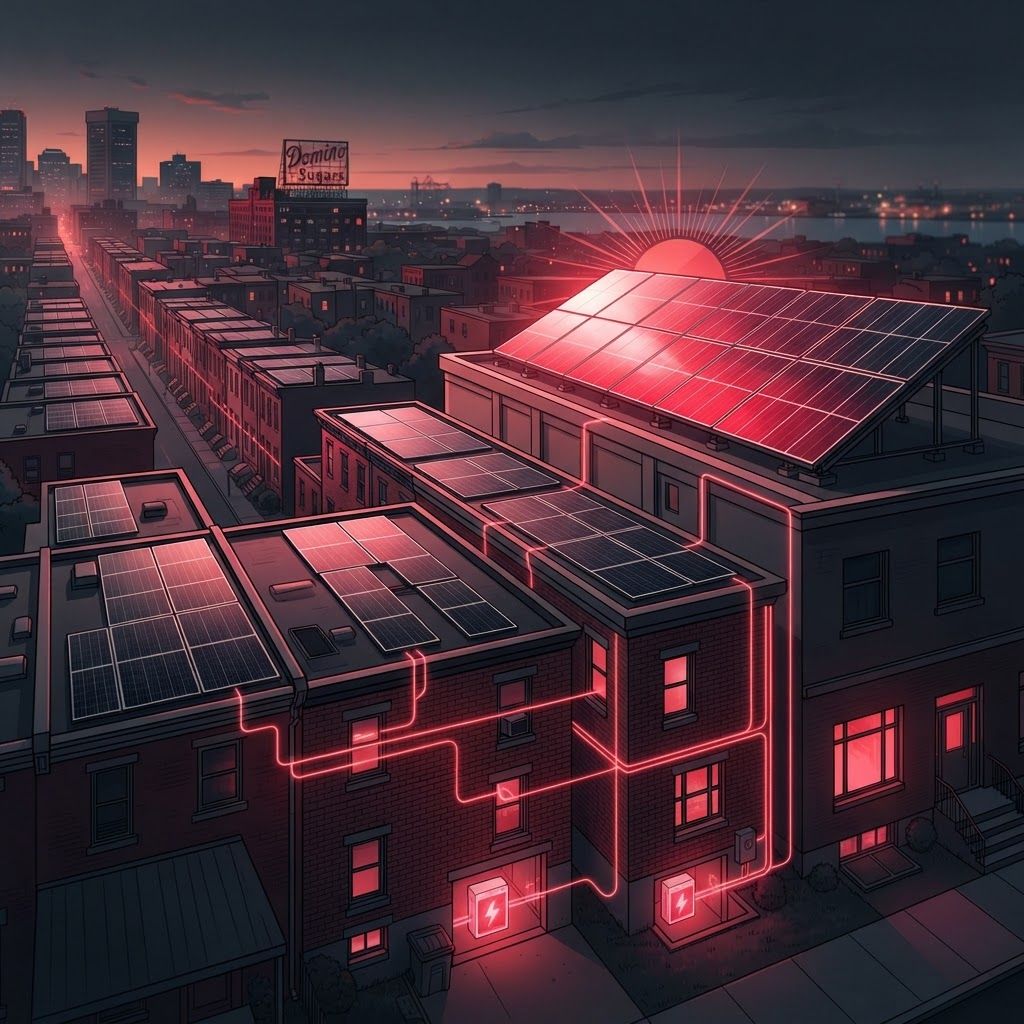
The city does present distinctive technical challenges. Much of Baltimore's housing stock consists of rowhouses with flat or low-slope roofs, limited area, shared parapets, and older structural framing. Many neighborhoods fall within historic districts where exterior changes require design review, and tree canopy in areas like Roland Park and Homeland creates shading complexity. Successful installers here are the ones who have solved these problems repeatedly rather than those applying suburban ranch-house templates.
Ten Solar Companies Serving the Baltimore Area
Solar Energy World is one of the largest Maryland-based installers, offering in-house design, permitting, installation, and monitoring for residential and commercial customers, along with battery storage integration.
Trinity Solar operates across the mid-Atlantic and Northeast with a large service organization, offering purchase, loan, and lease options and maintaining regional crews for ongoing maintenance.
Solar Solution and comparable regional installers focus on the Baltimore and Washington corridor, with experience navigating both jurisdictions' permitting and interconnection requirements.
SunPower dealer networks in Maryland provide access to high-efficiency module and integrated system products, which matter on the small roof areas typical of city properties where output per square foot drives feasibility.
Aurora Energy serves commercial rooftop, canopy, and ground-mount projects, handling larger interconnection processes and structured financing for business customers.
Ipsun Solar works across the region on residential and commercial installations with attention to historic property considerations and battery backup design.
Sunrise Solar and other local specialists concentrate on rowhouse and small multifamily installations, where structural assessment, membrane roofing compatibility, and access constraints require tailored engineering.
Neighborhood Sun is a Maryland community solar subscription provider, enabling renters and households with unsuitable roofs to receive credits from shared arrays without installing equipment.
Civic Works' Energy Programs support income-qualified households with solar access, energy audits, and workforce training, extending benefits to communities historically left out of clean energy adoption.
Power52 and mission-driven solar organizations combine installation work with job training for Baltimore residents, delivering both energy savings and local employment outcomes.
Understanding Your Options
There are three basic routes to solar benefits. Ownership through cash purchase or a loan captures the most long-term value, including federal incentives, state grants, and renewable energy credit revenue. Third-party ownership through a lease or power purchase agreement requires little or no upfront cost but transfers incentives to the provider and locks in a contract with escalation terms that must be read carefully. Community solar subscriptions require no installation at all and can typically be cancelled with reasonable notice, making them ideal for renters and for anyone whose roof is shaded, aging, or too small.
Battery storage is increasingly common. Storage adds resilience during outages, can shift consumption to reduce commercial demand charges, and pairs well with electrification of heating and vehicle charging. It does raise cost meaningfully, so buyers should decide whether backup capability or bill savings is the primary objective and size the system accordingly.
How to Evaluate Solar Proposals
Compare proposals on a consistent basis. Confirm system size in kilowatts, estimated first-year production in kilowatt-hours, and the assumptions behind that estimate including shading analysis, tilt, orientation, and annual degradation. A proposal that omits shading modeling or assumes unrealistic utility rate increases will overstate savings.
Examine equipment specifics: module efficiency and warranty, inverter type and warranty length, racking suitability for your roof type, and battery chemistry and cycle warranty if included. Ask about roof condition explicitly, because installing over a membrane or shingle roof near the end of its life creates expensive removal costs later. Reputable Baltimore installers will recommend roof replacement first when appropriate rather than proceeding regardless.
Verify credentials. Look for Maryland electrical licensing, appropriate contractor registration, general liability and workers' compensation coverage, and recognized installer certification. Request references from installations in the city rather than the suburbs, and ask how permitting, historic district approval, and utility interconnection are handled and who bears delay risk.
Finally, understand the economics in writing. Clarify total cost, incentive eligibility and who claims each, renewable energy credit registration and whether the installer or owner retains that revenue, monitoring access, workmanship warranty duration, and service response commitments. For financed systems, compare the total interest cost rather than the monthly payment alone.
The Outlook for Baltimore Solar
Adoption continues to grow across residential rooftops, commercial warehouses, parking canopies, church and school buildings, and brownfield sites. Community solar has broadened participation significantly, and program expansion has made subscriptions available to more low- and moderate-income households. Workforce development organizations in the city are training installers and auditors, which helps address the labor constraint that most limits project volume.
For property owners, the practical advice is straightforward: assess your roof honestly, get at least three detailed proposals, prioritize efficiency improvements alongside generation, and choose an installer with demonstrated Baltimore-specific experience. Done carefully, solar remains one of the more reliable investments available to households and businesses in the city.
