
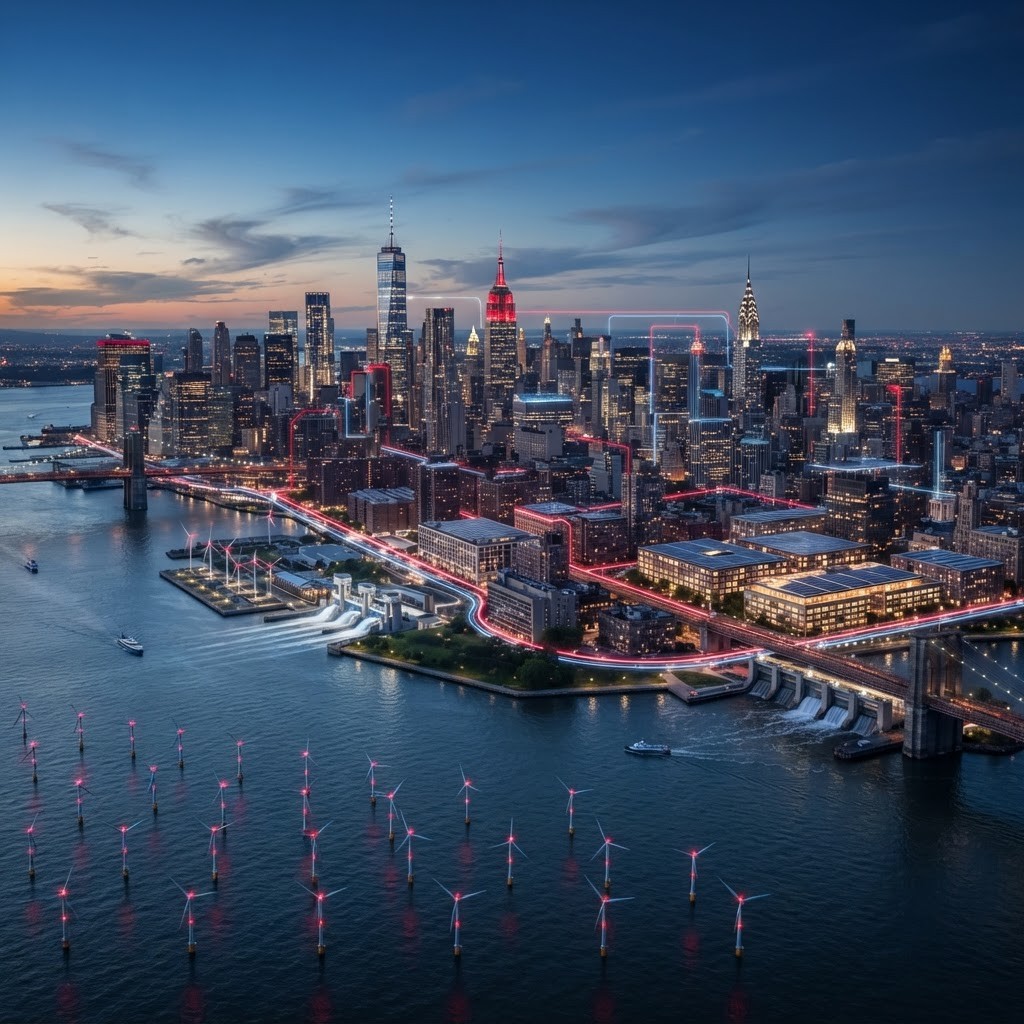
New York’s Renewable Energy Opportunity
New York has set ambitious climate and electricity goals while confronting a uniquely complex energy landscape. Dense downstate demand, constrained transmission, aging buildings, and extensive upstate resources create both challenges and opportunities. Renewable developers, utilities, technology providers, and infrastructure owners are responding with wind, hydro, solar, storage, and grid projects. The companies below are notable participants in New York’s market; inclusion reflects relevance and capabilities rather than a universal ranking.
1. NYPA
The New York Power Authority is the country’s largest state public power organization and a central force in New York’s clean-energy system. Its hydropower assets, transmission investments, energy-efficiency programs, and public-sector partnerships give it an unusually broad role. NYPA also supports electrification and grid modernization across the state.
2. Con Edison Clean Energy Businesses
Con Edison’s clean-energy activities have included renewable generation and infrastructure beyond its regulated New York utility operations. The wider Con Edison organization also plays a crucial role in connecting distributed resources and preparing the city grid for electrification. Grid reliability and customer adoption must advance together.
3. Ørsted
Ørsted is a major offshore wind developer involved in the northeastern United States. Offshore wind is strategically important to New York because strong coastal resources sit near substantial downstate demand. Projects require complex coordination across permitting, ports, supply chains, transmission, fisheries, and community interests.
4. Equinor
Equinor has pursued offshore wind development serving New York and has invested in related port and supply-chain planning. The company brings experience from large marine energy projects and global operations. Its work highlights how renewable generation can also influence industrial development and waterfront infrastructure.
5. Invenergy
Invenergy develops and operates wind, solar, storage, and transmission infrastructure. In New York, long-distance transmission is essential to move lower-carbon electricity toward areas of high demand. The company’s integrated view of generation and delivery addresses one of the state’s central energy bottlenecks.
6. Brookfield Renewable
Brookfield Renewable owns and operates renewable power assets, including substantial hydroelectric resources. Hydropower offers long-lived generation and can complement variable wind and solar production. The company’s investment and operating capabilities span multiple technologies and markets.
7. Nexamp
Nexamp develops distributed solar and energy-storage projects, including community solar programs that allow customers to participate without installing panels on their own property. This model is relevant to renters, multifamily residents, and organizations with unsuitable roofs. Customer experience and clear savings terms are important to adoption.
8. Catalyze
Catalyze develops distributed renewable-energy and storage projects for commercial and industrial properties. Rooftops, parking areas, and underused land can become productive energy assets when financing, interconnection, and operations are coordinated. The company’s model addresses these practical deployment barriers.
9. NineDot Energy
NineDot Energy focuses on distributed clean-energy projects in the New York City area, particularly battery storage. Storage can reduce peak strain, support local reliability, and make better use of renewable generation. Urban projects demand careful siting, safety design, permitting, and community engagement.
10. Rise Light & Power
Rise Light & Power is working to transform legacy generation infrastructure in New York City toward cleaner energy uses. Reusing existing industrial sites and grid connections may help accelerate transition while preserving strategically valuable locations. Its approach reflects the broader challenge of replacing fossil assets without compromising reliability.
Market Trends and Selection Criteria
Transmission expansion, interconnection reform, storage, offshore-wind supply chains, and building electrification will shape New York’s next phase. Developers must also demonstrate community benefits, responsible siting, workforce development, and environmental stewardship. Policy ambition alone does not deliver projects; permitting discipline and viable economics remain essential.
Customers and partners should assess operating history, financial strength, safety, contract terms, and local execution. For community or onsite projects, review production assumptions, escalation clauses, maintenance obligations, and exit rights. The strongest renewable-energy companies combine technical capability with transparent stakeholder engagement and a realistic understanding of New York’s grid. That combination will determine which projects move from announcement to dependable clean power.
