

Airline Crew Scheduling: Strategies for Reducing Delays and Improving Crew Utilization
In December 2025, IndiGo cancelled nearly 4,500 flights in ten days. New duty time rules cut night landings from six per week to two. The airline's rosters simply couldn't absorb the change. Years of lean pilot hiring finally caught up with it. The story is a blunt reminder of what happens when scheduling lags behind reality. Airline crew scheduling is the discipline built to prevent exactly this kind of collapse. Done well, it keeps pilots and cabin crew legal and rested. It puts them in the right seat at the right time. This blog covers the strategies, tools, and numbers behind scheduling that actually holds up under pressure.
What Is Airline Crew Scheduling?
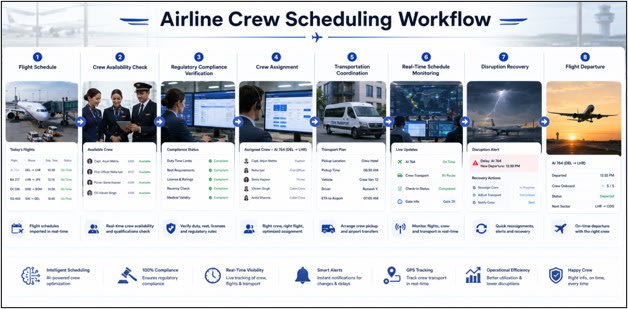
Airline crew scheduling is the process of building pairings, assigning rosters, and managing reserve crew for pilots and flight attendants. It sits apart from ground crew logistics, which covers ramp agents and baggage handlers instead. Airlines sometimes call this flight crew scheduling, since it governs the people actually flying the aircraft. A few elements sit at its core.
- Pairing construction, linking flights into legal, efficient sequences
- Duty and rest rule compliance, tracked against regulations like FAR 117
- Reserve crew pools for last-minute sick calls and delays
- Bidding and seniority systems that assign trips to individual crew members
- Real-time adjustments when weather or mechanical issues disrupt a pairing
Crew costs sit second only to fuel on most airline budgets. That's often 20 to 30 percent of total operating spend. It explains why scheduling gets so much attention from finance teams, not just operations.
Why Do Crew Scheduling Errors Cause Delays?
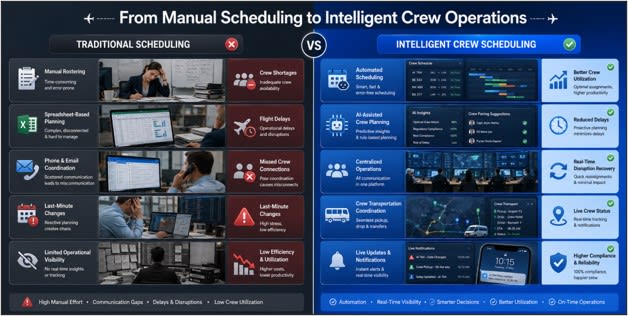
Flight disruptions cost the U.S. economy up to $34 billion a year, and crew scheduling failures are a recurring driver. A pairing built without enough rest margin breaches duty rules the moment a flight runs long. A reserve pool that's too thin leaves no one to call when a crew member gets sick. IndiGo's 2025 crisis shows how fast this compounds. New rest rules exposed a scheduling system with no slack left. Cancellations followed within days.
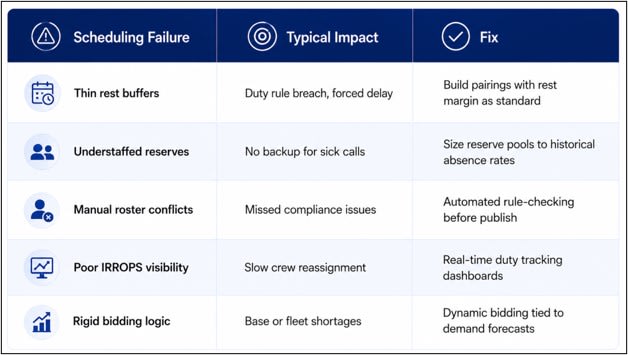
Some causes show up again and again across carriers, regardless of fleet size or route structure.
- Pairings built with little or no rest buffer
- Understaffed reserve pools during peak travel periods
- Manual rosters that miss regulatory conflicts until it's too late
- Poor visibility into real-time crew duty hours during irregular operations
- Bidding systems that don't account for base or aircraft type shortages
How Can Airlines Optimize Crew Pairings?
Pairing optimization is where most of the real savings live. A well-built pairing minimizes wasted time without breaking a single duty rule.
Building Pairings That Hold Up
Efficient pairings link flights with minimal sit time between legs. That cuts the hours crew spend paid but idle. Airlines using optimization software report crew cost reductions of 15 to 20 percent through better pairing alone. That's not a small number on a budget where crew is already the second-largest line item.
- Minimize deadhead time, when crew fly as passengers to reposition
- Reduce layover nights that add hotel and per diem costs
- Balance workload evenly across bases and crew bases
- Rebuild pairings automatically when a single flight changes
Sizing Reserve Crew Correctly
Reserve crew exists for exactly the disruptions regular pairings can't absorb. Sizing that pool correctly is part science, part judgment. Too few reserves and one sick call cascades into a cancellation. Too many and the airline pays for idle capacity every single day.
Most carriers build reserve staffing off historical absence and disruption data rather than a flat percentage. A base with a history of winter weather delays needs a thicker reserve cushion. A base in a mild climate can run leaner. Seasonal swings matter too. Peak summer travel and holiday periods strain reserve pools the hardest. That's exactly when a scheduling failure costs the most in rebooking and goodwill.
What Role Does Crew Scheduling Software Play?
Manual roster creation traditionally took scheduling teams around three weeks per cycle. Airline crew scheduling software compresses that into days. It runs compliance checks automatically and flags conflicts before publication. During disruptions, it recalculates duty limits and suggests replacement crew in minutes rather than hours.
The difference shows up clearly when you compare the two approaches side by side.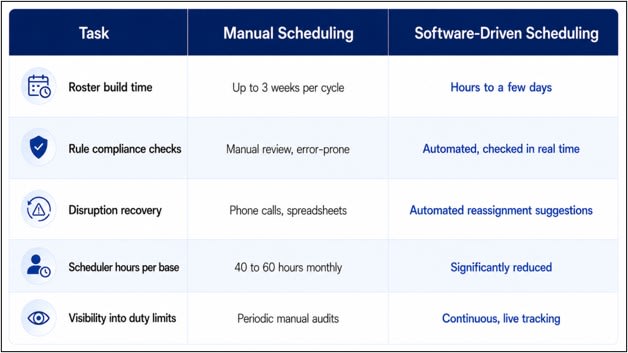
Advanced rostering systems can prevent up to 80 percent of crew-related delays, according to industry estimates. That's the kind of number that gets a CFO's attention as fast as an operations director's.
Adoption is picking up pace industry-wide too. Spending on AI-driven aviation tools is projected to reach nearly $4.86 billion by 2030. Crew rostering platforms are a growing share of that. Airlines that hold off risk falling behind carriers already running leaner, faster scheduling operations.
How Does Better Scheduling Improve Crew Utilization?
Utilization measures how much of a crew member's paid duty time goes toward flying, not waiting around. Every unnecessary overnight stay costs an airline somewhere between $150 and $300 per crew member. Multiply that across a large fleet. Inefficient scheduling turns into a real line item on the income statement.
Better scheduling improves utilization in a few concrete ways:
- Fewer unproductive layovers through tighter pairing construction
- Reduced deadhead flying by matching crew bases to route networks
- Faster recovery after disruptions, so utilization doesn't collapse during irregular operations
- Balanced reserve loads that avoid burning out a small group of crew members
None of this requires cutting corners on rest or safety. It just means less waste sitting inside the schedule itself.
A useful way to picture the difference is a single crew base running 40 pairings a week. Trim even 10 percent of unnecessary layover nights and deadhead legs. That base recovers hundreds of productive duty hours a year, without adding a single new hire. Multiply that across a network of bases, and utilization gains start compounding fast.
What Metrics Define Effective Crew Scheduling?
Good scheduling teams track a consistent set of numbers, not a different dashboard every month. These metrics tend to predict trouble before it becomes a cancellation. The table below covers the six that matter most across nearly every airline size and route network.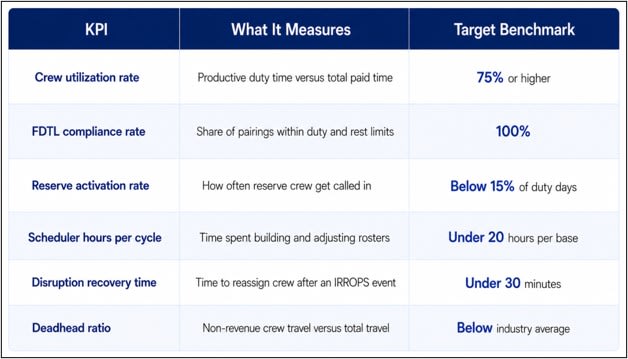
Watching these together matters more than watching any single number. A rising reserve activation rate, for instance, often signals a pairing structure that's due for a rebuild. A slipping FDTL compliance rate is worth treating as urgent, not routine. It usually means a base is running short on qualified crew for its flight volume. That shortfall tends to widen before anyone spots it on a spreadsheet. Review these numbers weekly, not monthly. Schedulers get a real chance to correct course early. That stops a small imbalance from turning into a string of delays.
What to Look for in Crew Scheduling Software?
Not every platform on the market handles the full picture. Some focus narrowly on roster building and leave compliance and disruption recovery as an afterthought. A handful of capabilities separate the ones worth paying for.
- Automated duty and rest rule compliance, built for your regulatory region
- Real-time disruption recovery and rebidding tools
- Integration with flight operations and dispatch systems
- Support for crew transportation management, covering hotel and layover ground moves
- Broader crew mobility management, including airport shuttle management software for crew moving between terminals or hotels
- Compatibility with airline crew transportation services for layover and reserve crew pickups
- Reporting built around the KPIs that actually predict disruptions
Platforms built on solid flight crew logistics principles treat scheduling as a living system. They adjust continuously, not once a month when the roster gets published.
Conclusion
IndiGo's 2025 disruption is a cautionary tale, not an isolated one. Any airline running lean on scheduling margin is one regulatory change away from the same headline. Airline crew scheduling done well keeps crews legal and rested. It keeps them available without burning cash on idle time or last-minute overnight stays. The airlines pulling ahead treat scheduling as a live operational system, complemented by a shuttle scheduling system that supports seamless crew movement. Not a static document built once a month. Expect automation and predictive rostering to keep expanding through 2026 and beyond. Scheduling is no longer a back-office function nobody notices until it fails. It's becoming a genuine competitive edge. Carriers that invest now will spend less time explaining cancellations later.
Frequently Asked Questions
Q. What is the difference between airline crew scheduling and crew logistics management?
Ans. Airline crew scheduling covers pilots and flight attendants, from pairings and rosters to duty compliance. Crew logistics management usually refers to ground personnel instead, covering ramp agents, baggage handlers, and gate staff. Both disciplines aim for the same outcome. Get the right person to the right place, on time, without breaking any rules along the way.
Q. How do duty time and rest rules affect scheduling?
Ans. Regulations like FAR 117 in the United States set hard limits on crew work hours. They also set minimum rest between duty periods. Schedulers must build pairings inside those limits, with a safety margin for delays. Breach the limit, even slightly, and a flight gets delayed. Sometimes it gets cancelled while a replacement crew is found.
Q. What causes last-minute crew scheduling disruptions?
Ans. Weather, mechanical issues, and sick calls are the usual suspects. A single delayed inbound flight can push a crew past its duty limit. That triggers a cascade of reassignments. Thin reserve pools make this worse. There's no buffer to absorb the first disruption before it spreads to other flights.
Q. Can smaller or regional airlines benefit from crew scheduling software?
Ans. Yes, often disproportionately so. Smaller carriers run with less slack in both aircraft and crew. A single scheduling error has fewer places to hide. Automated compliance checks and disruption recovery tools tend to pay for themselves fast. That holds true even at a fraction of a major carrier's flight volume.
Q. How does crew transportation affect on-time performance?
Ans. Getting crew to the airport, or between a hotel and the terminal, sounds minor. It matters the moment it goes wrong. A delayed van on a layover morning can push a pairing past its legal report time. Reliable airline crew transportation systems remove one more variable schedulers would otherwise have to build slack around.
