
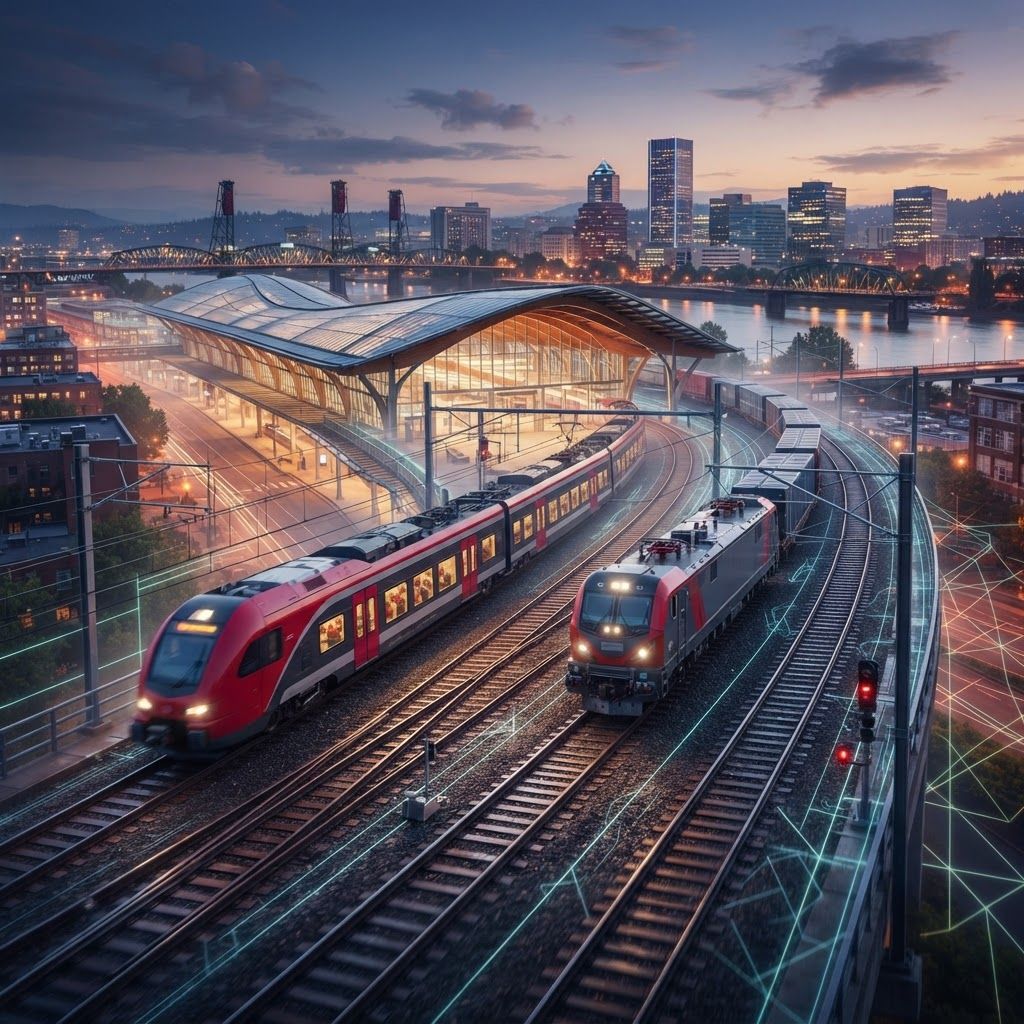
A City Built Around the Rails
Portland's growth in the nineteenth and early twentieth centuries was inseparable from rail. Union Station, with its distinctive clock tower, still anchors the north end of downtown and remains an operating passenger terminal rather than a museum piece. The rail corridors that carried lumber, grain, and manufactured goods to the river continue to structure the city's industrial geography, and several of the region's most successful redevelopment districts sit on former railyards.
Today the network serves four distinct functions: heavy freight moving national and international commodities, intercity passenger service along the Cascades corridor, regional and urban transit that carries hundreds of thousands of daily trips, and tourist or heritage operations that preserve historic equipment. Different operators handle each.
The Ten Operators That Define Portland Rail
1. Union Pacific Railroad is the dominant freight presence, operating major yards in the metro area and routes running south through the Willamette Valley and east along the Columbia River. Its Portland operations handle intermodal containers, agricultural bulk, chemicals, and manufactured goods, and its dispatching decisions affect passenger schedules that share the same track.
2. BNSF Railway is the second Class I carrier, with routing north into Washington and east through the Gorge. BNSF's intermodal service connects Northwest shippers to inland hubs, and its bridge and terminal facilities in the area are critical infrastructure for regional commerce.
3. Amtrak operates intercity passenger service from Union Station, including the Cascades corridor trains linking Eugene, Portland, Seattle, and Vancouver, British Columbia, plus long-distance routes running east and south. Portland is one of the busiest Amtrak stations in the West, and corridor ridership has been strengthened by state investment in equipment and schedules.
4. TriMet MAX Light Rail is the region's flagship transit rail system, with multiple lines connecting the airport, the western suburbs, north and east Portland, and the city center. It has shaped land use for three decades, with dense mixed-use development clustering around stations in a pattern studied by planners nationally.
5. TriMet WES Commuter Rail provides peak-period service in the western suburbs between Beaverton and Wilsonville, operating on freight-owned track. It serves the technology employment corridor and demonstrates how commuter rail can share infrastructure with freight under carefully negotiated agreements.
6. Portland Streetcar operates in the central city, linking the Pearl District, downtown, the South Waterfront, and the east side loop. Its role is circulation and development catalysis rather than long-distance commuting, and it has been closely associated with the transformation of former industrial neighborhoods.
7. Portland and Western Railroad, a short line operator, serves industrial customers across the Willamette Valley and the Portland area, providing the crucial first and last mile of rail service that connects local shippers to the Class I network. Short lines like this one keep rail viable for businesses that generate a few carloads rather than unit trains.
8. Oregon Pacific Railroad operates freight service on regional trackage and also runs excursion trains, blending working railroad operations with public-facing heritage programming. Its Oaks Park excursions are a familiar local experience.
9. Mount Hood Railroad, based in nearby Hood River, offers scenic excursions through the Columbia River Gorge and Hood River Valley orchards, with seasonal themed trains. It is among the most popular rail tourism experiences within reach of the city.
10. Oregon Rail Heritage Center and Foundation preserves and operates historic steam locomotives, maintaining equipment that once worked Northwest routes. Public open houses and occasional excursions make it a genuine civic asset for anyone interested in transportation history.
Understanding How the System Fits Together
Passenger and freight rail coexist here through negotiated access. Amtrak's Cascades trains and TriMet's commuter service run on infrastructure owned or dispatched by freight railroads, which means freight congestion can affect passenger punctuality. State transportation investment has targeted exactly this problem through track improvements, siding extensions, and signal upgrades along the corridor.
For travelers, the practical implications are simple. Intercity trips to Seattle or Eugene are comfortable, scenic, and downtown-to-downtown, but build in schedule flexibility. Airport trips on light rail are among the most reliable of any American city. Local circulation on the streetcar is pleasant but slow, and walking is often faster for short distances.
Trends and Developments
Corridor investment is the dominant theme. Higher-speed rail planning for the Cascades corridor has advanced, with federal programs supporting studies and improvements aimed at faster and more frequent service between Portland, Seattle, and Vancouver. Even incremental gains in reliability and frequency substantially change the mode's competitiveness against short-haul flights and driving.
On the freight side, precision scheduled railroading has reshaped operating practices, emphasizing longer trains and tighter asset utilization. That has efficiency benefits and service trade-offs, and it has increased the importance of short lines for smaller shippers. Both Class I carriers are also testing alternative motive power technologies, including battery-electric and hydrogen concepts, alongside efficiency upgrades to existing locomotive fleets.
Transit rail continues to expand, with regional planning focused on new corridors, station area development, and improved bus-rail integration. Safety and rider experience investments, including platform improvements and better real-time information, have accompanied that growth.
Getting the Most From Portland Rail
For visitors, the light rail line from the airport to downtown is the easiest introduction and costs a fraction of any alternative. For a day trip, the Mount Hood Railroad in the Gorge delivers scenery no highway can match. For travel up or down the corridor, book Amtrak in advance for the best fares and consider business class on the Cascades for the extra space.
For shippers, the presence of two competing Class I railroads plus active short lines is a genuine advantage. Rail-served industrial property in the region carries real value, and transload facilities let companies without direct track access still capture rail economics. In a market where trucking capacity and fuel costs fluctuate, that optionality is worth understanding.
