
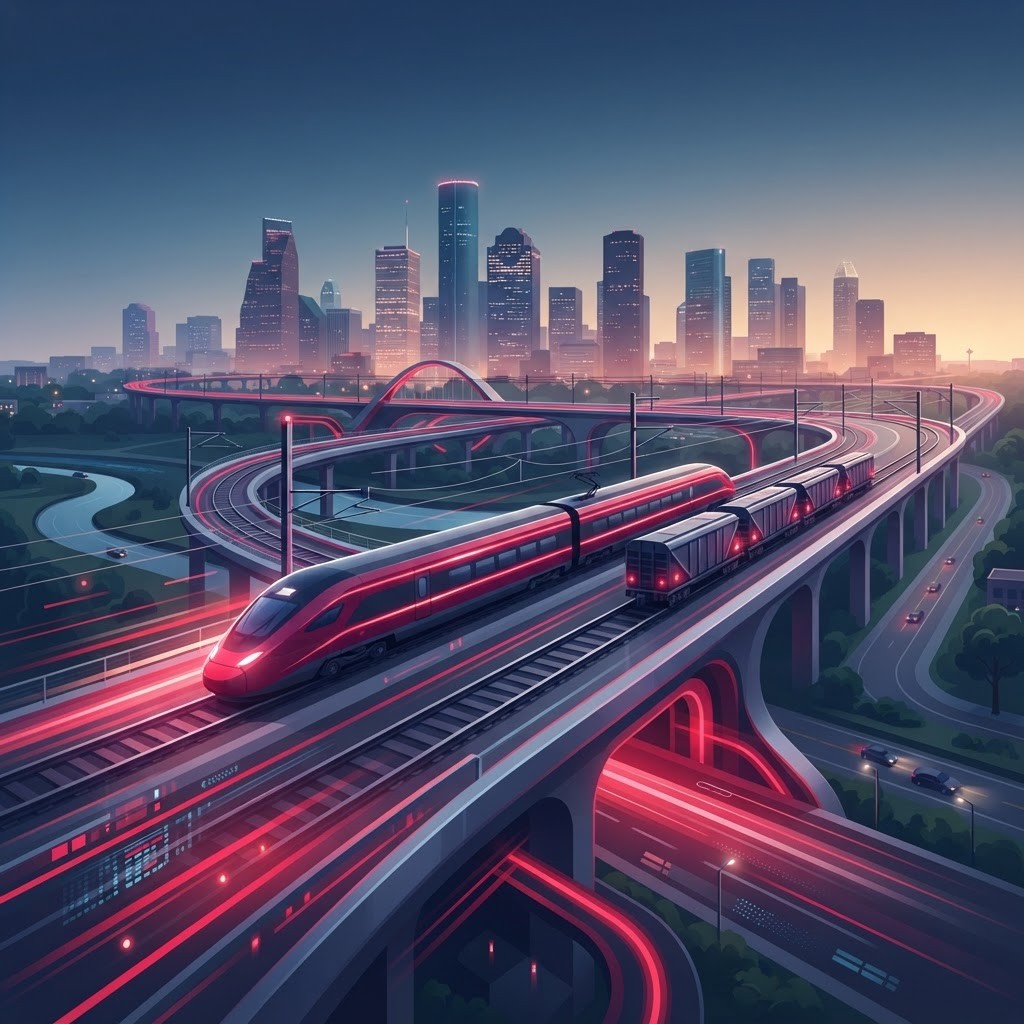
Rail Transportation in Houston
Houston is one of the nation's most important rail hubs. Freight railroads connect the region's ports, refineries, chemical plants, warehouses, and manufacturers to markets across North America, while passenger and light-rail services support intercity and urban mobility. The city's rail system is complex: major Class I carriers share the market with short-line operators, port rail facilities, public transit, and passenger services.
The term railway operator covers organizations with different roles. Some haul long-distance freight, others switch railcars within industrial zones, and public agencies move passengers. The following operators and rail organizations are among the most relevant to Houston's transportation landscape.
1. Union Pacific Railroad
Union Pacific is a dominant freight railroad in Houston and across the western United States. It serves petrochemical facilities, ports, automotive customers, agricultural shippers, and intermodal terminals. Its extensive network connects Houston with West Coast gateways, Mexico crossings, and major inland markets.
2. BNSF Railway
BNSF Railway provides major freight service to the Houston region through a broad western network. The railroad moves intermodal containers, industrial products, chemicals, grain, and consumer goods. Its long-haul reach gives Houston shippers access to important domestic and international trade corridors.
3. CPKC
Canadian Pacific Kansas City offers a single-line rail network linking Canada, the United States, and Mexico. Through its regional infrastructure and connections, CPKC supports cross-border trade relevant to Houston's manufacturers and importers. The integrated North American network is a distinctive competitive feature.
4. Port Terminal Railroad Association
The Port Terminal Railroad Association provides switching services for the Port of Houston and surrounding industrial complex. It connects numerous customers with major railroads and helps coordinate dense freight activity in the port area. This neutral switching role is essential to efficient cargo movement.
5. Houston Belt & Terminal Railway
Houston Belt & Terminal Railway supports freight movement and switching across key rail infrastructure in the metropolitan area. Its yards and connecting tracks help major carriers exchange traffic and serve local industries. Such terminal operations are less visible to the public but critical to network fluidity.
6. Watco
Watco operates short-line railroads, terminals, and industrial switching services in many markets. Its Houston-area relevance comes from customized rail and material-handling solutions for industrial customers. Short-line expertise can bridge the gap between plant operations and major railroad networks.
7. Genesee & Wyoming
Genesee & Wyoming manages short-line and regional rail operations, including services relevant to Gulf Coast industries. Its model focuses on local customer access and connections to Class I carriers. These operations support facilities that need flexible switching and specialized attention.
8. Amtrak
Amtrak provides Houston's primary intercity passenger rail connection through the Sunset Limited. The route links Houston with destinations toward New Orleans and Los Angeles on its broader journey. Although service frequency is limited compared with major Northeast corridors, it remains an important travel alternative.
9. METRORail
METRORail operates Houston's urban light-rail system. Its lines connect Downtown with the Texas Medical Center, universities, sports venues, the Museum District, and neighborhoods to the north and southeast. For visitors and commuters traveling along the corridors, it offers an alternative to driving and parking.
10. Texas State Railroad
Texas State Railroad is a heritage passenger railway located outside Houston but relevant to regional rail tourism. Its excursion trains provide an educational and recreational experience for Houston families and visitors interested in historic rail travel. It represents the leisure side of the wider Texas railway landscape.
How Freight Rail Supports Houston
Rail is especially efficient for heavy, high-volume commodities traveling long distances. Houston's chemical industry relies on specialized tank cars and rigorous safety processes, while the port uses rail for containers, steel, plastics, agricultural products, and project cargo. A single train can replace many truck movements, reducing highway congestion and improving efficiency.
Rail service quality depends on network capacity, switching coordination, equipment supply, terminal performance, and communication. Industrial shippers often work with several operators because local switching railroads connect facilities to competing long-haul carriers.
Passenger Rail Considerations
METRORail is most useful when origins and destinations lie near its lines. Riders should consider transfers, event schedules, and last-mile transportation. Amtrak passengers need to account for limited frequency and potential long-distance delays, but rail offers spacious seating and a relaxed alternative to highway travel.
Rail Industry Trends
Railroads are investing in terminal automation, track monitoring, predictive maintenance, and shipment visibility. Safety technology can detect equipment issues before failures, while digital tools improve estimated arrival information. Intermodal rail is growing in strategic importance as companies seek alternatives to long-haul trucking.
Environmental performance is another major advantage. Freight rail generally moves a ton of cargo more efficiently than highway transportation. Operators are testing lower-emission locomotives and alternative fuels while improving train handling and network efficiency.
Final Thoughts
Union Pacific, BNSF, and CPKC connect Houston to continental markets, while the Port Terminal Railroad Association and Houston Belt & Terminal Railway keep local freight moving. Amtrak and METRORail serve passenger needs at different scales. Together, these organizations make rail an indispensable part of Houston's industrial economy, port competitiveness, and transportation system.
