
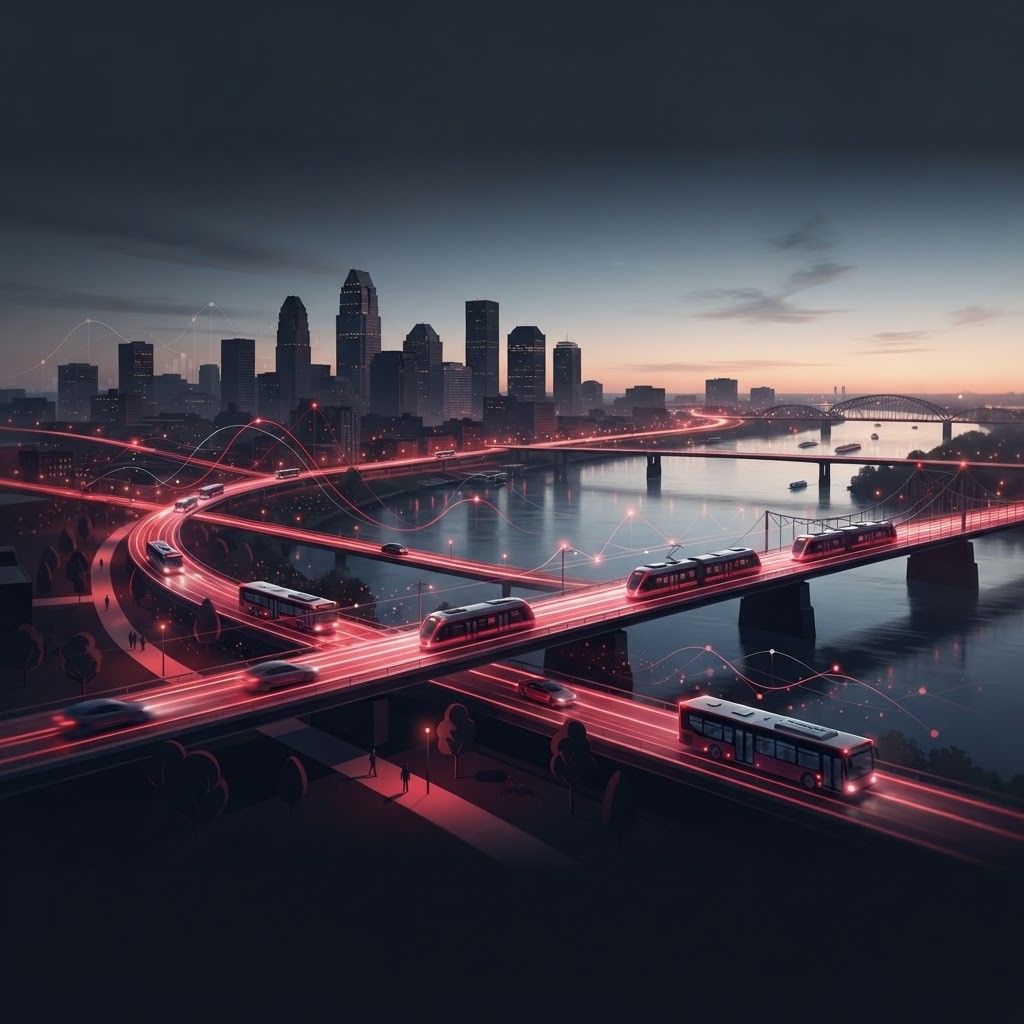
Why Public Transit Matters in Louisville
Louisville sits at a crossroads of the Ohio River Valley, and its transportation needs reflect that geography. The metro area spreads across Jefferson County and reaches into Southern Indiana, which means residents commute across bridges, along river corridors, and through neighborhoods that developed long before car ownership became universal. Public transit fills the gaps that highways cannot, connecting workers to shifts at logistics hubs near the airport, students to campuses in Old Louisville and downtown, and families to medical appointments in the hospital district.
Demand for transit in Louisville is also shaped by the city's employment profile. With a large concentration of warehousing, healthcare, and hospitality jobs, a significant share of the workforce operates outside standard business hours. Transit providers that serve these riders must think in terms of early-morning departures, late-night returns, and weekend frequency rather than a simple nine-to-five model. The services listed below have each responded to that reality in their own way.
1. TARC (Transit Authority of River City)
TARC is the backbone of public transportation in the Louisville metro area and the reference point against which every other service is measured. Operating a fleet of fixed-route buses across dozens of lines, TARC connects downtown to the East End, South End, West End, and across the river into Southern Indiana. Its high-frequency corridors along major arterials such as Broadway, Dixie Highway, and Preston Highway carry the bulk of daily ridership.
What distinguishes TARC is its combination of coverage and continuous modernization. The agency has invested in cleaner propulsion technology, real-time arrival information, and mobile fare payment, allowing riders to plan trips and pay without cash. Its transfer hub downtown functions as the anchor of the network, letting riders connect between crosstown and radial routes with minimal walking. For newcomers to Louisville, learning the TARC system is the single most useful transit skill to acquire.
2. TARC3 Paratransit Service
TARC3 is the origin-to-destination paratransit program that serves riders whose disabilities prevent them from using fixed-route buses. Operating as a complementary service, it provides shared-ride trips scheduled in advance within a defined service area. Vehicles are equipped with lifts and securement systems, and drivers receive specialized training in passenger assistance.
The value of TARC3 lies in independence. For many riders, it is the difference between attending dialysis appointments, adult day programs, or employment on their own terms versus relying entirely on family. The eligibility process involves a functional assessment rather than a diagnosis alone, which helps match the service to actual mobility needs. Riders who can use fixed routes for part of a trip are often encouraged toward conditional eligibility, keeping capacity available for those who need door-to-door service most.
3. TARC Express and Commuter Routes
Express service within the TARC family deserves separate recognition because it addresses a different rider profile. These routes use limited-stop patterns and interstate segments to move commuters from outlying park-and-ride locations into the central business district quickly. By skipping local stops, express buses cut travel time substantially compared with all-stop equivalents.
Commuters who use express service typically value predictability above all else. Park-and-ride lots reduce the friction of the first mile, and consistent peak-period headways make it realistic to leave a personal vehicle at home. For employers in downtown Louisville, express routes also function as a recruiting tool, widening the practical labor market without requiring additional parking investment.
4. University of Louisville Campus Shuttle Network
The University of Louisville operates an extensive shuttle system linking its Belknap Campus, Health Sciences Center, and satellite parking areas. Running on frequent loops during academic terms, these shuttles function as a genuine transit service for tens of thousands of students, faculty, and staff. Evening and late-night circulators improve safety for students moving between libraries, labs, and residence halls.
The shuttle network is notable for its integration with the broader transit picture. Students frequently combine campus shuttles with TARC routes to reach internships, part-time jobs, and clinical rotations across the city. Real-time vehicle tracking through a mobile application has made the system considerably more usable, reducing the uncertainty that once discouraged riders from waiting at stops.
5. Louisville Muhammad Ali International Airport Ground Transit Connections
Airport-oriented transit is a distinct category with its own service expectations. Connections serving Louisville Muhammad Ali International Airport link terminals to downtown hotels, the fairgrounds and exposition center, and nearby employment centers. Because the airport area is also one of the region's largest logistics employment zones, these connections carry both travelers and shift workers.
Reliability at unusual hours is the defining requirement here. Air cargo operations in Louisville run overnight, creating a workforce that arrives and departs when most transit systems are idle. Services that align with those shift patterns provide an economic function well beyond tourism, supporting access to thousands of jobs that would otherwise require personal vehicles.
6. Southern Indiana Regional Connections
Cross-river service linking Clark and Floyd counties in Southern Indiana to downtown Louisville is an essential part of the metro transit picture. Communities such as Jeffersonville, Clarksville, and New Albany send substantial numbers of commuters into Kentucky each day, and bridge tolling has made transit an increasingly attractive alternative for regular travelers.
Regional connections work best when they are designed around bridge capacity rather than in spite of it. Buses that use dedicated ramps and consolidated stops avoid the worst congestion points, and coordinated schedules allow riders to transfer into the Louisville network without long waits. For households in Southern Indiana, these routes turn a stressful daily crossing into productive or restful time.
7. Downtown Circulator and Trolley-Style Services
Short-distance circulators serve the dense core of Louisville where walking distances between destinations can still be inconvenient. Trolley-style vehicles and small buses run frequently along Main Street, Market Street, and Fourth Street, connecting hotels, museums, restaurants on Whiskey Row, and the convention district.
The appeal of a circulator is simplicity. Riders do not need to study a system map; they only need to know that a vehicle will arrive soon and travel in a predictable loop. For conventions and events, circulators absorb trips that would otherwise create parking pressure, and for downtown residents they make a car-free lifestyle genuinely practical.
8. Medical District Shuttle Services
Louisville's downtown medical district concentrates hospitals, specialty clinics, research facilities, and medical education in a compact area. Dedicated shuttles connect these institutions with employee parking, nearby campuses, and transit hubs. Service tends to run at high frequency during shift changes, which for healthcare facilities occur several times daily.
These shuttles solve a problem that general transit handles poorly: moving large numbers of people short distances at concentrated times. Their value shows up in reduced parking demand, shorter walks for staff working overnight, and easier navigation for patients and visitors who arrive unfamiliar with the district's layout.
9. Senior and Human Services Transportation Programs
A network of human services transportation programs operates across Jefferson County, coordinated through community organizations and senior centers. These programs provide scheduled trips to grocery stores, pharmacies, congregate meal sites, and medical appointments, often using accessible vans with volunteer or trained paid drivers.
What sets these programs apart is the level of assistance offered. Drivers may help riders with packages, wait during appointments, and provide door-through-door support when needed. For older adults who have stopped driving, this category of transit preserves community connection and reduces isolation in a way that no fixed-route bus can replicate.
10. Microtransit and On-Demand Pilot Services
Microtransit represents the newest layer of Louisville's transit ecosystem. These on-demand services use smaller vehicles and app-based booking to serve zones where fixed-route ridership is too thin to justify full-size buses. Riders request a trip, and dynamic routing software groups compatible passengers into shared vehicles.
The strategic value of microtransit is flexibility. It allows transit planners to maintain coverage in low-density neighborhoods and industrial parks while concentrating high-capacity buses on productive corridors. As these services mature, the most successful implementations tend to be those that function as feeders into the main network rather than as isolated point-to-point offerings.
Trends Shaping Louisville Transit
Several trends are reshaping how transit works in the Louisville region. Fare technology has moved decisively toward account-based systems, where riders tap a card or phone and fare capping automatically ensures no one pays more than the value of a pass. This removes the upfront cost barrier that historically penalized low-income riders who could not afford a monthly pass in a single payment.
Fleet electrification is a second major shift. Battery-electric buses reduce operating noise and tailpipe emissions along the arterial corridors where they run most, which matters in neighborhoods that have long carried a disproportionate share of air quality burden. Charging infrastructure and route-planning software must evolve together for electrification to succeed operationally.
A third trend is data-driven network redesign. Rather than layering new routes onto historical patterns, agencies now analyze origin-destination data to rebuild networks around where people actually travel. This often means straighter routes, fewer deviations, and higher frequency on core corridors, accepting slightly longer walks in exchange for shorter waits.
How to Choose the Right Transit Option
Selecting among these services depends on your trip profile. For daily commuting within Jefferson County, the TARC fixed-route network combined with express routes will usually offer the best combination of coverage and cost. If your trips originate in Southern Indiana, regional connections paired with a downtown transfer typically outperform driving once tolls and parking are counted.
Riders with disabilities should begin with a TARC3 eligibility assessment, but should also explore whether conditional eligibility combined with accessible fixed-route service offers greater spontaneity. Older adults who need assistance during trips will generally find human services programs more supportive than general transit, while students should build their travel habits around campus shuttles supplemented by city routes.
Finally, consider the total journey rather than the vehicle. The best transit experience in Louisville usually involves combining services: a shuttle to a transfer point, a high-frequency bus along a main corridor, and a short walk at the end. Learning how these layers connect is what turns transit from a fallback option into a genuinely convenient way to move around the city.
Final Thoughts
Louisville's transit landscape is more capable than many residents realize. Between a comprehensive fixed-route backbone, specialized paratransit, institutional shuttles, regional cross-river links, and emerging on-demand pilots, most trips in the metro area can be made without a personal vehicle. The services profiled here each fill a specific niche, and together they form a network that continues to expand in both technology and reach. As investment in electrification, fare modernization, and network redesign continues, public transit in Louisville is positioned to serve a broader share of the region's travel needs.
