
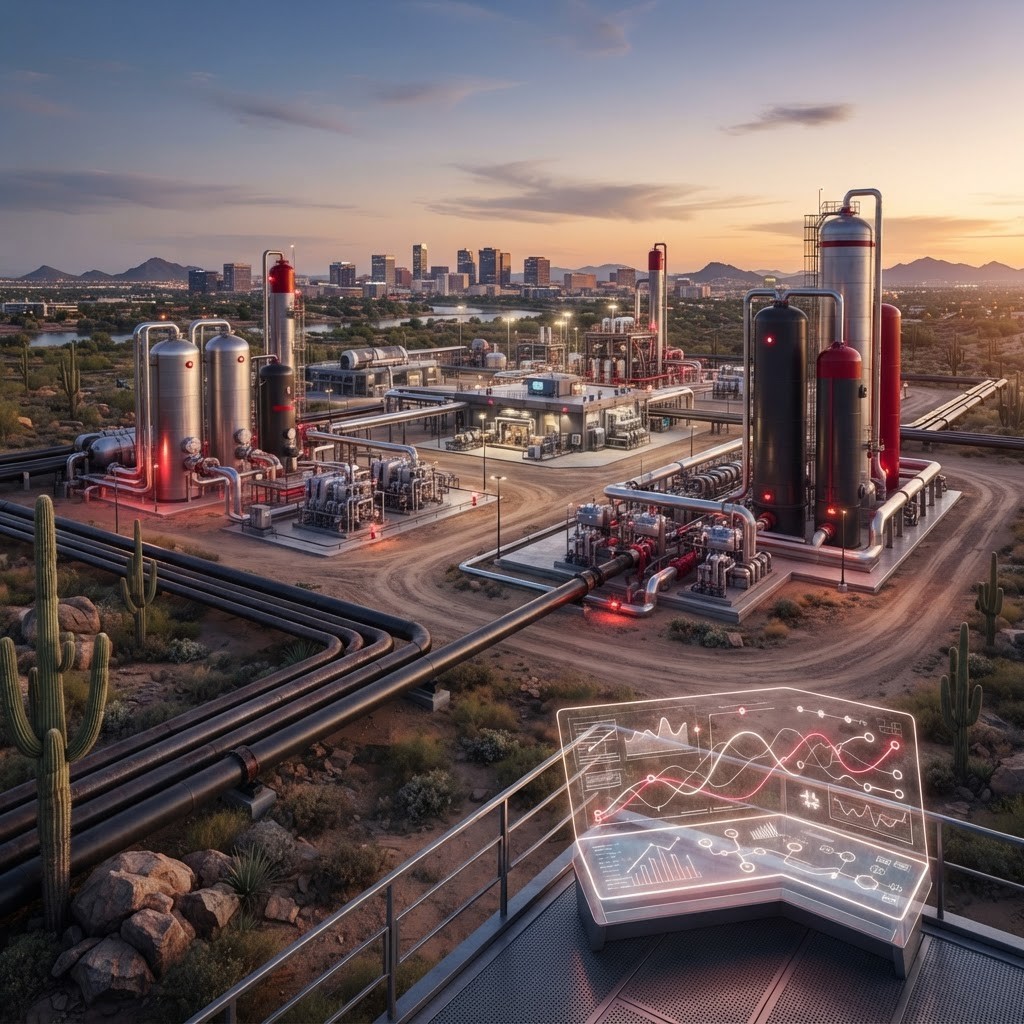
Understanding Phoenix's Oil and Gas Market
Arizona produces little crude oil and has no major operating refinery, so Phoenix depends on sophisticated regional supply chains. Pipelines deliver refined products from neighboring states, while terminals, distributors, retailers, and logistics firms keep transportation and industry moving. Companies are also responding to cleaner-fuel standards, efficiency goals, safety expectations, and rising interest in alternative energy. The organizations below have meaningful roles in serving the Phoenix and Arizona market.
1. Kinder Morgan
Kinder Morgan operates critical pipeline and terminal infrastructure that moves refined petroleum products into Arizona. Its systems connect Phoenix demand with supply from major refining centers. Pipeline reliability, inspection, leak prevention, and coordinated scheduling are essential because regional inventories depend on consistent deliveries.
2. HF Sinclair
HF Sinclair is a refining and marketing company with a substantial western United States footprint. Its fuels reach Arizona through wholesale and branded channels. The company's integrated operations include refining, logistics, lubricants, and renewable products, giving it exposure to both conventional demand and changing fuel markets.
3. Marathon Petroleum
Marathon Petroleum is a major refiner, marketer, and midstream participant serving western markets. Its products and branded retail relationships contribute to fuel availability in Arizona. Scale allows the company to coordinate refinery output, transportation, terminal supply, and quality requirements across a broad network.
4. Phillips 66
Phillips 66 operates across refining, midstream, chemicals, marketing, and emerging energy areas. Its branded fuels and commercial supply activities are visible in the Arizona market. The company also invests in lower-carbon fuels and infrastructure, reflecting how established energy businesses are adapting their asset portfolios.
5. Chevron
Chevron supplies branded fuels and related products through stations and commercial relationships in Greater Phoenix. Its broader operations include production, refining, additives, and new-energy initiatives. For local consumers, brand standards, fuel quality programs, payment technology, and station-operator execution shape the practical experience.
6. Shell
Shell-branded stations serve drivers across the Valley through independently operated retail locations and supply arrangements. The global company participates in oil, gas, liquefied natural gas, chemicals, power, and lower-carbon solutions. Its retail presence combines fuel distribution with loyalty, convenience, and evolving mobility services.
7. ExxonMobil
ExxonMobil products reach Arizona through branded and commercial channels. The company is one of the world's largest integrated energy and chemical businesses, with capabilities spanning production, refining, technology, and lubricants. Research and operational scale are key differentiators, although local delivery depends on regional partners and infrastructure.
8. Suburban Propane
Suburban Propane serves residential, commercial, industrial, and agricultural customers with propane and related energy services. In the Phoenix region, propane supports businesses, construction, backup systems, outdoor living, and customers beyond natural-gas networks. Dependable scheduling and strong cylinder and tank safety practices are central to service quality.
9. Ferrellgas
Ferrellgas distributes propane to households and businesses and supports portable cylinder exchange. Its national network provides procurement scale while local teams manage delivery and customer needs. Propane distributors must plan carefully for seasonal changes, fleet safety, storage requirements, and emergency response.
10. Offen Petroleum
Offen Petroleum is a regional fuel and lubricant distributor serving commercial and retail customers across the West, including Arizona. Distributors bridge large supply systems and end users through transportation, inventory, branded programs, and account support. This behind-the-scenes role is important to construction, trucking, fleet, and convenience-store operations.
Industry Trends in Arizona
Phoenix population growth and logistics activity continue to support fuel demand, while more efficient vehicles and electrification change long-range forecasts. Extreme heat places added stress on equipment, fleets, and storage operations. Companies are using monitoring, predictive maintenance, route optimization, and automated inventory controls to improve safety and continuity.
Environmental performance is another competitive factor. Vapor controls, spill prevention, pipeline integrity, and transparent incident response protect communities and reduce operational risk. Major companies are also exploring renewable diesel, hydrogen, carbon management, biofuels, and electric charging, though investment strategies differ.
Choosing a Commercial Fuel Partner
Businesses should compare supply reliability, product specifications, pricing structure, delivery coverage, emergency capabilities, safety record, credit terms, and reporting tools. Fleet customers may need card controls and detailed consumption data; industrial buyers may prioritize storage compliance and lubricant expertise. Contract terms should clearly address index pricing, fees, minimum volumes, and disruption procedures.
Phoenix's oil and gas sector is best understood as a network rather than a collection of local producers. Pipelines, refiners, marketers, propane suppliers, and distributors each keep energy available in a landlocked market. The strongest partners combine reliable logistics with safety, transparent terms, responsive service, and a credible plan for an energy system that is gradually becoming more diverse.
Safety and Resilience
Fuel infrastructure supports ambulances, aviation, construction, freight, backup generation, and daily transportation, making continuity a regional resilience concern. Operators should plan for pipeline interruptions, extreme heat, power outages, wildfires, equipment failure, and transportation constraints. Commercial customers can reduce disruption by monitoring storage, maintaining equipment, forecasting usage, and defining backup arrangements where practical. Safety training should cover transfer procedures, ignition control, spill response, and rapid reporting instead of relying only on written manuals. Phoenix growth makes careful siting and communication increasingly important as industrial operations and neighborhoods move closer together. Companies that invest consistently in inspection, workforce capability, emergency coordination, and transparent incident response are better positioned to protect employees and communities while retaining the confidence of customers and public agencies.
