
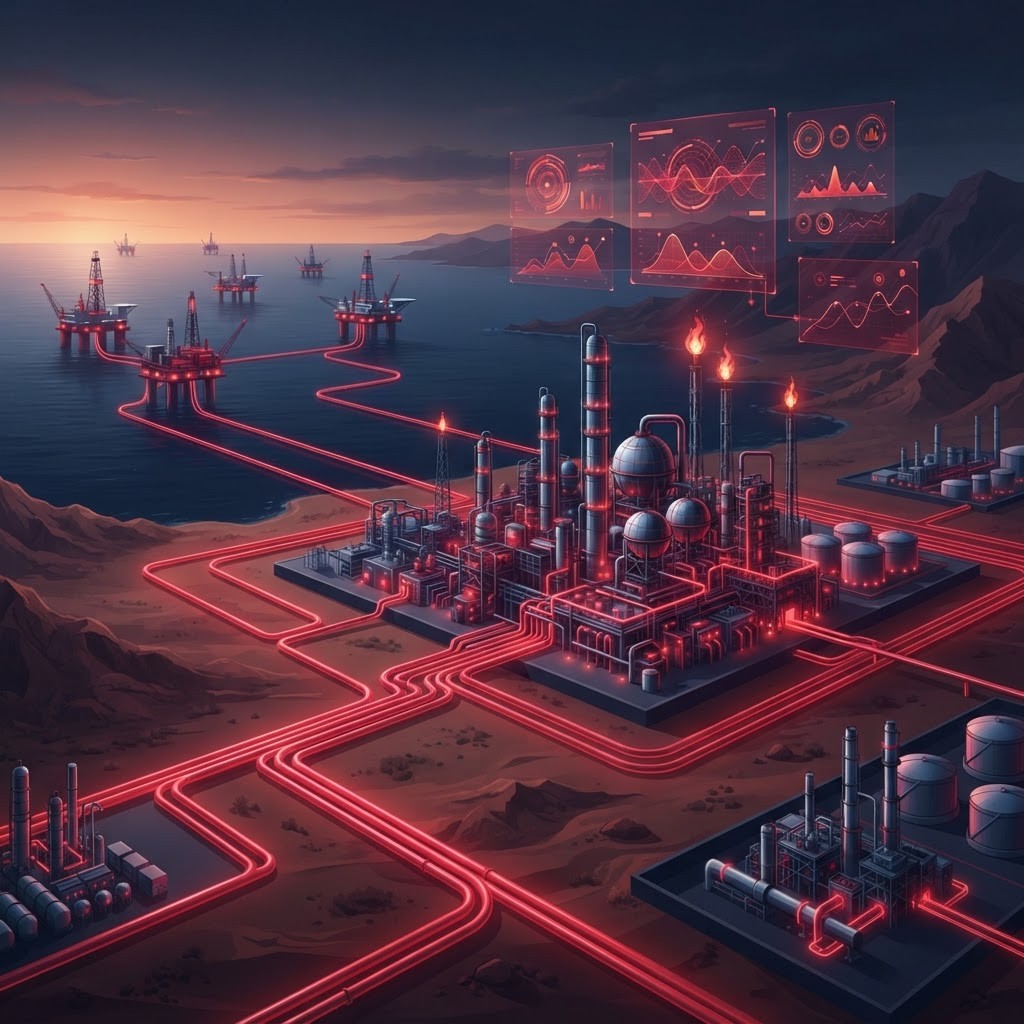
The Backbone of Oman's Economy
Oil and gas have long been the foundation of Oman's economy, funding development, infrastructure, and public services for decades. Despite the global push toward diversification, hydrocarbons remain a vital pillar of the Sultanate's prosperity and a major source of export revenue. Oman's oil and gas sector is characterised by technically challenging reservoirs, world-leading enhanced oil recovery techniques, and a growing emphasis on efficiency and lower-carbon operations.
The industry encompasses exploration and production, refining, petrochemicals, gas processing, and a vast network of service and supply companies. As Oman balances the ongoing importance of hydrocarbons with its Vision 2040 diversification goals, the sector is evolving, integrating renewables, reducing emissions, and investing in downstream value creation.
Structure of the Sector
Oman's oil and gas landscape features a mix of national entities, international partners, and specialised service providers. Upstream companies focus on exploration and production, deploying advanced techniques to maximise recovery from complex fields. Downstream operations add value through refining and petrochemicals, while gas infrastructure supports both domestic power generation and liquefied natural gas exports.
The Top 10 Oil and Gas Companies
1. Petroleum Development Oman (PDO) is the leading exploration and production company, responsible for the majority of the country's crude output and a pioneer in enhanced oil recovery.
2. OQ is the integrated national energy group spanning upstream, downstream, petrochemicals, and marketing, playing a central role across the entire value chain.
3. Oman LNG operates the Sultanate's liquefied natural gas production and export facilities, delivering Omani gas to international markets.
4. BP Oman is a key upstream partner, notably developing major tight gas resources that significantly boosted domestic gas supply.
5. Occidental Oman is a long-standing exploration and production operator with significant onshore assets and advanced recovery expertise.
6. Shell Oman contributes deep technical capability across upstream, gas, and emerging energy ventures throughout the country.
7. TotalEnergies Oman participates in major gas and LNG initiatives while advancing integrated energy and lower-carbon projects.
8. Daleel Petroleum is a productive onshore operator known for efficient field development and strong operational performance.
9. Oman Oil Refineries and Petroleum Industries Company (ORPIC), part of OQ, drives refining and petrochemical value addition at major industrial hubs.
10. CC Energy Development rounds out the list as an active exploration and production company contributing to the Sultanate's upstream output.
Services and Capabilities
These companies deliver the full spectrum of oil and gas activities: exploration, drilling, and production; enhanced oil recovery using thermal, chemical, and gas injection methods; gas processing and liquefaction; refining and petrochemical manufacturing; and extensive logistics and support services. Many are also investing in digital technologies, automation, and emissions-reduction initiatives to improve efficiency and sustainability.
Balancing Hydrocarbons and the Energy Transition
Oman's oil and gas companies are increasingly focused on operating responsibly. Enhanced oil recovery, though energy-intensive, is being paired with solar power to reduce gas consumption. Flaring reduction, methane management, and energy efficiency programmes are lowering the carbon footprint of operations. Several major players are simultaneously investing in renewables and green hydrogen, positioning themselves for a diversified energy future while maintaining the hydrocarbon output that underpins the economy.
Industry Trends
Key trends include the integration of renewable power into oilfield operations, digitalisation for improved reservoir management and predictive maintenance, and a growing emphasis on downstream petrochemicals to capture more value domestically. Natural gas is playing an expanding role as a cleaner-burning fuel for power and industry, while carbon management and efficiency remain top priorities across the sector.
Conclusion
Oil and gas continue to anchor Oman's economy while adapting to a changing energy world. The companies profiled here represent the technical excellence, operational strength, and forward thinking that define the Sultanate's hydrocarbon industry. As Oman pursues both continued production and ambitious diversification, these organisations will remain central to the nation's economic strength and its measured transition toward a lower-carbon future.
