
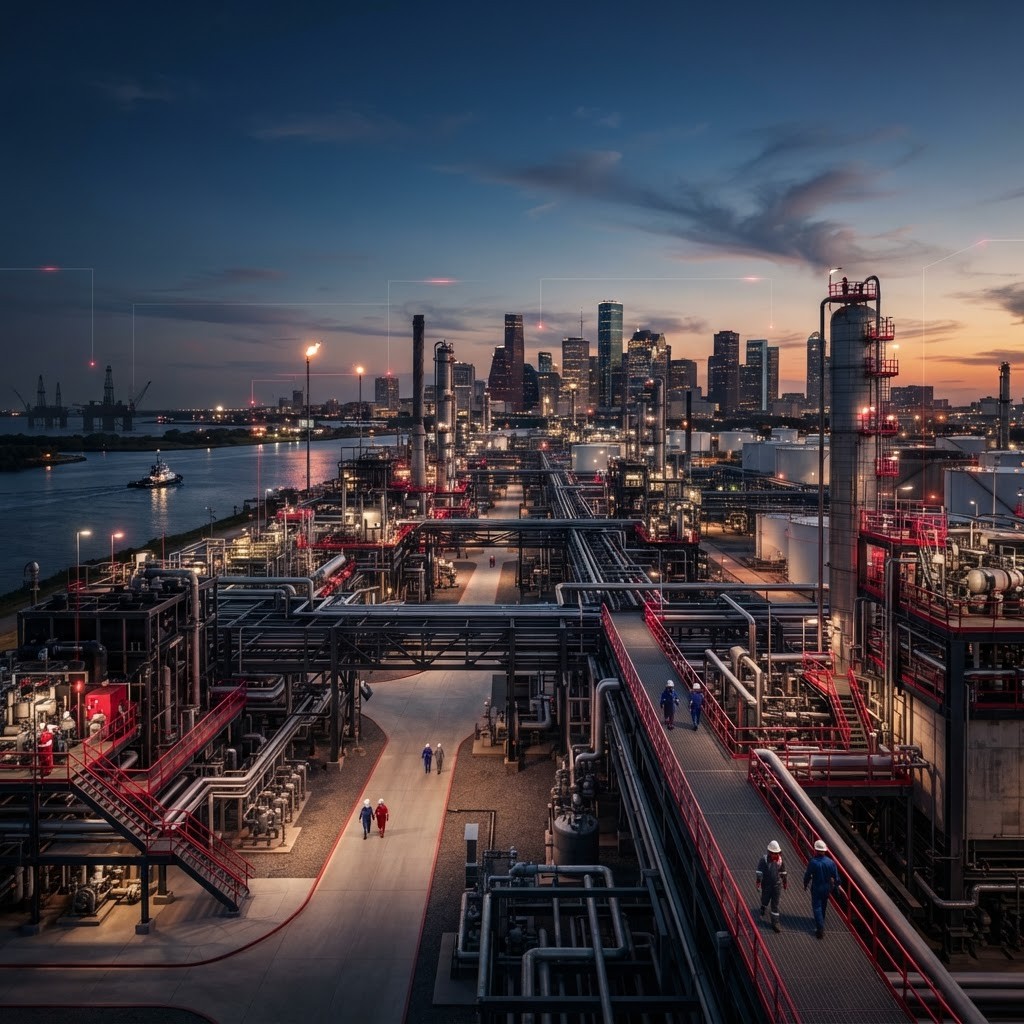
The Energy Capital’s Core Industry
Houston’s identity is inseparable from oil and gas. The region hosts headquarters, refineries, petrochemical plants, engineering firms, service companies, traders, and a highly specialized workforce. Although the industry faces commodity cycles and pressure to reduce emissions, it remains essential to transportation, manufacturing, chemicals, and global energy security.
The following companies have major Houston operations and industry influence. They differ significantly: some produce resources, others refine and market fuels, transport hydrocarbons, export liquefied natural gas, or supply technology. This is an editorial overview rather than an investment recommendation or safety ranking.
1. ExxonMobil
ExxonMobil has consolidated its corporate presence in the Houston area and operates across exploration, production, refining, chemicals, and lower-emission initiatives. Its scale, integrated assets, technical research, and global project capabilities set it apart. The company also plays a major role in regional employment and supplier networks.
2. Chevron
Chevron maintains a major Houston workforce and manages global upstream, technology, trading, and project activities from the city. Its portfolio spans oil, natural gas, LNG, refining, and emerging lower-carbon businesses. Deepwater expertise and disciplined large-project execution are notable strengths.
3. ConocoPhillips
Houston-headquartered ConocoPhillips is one of the world’s largest independent exploration and production companies. It concentrates on finding and producing oil and natural gas rather than refining. Portfolio depth, operating discipline, and significant unconventional and international positions distinguish the company.
4. Occidental
Occidental, commonly called Oxy, is headquartered in Houston and has major oil, gas, and chemical operations. It is also investing in carbon management and direct air capture. Experience with carbon dioxide use in enhanced recovery gives the company a distinctive technical foundation for carbon-storage initiatives.
5. Phillips 66
Phillips 66 is a Houston-based diversified downstream energy company. Its businesses include refining, midstream infrastructure, chemicals, marketing, and renewable fuels. Operational optimization and integration across logistics and manufacturing are important differentiators.
6. Halliburton
Halliburton is one of the largest oilfield service companies and has longstanding Houston roots. It provides drilling, completion, production, and digital technologies to operators around the world. Its performance depends on technical innovation, field execution, safety, and the investment cycles of producer customers.
7. SLB
SLB maintains major Houston operations and provides technology across subsurface evaluation, drilling, production, and energy systems. Global reach and extensive scientific expertise distinguish the company. Its digital platforms and work in carbon, geothermal, and other new energy areas show how service capabilities are broadening.
8. Baker Hughes
Houston-based Baker Hughes supplies oilfield services, industrial equipment, turbomachinery, and energy technology. It is especially significant to LNG and gas infrastructure through major equipment offerings. The company combines traditional industry expertise with investments in emissions measurement and lower-carbon technologies.
9. Kinder Morgan
Kinder Morgan is headquartered in Houston and operates an extensive network of pipelines and terminals. Midstream infrastructure connects producing regions with utilities, industrial users, export facilities, and refineries. Reliability, regulatory compliance, integrity management, and long-term contracts are core to its business.
10. Cheniere Energy
Houston-headquartered Cheniere Energy helped establish the United States as a major LNG exporter. Its Gulf Coast facilities cool natural gas for shipment to global buyers. Complex engineering, long-term commercial agreements, shipping logistics, and facility reliability drive its position in the market.
How Industry Leadership Is Changing
Scale alone no longer defines leadership. Investors, customers, regulators, and communities increasingly evaluate methane control, flaring, water management, worker safety, cyber resilience, and emissions intensity. Digital tools improve reservoir models and equipment maintenance, while automation can reduce exposure to hazardous tasks. Companies also need strong capital discipline through volatile price cycles.
Houston’s Continuing Advantage
The city offers dense networks of specialized talent. A project can draw on geoscientists, engineers, commodity traders, maritime lawyers, fabricators, software developers, and financiers within one metropolitan region. The Houston Ship Channel adds refining, chemical, port, and export infrastructure that is difficult to replicate.
At the same time, extreme weather and a changing energy system require adaptation. Companies that maintain safe, efficient core operations while credibly developing lower-emission technologies are likely to remain influential. Houston’s oil and gas sector is not static; it is using decades of project expertise to respond to new market and environmental expectations.
