
Understanding New York’s Hardware Ecosystem
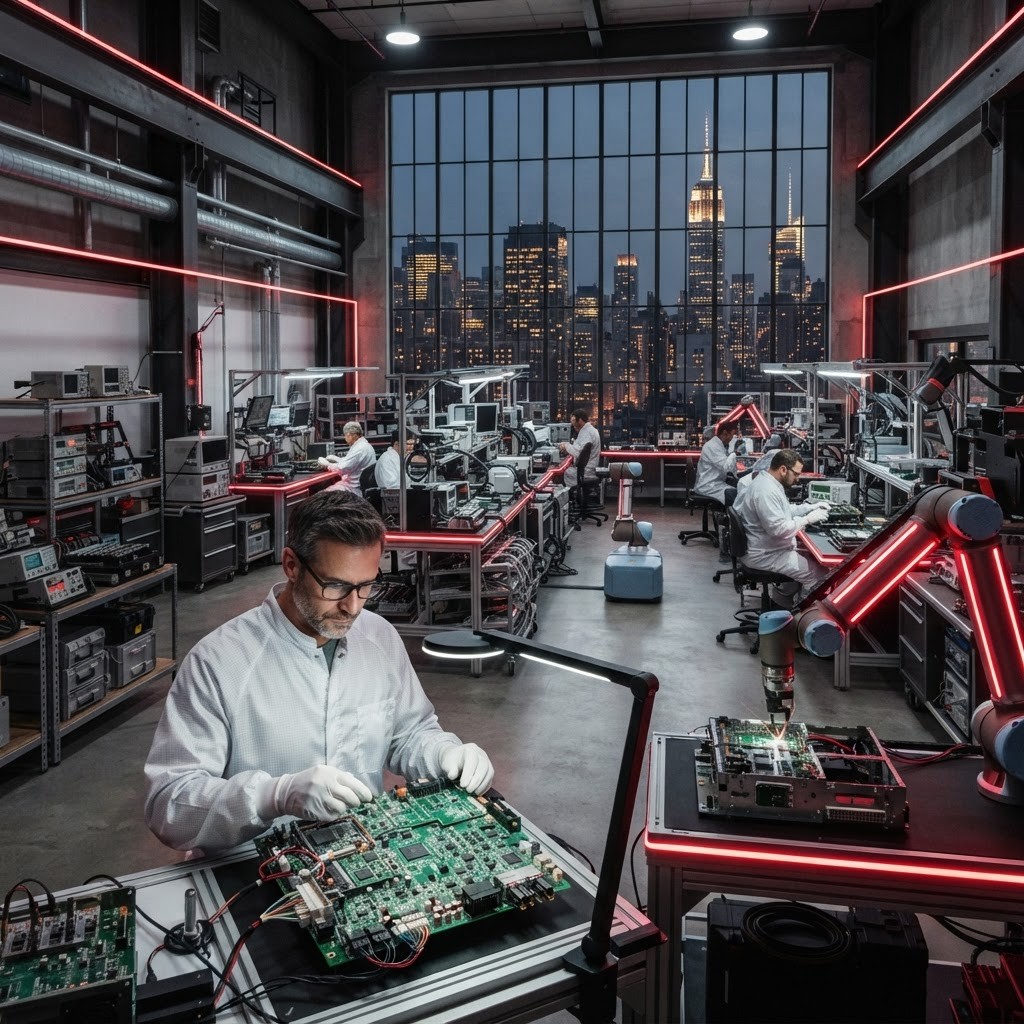
Hardware manufacturing in New York extends beyond assembly lines. The state supports semiconductor research and fabrication, enterprise systems, imaging, communications, industrial technology, and growing startup communities. Some companies listed here are headquartered in New York, while others maintain major manufacturing, research, or business operations in the state. They serve very different buyers, so this list is best used as a map of capabilities rather than a direct ranking. Procurement teams should evaluate quality systems, supply-chain resilience, serviceability, cybersecurity, and lifecycle support alongside product specifications.
1. IBM
IBM has deep historical ties to New York and continues to contribute to semiconductor research, enterprise systems, quantum computing, and advanced hardware development. Its mainframe and server technologies support demanding workloads where reliability, security, and transaction performance are priorities. IBM’s research presence in the state strengthens its position in next-generation computing. Enterprise buyers value long product lifecycles and integrated support, but should assess architecture fit, software dependencies, skills availability, energy use, and total operating cost over many years.
2. GlobalFoundries
GlobalFoundries operates a major semiconductor manufacturing facility in New York’s Capital Region. It produces chips for automotive, communications, industrial, aerospace, defense, and connected-device applications. The company is important to domestic semiconductor capacity and to customers that require specialized manufacturing processes rather than only the smallest geometries. Its differentiators include scale, manufacturing expertise, and established process technologies. Customers should evaluate capacity commitments, qualification requirements, geographic supply resilience, intellectual-property safeguards, and long-term process availability.
3. Corning
Corning, headquartered in Corning, New York, is a leader in materials science and manufactures specialty glass, ceramics, and related technologies. Its products support displays, optical communications, mobile devices, life sciences, automotive systems, and other industries. The company’s advantage comes from sustained research and mastery of complex material and manufacturing processes. Buyers and partners may value its ability to move innovations from laboratory development to large-scale production. Qualification cycles, application-specific durability, sustainability, and supply planning remain important considerations.
4. Kodak
Eastman Kodak, based in Rochester, has evolved from its photographic heritage into commercial print, advanced materials, chemicals, and imaging-related manufacturing. Its expertise in coating, film, color science, and precision production gives it capabilities applicable beyond consumer photography. Kodak remains part of western New York’s imaging and manufacturing cluster. Commercial customers should evaluate each product line on current capabilities, service, consumables, integration, and long-term support. The company’s historic brand is notable, but procurement decisions should rest on present operational fit.
5. Zebra Technologies
Zebra Technologies provides enterprise mobile computers, barcode scanners, printers, radio-frequency identification products, and related operational technology. While headquartered outside New York, its hardware is widely used by retailers, logistics operators, healthcare providers, manufacturers, and public organizations throughout the city and state. Zebra’s strength lies in rugged devices and systems designed for frontline workflows. Buyers should consider device management, battery lifecycle, repair programs, wireless performance, accessory compatibility, and software integration rather than treating hardware as an isolated purchase.
6. Datto
Datto, now part of Kaseya, has roots in the New York region and is known for backup, disaster recovery, networking, and business-continuity products delivered through managed service providers. Its appliances combine hardware with cloud software and operational services. For small and midsize New York businesses, this integrated model can simplify recovery capabilities. Customers should test restoration procedures, clarify data retention, understand provider responsibilities, and verify how systems operate during extended connectivity or service disruptions. A backup is only valuable when recovery is proven.
7. MakerBot
MakerBot emerged from New York’s technology community and helped popularize accessible desktop three-dimensional printing. Now associated with UltiMaker, its product lineage serves education, design, and professional prototyping. Additive manufacturing can help teams create models, fixtures, and early product iterations without waiting for conventional tooling. Buyers should compare material compatibility, dimensional accuracy, reliability, software workflow, ventilation needs, and support. The right printer depends on intended parts and operating environment rather than maximum specification claims.
8. Adafruit Industries
Adafruit Industries is a New York City company that designs and manufactures electronics for learning, prototyping, and creative technology projects. Its catalog includes development boards, sensors, displays, components, and kits supported by extensive educational material. Adafruit stands out for making hardware approachable to students, makers, educators, and engineers. Its open educational culture contributes to the city’s hardware community. Professional users should still plan for component lifecycle, certification, environmental limits, and production-scale sourcing when moving prototypes into commercial products.
9. goTenna
Brooklyn-founded goTenna develops mobile mesh networking hardware and software that enable communications when conventional connectivity is limited or unavailable. Its technology is relevant to public safety, defense, field operations, and organizations requiring resilient off-grid coordination. The company’s focus on portable, decentralized communications differentiates it from standard cellular device manufacturers. Buyers should test range and performance in representative urban and field conditions, review encryption and device management, and plan for spectrum, training, battery, and interoperability requirements.
10. Nanotronics
Nanotronics, based in Brooklyn, develops advanced inspection and process-control systems that combine microscopy, robotics, and artificial intelligence for manufacturing. Its products help producers identify defects and understand processes across semiconductor, materials, and other precision industries. The company represents New York’s growing overlap between hardware, automation, and applied AI. Manufacturers should evaluate detection performance on real samples, integration with production equipment, calibration, throughput, explainability, and the workflow for acting on findings.
Choosing a Hardware Manufacturer or Platform
Begin with environmental, performance, certification, and lifecycle requirements. Request evidence from representative workloads and conditions, not only laboratory specifications. Investigate component sourcing, manufacturing locations, quality controls, repairability, warranty terms, firmware update policy, vulnerability disclosure, and end-of-life notice. New York buyers with critical operations should maintain spares and validate alternatives for constrained components. Sustainability considerations include energy use, packaging, material origin, repair programs, and responsible recycling. The best hardware partner combines dependable products with transparent supply planning, secure software support, responsive service, and a credible roadmap that protects the customer’s investment over the full useful life of the equipment.
