
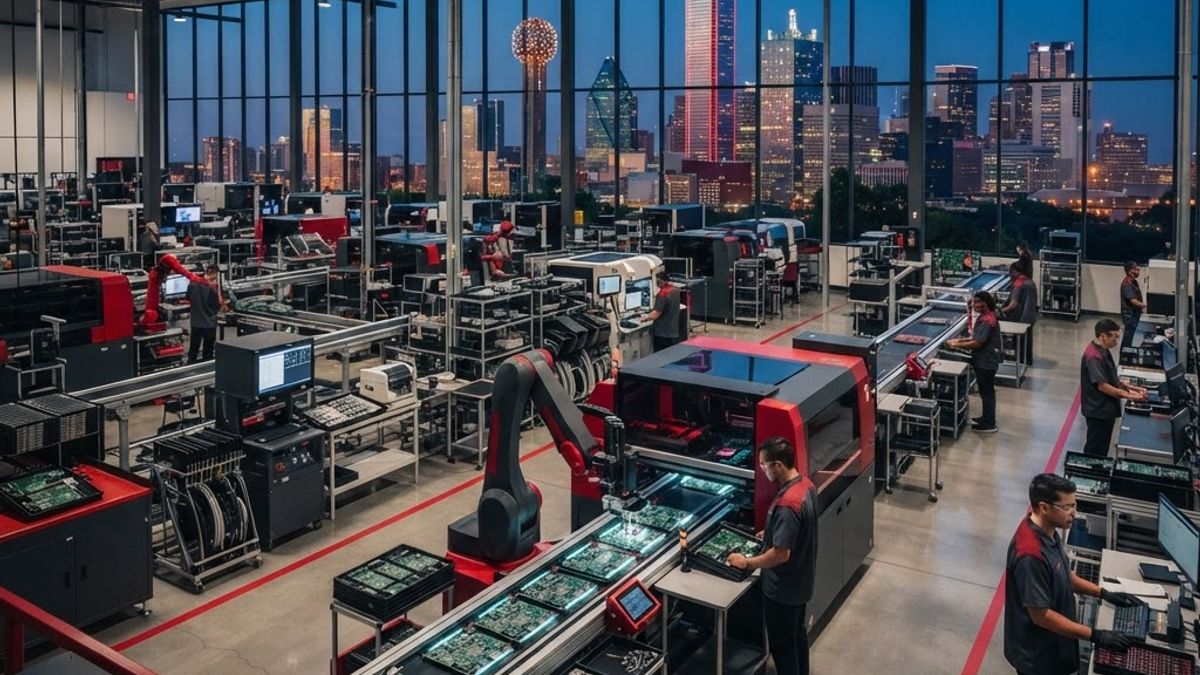
North Texas Hardware Manufacturing
Dallas–Fort Worth has grown from a telecommunications center into a broad advanced-manufacturing ecosystem. The region combines semiconductor expertise, aerospace and defense demand, logistics infrastructure, engineering talent, data-center growth, and access to a large central U.S. market. Recent investment in AI infrastructure and electronics assembly is strengthening a supply chain already known for chips, communications equipment, sensors, and industrial systems.
The following companies have headquarters, major facilities, or meaningful manufacturing operations in the region. They serve different markets, so the right choice depends on product complexity, certifications, volume, sourcing needs, and intellectual-property requirements.
1. Texas Instruments
Dallas-headquartered Texas Instruments is one of the world’s most important semiconductor manufacturers. The company produces analog and embedded processing chips used in automotive, industrial, personal electronics, and communications applications. Its long-term investment in North Texas wafer fabrication reinforces the region’s role in resilient domestic semiconductor production.
2. Qorvo
Qorvo maintains significant Richardson operations tied to radio-frequency and semiconductor technologies. Its products support wireless communications, aerospace, defense, automotive, and connected devices. The company represents the specialized expertise that grew around North Texas telecommunications and continues to serve modern high-frequency applications.
3. Sanmina
Sanmina operates in the Dallas area as part of a global electronics manufacturing network. It provides design, engineering, printed circuit board assembly, systems integration, and supply-chain services. The company is relevant for complex products in regulated or demanding markets where quality systems and manufacturing discipline are essential.
4. Flex
Flex has a notable North Texas presence and offers product design, electronics manufacturing, supply-chain management, and lifecycle services. Its global reach can help brands scale production across regions. Customers should assess the fit between program volume, required technologies, facility capabilities, and the level of engineering support.
5. LITEON
LITEON is expanding its McKinney footprint with advanced manufacturing and regional headquarters investment. The company produces power, optoelectronic, and electronic components used across cloud, automotive, industrial, and consumer markets. Its growth reflects increasing North Texas demand for power and infrastructure hardware supporting data-intensive computing.
6. Celestica
Celestica’s planned Richardson-area expansion strengthens the region’s capacity for advanced electronics and AI data-center infrastructure. The company provides design, manufacturing, and supply-chain solutions for demanding technology markets. Its investment is an important signal that North Texas is becoming a production center for the physical systems behind artificial intelligence.
7. Foxlink
Foxlink is establishing Fort Worth manufacturing focused on electronics and circuit-board assembly for advanced computing. The project adds another link to the regional AI hardware supply chain. Proximity among assemblers, data centers, logistics providers, and skilled workers can reduce coordination challenges for rapidly evolving infrastructure products.
8. Microtex Electronics
Microtex Electronics provides custom electronics manufacturing, printed circuit board assembly, embedded computing, and engineering services. A focused local provider can be attractive for prototypes, specialized products, and customers that value close communication. Buyers should review equipment, inspection methods, sourcing controls, and experience with relevant standards.
9. Texas Flex
Texas Flex manufactures access-control and security hardware in North Texas. Its specialization illustrates the region’s diversity beyond high-volume semiconductors. For customers seeking physical security products, domestic production and focused expertise can support responsiveness, customization, and supply-chain visibility.
10. Kopin
Kopin’s Dallas design and manufacturing activity centers on advanced optics and microdisplays. These technologies serve defense, industrial, and wearable applications where compact size and optical performance matter. The facility adds specialized photonics capability to the area’s established electronics base.
How to Select a Manufacturing Partner
Hardware buyers should evaluate far more than unit price. Review design-for-manufacturing support, component sourcing, traceability, yield management, testing, certifications, cybersecurity, intellectual-property controls, and business continuity. Ask how the manufacturer manages shortages and substitutions, and require approval processes for changes affecting form, fit, function, or regulatory status.
North Texas offers advantages in central logistics, engineering access, and a growing supplier network. Trends in reshoring, semiconductor investment, AI infrastructure, electrification, and secure supply chains should continue to benefit the region. The best manufacturing relationship is transparent and collaborative, with shared quality metrics, clear escalation paths, and early engineering involvement that prevents expensive production problems.
