
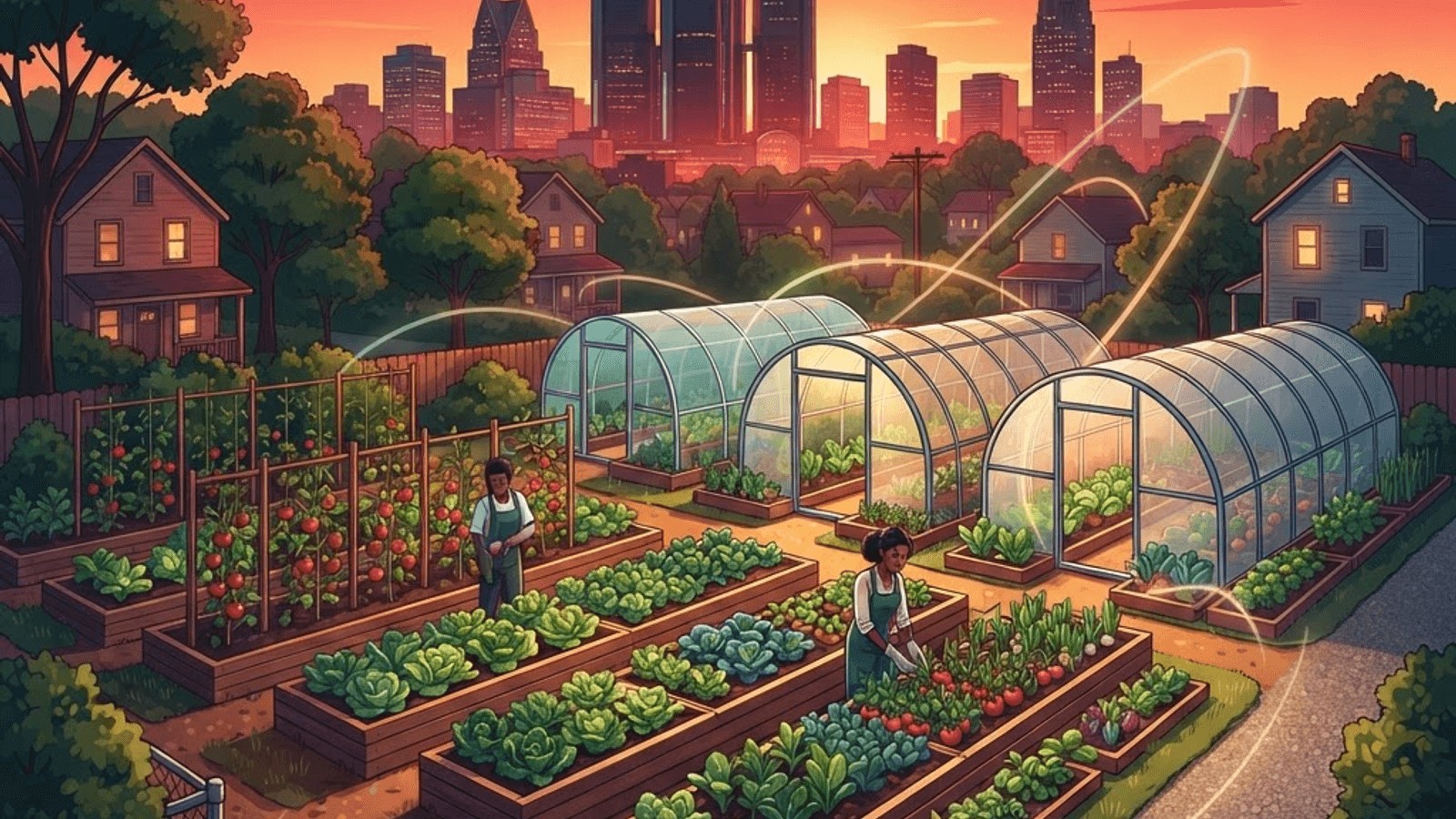
How Detroit Became an Urban Farming Leader
Few cities illustrate the potential of urban agriculture as vividly as Detroit. Decades of population decline left the city with an unusual asset: substantial available land inside its boundaries. Where other dense cities struggle to find a single vacant lot, Detroit neighborhoods contained blocks of open ground. Residents, community organizations and entrepreneurs began putting that land to work growing food, and over time an informal practice matured into a recognized agricultural sector supported by policy, research and commercial investment.
Today Detroit hosts hundreds of gardens and farms ranging from small neighborhood plots to multi-acre commercial operations and sophisticated indoor growing facilities. Together they supply farmers markets, restaurants, grocery retailers, food pantries and community kitchens while addressing food access challenges in areas underserved by full-service supermarkets.
The Models of Farming Found in Detroit
Several distinct approaches coexist. Community-based farms prioritize neighborhood food access, youth education and land stewardship, often operating as nonprofits with volunteer labor and grant support. Commercial market farms focus on production efficiency and sales to restaurants, markets and wholesale accounts, using intensive bed systems and season-extension structures.
Controlled environment agriculture represents the technology-forward end of the sector, employing greenhouses, hydroponics and vertical systems to produce leafy greens, herbs and microgreens year-round regardless of Michigan winters. Finally, agroforestry and orchard projects take a longer view, planting fruit and nut trees that stabilize soil, improve neighborhood environments and produce for decades.
Ten Farming Organizations Making an Impact in Detroit
Michigan Urban Farming Initiative is known internationally for developing an agrihood concept in the North End, where a working farm anchors a residential neighborhood and distributes produce to nearby households at no cost, demonstrating agriculture as community infrastructure.
Keep Growing Detroit supports a vast network of gardens and farms across the city through seed and transplant distribution, training and market access, and has been central to the goal of Detroit growing a majority of its own fruits and vegetables.
Oakland Avenue Urban Farm combines food production with cultural programming and neighborhood development, operating as both a working farm and a gathering space that connects agriculture to art, education and local enterprise.
D-Town Farm, developed by the Detroit Black Community Food Security Network, operates a multi-acre farm in Rouge Park with a strong emphasis on food sovereignty, organic growing practices and building Black-led agricultural capacity.
RecoveryPark Farms pursued a distinctive model linking commercial specialty crop production for restaurants with employment opportunities for people facing significant barriers to work, illustrating agriculture as a workforce development tool.
Rising Pheasant Farms built a respected reputation as a small-scale intensive market farm, supplying microgreens and vegetables to local markets and restaurants while demonstrating that modest acreage can support a viable business.
Brother Nature Produce operates in the Corktown area growing salad greens and specialty vegetables for local chefs, an early example of a Detroit farm building a commercial brand around quality and consistency.
Fisheye Farms cultivates vegetables and flowers on formerly vacant west side land, selling through markets and community supported agriculture arrangements while modeling careful soil remediation practice.
Green Collar Foods and comparable controlled environment growers apply hydroponic and aeroponic technology within greenhouse structures, producing high-value crops year-round with reduced water use and predictable yields.
Detroit Hives and urban apiary operations extend the definition of farming into pollinator stewardship, converting vacant lots into bee habitat, producing honey and delivering education on the ecological foundations of food production.
The Economics and Challenges of Urban Farming
Urban farming in Detroit is genuinely promising but not simple. Land access requires navigating ownership records, acquisition processes and zoning requirements. Soil quality demands attention because former residential and industrial parcels can carry contamination, making testing and remediation, often through raised beds and imported growing media, a standard first step.
Infrastructure presents another hurdle. Water access, fencing, storage, refrigeration and wash-pack facilities all require capital that small farms struggle to finance. Labor economics are equally challenging; intensive vegetable production is labor demanding, and urban wage expectations are higher than in rural farming regions.
Successful operations respond with strategy rather than scale. They concentrate on high-value crops such as salad greens, herbs, microgreens and specialty vegetables that command premium prices and tolerate short supply chains. They diversify revenue across market sales, restaurant accounts, subscription boxes, value-added products, education programming and grants. And they build direct relationships with customers who value freshness and local origin.
Community and Environmental Benefits
The value of Detroit's farms extends well beyond produce volume. Farms convert neglected land into maintained, active space, which measurably improves neighborhood conditions. They create employment and skills training, particularly for young people. They increase access to fresh food in areas where grocery options are limited. They capture stormwater, support pollinators, sequester carbon in soil and reduce urban heat.
Perhaps most importantly, they build social infrastructure. A farm becomes a place where neighbors meet, where knowledge passes between generations and where residents exercise direct control over an essential part of their lives. That civic dimension explains why Detroit's agricultural movement has proven so durable.
What Comes Next
Detroit's farming sector is maturing from experimentation toward institutionalization. Clearer land tenure pathways, growing investment in processing and distribution infrastructure, expanding partnerships with schools and hospitals, and increasing sophistication in controlled environment production all point toward a larger and more stable industry. The city has demonstrated something significant: that agriculture belongs in urban economies, and that farming can be simultaneously a business, a public good and a form of community self-determination.
