
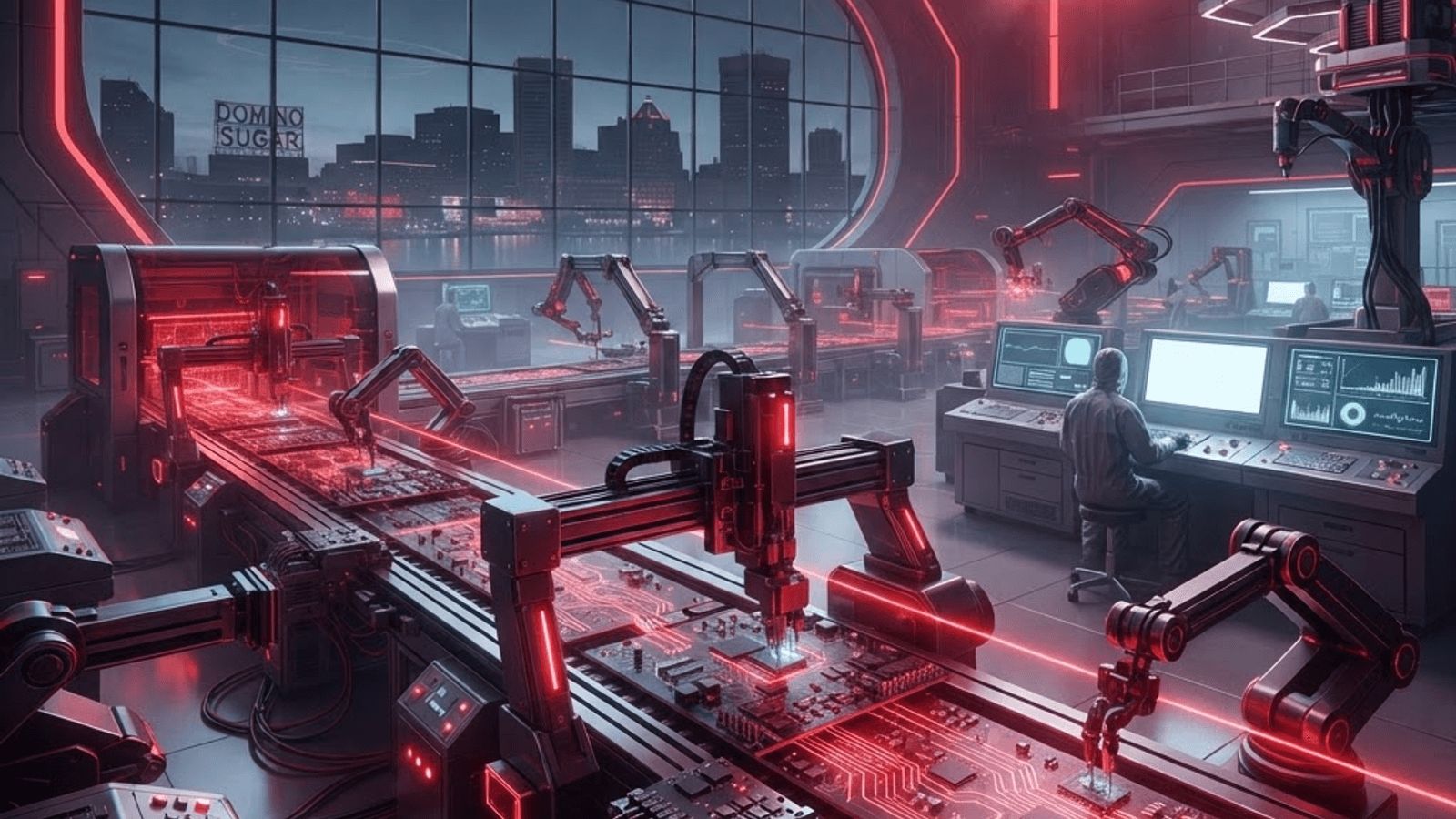
Why Baltimore Punches Above Its Weight in Electronics
Baltimore's electronics industry does not look like Silicon Valley, and that is precisely its strength. The regional demand base is anchored in defense and aerospace systems, medical devices, laboratory instrumentation, and industrial controls, all of which require low-to-medium volume production with exceptional quality documentation. That is a fundamentally different business from consumer electronics, and the companies serving it have built capabilities around traceability, testing, and regulatory compliance rather than sheer unit cost.
The presence of Johns Hopkins University and its Applied Physics Laboratory, the University of Maryland system, and numerous federal facilities creates a continuous flow of prototypes needing to become products. Contract manufacturers in the region have adapted to this reality, offering engineering support alongside assembly, because their customers are frequently scientists and engineers rather than experienced hardware operations teams.
Understanding the Electronics Manufacturing Landscape
The sector divides into recognizable roles. Original equipment manufacturers design and sell their own branded products. Electronics manufacturing services providers, commonly called contract manufacturers, build to customer designs, handling procurement, printed circuit board assembly, testing, and often box build. Printed circuit board fabricators produce the bare boards. Cable and harness shops handle interconnect. Test and certification labs verify performance and compliance.
Most buyers need a contract manufacturer, and the critical distinctions among them are the technologies they support, the volumes they serve efficiently, and the certifications they hold. Surface mount capability with fine-pitch components, ball grid array placement and X-ray inspection, conformal coating, and IPC workmanship class matter enormously. A shop optimized for high-volume consumer boards will not serve a fifty-unit medical instrument program well, and vice versa.
The Leading Electronics Manufacturers Serving Baltimore
Northrop Grumman maintains a major presence in the Baltimore region and represents the high end of electronics system manufacturing, producing radar, electronic warfare, and mission systems. Its differentiators are engineering depth, security clearance infrastructure, and quality systems built for programs where failure is unacceptable. For the local ecosystem, it is also a demand engine that sustains dozens of specialized suppliers.
Lockheed Martin similarly supports advanced electronics and integration work in the region, contributing to a supplier base skilled in aerospace-grade assembly, environmental testing, and configuration management.
Chesapeake Circuit Assembly serves as a regional contract manufacturer focused on low-to-medium volume printed circuit board assembly with strong prototype support. Startups and research groups value its willingness to build small quantities and its engineering feedback on manufacturability before committing to production tooling.
Patapsco Electronics Group provides full box-build and systems integration, taking populated boards through enclosure assembly, wiring, functional test, and packaging. Customers appreciate having one accountable partner rather than coordinating three vendors.
Harbor Precision Interconnect specializes in cable assemblies, wire harnesses, and connector solutions for industrial and medical equipment. Interconnect is a frequent source of field failures, and dedicated shops with proper crimp validation and pull testing meaningfully improve reliability.
Hopkins Instrumentation Partners works closely with research institutions to convert laboratory prototypes into repeatable instruments, offering design-for-manufacturing support, documentation packages, and pilot production. Its differentiator is fluency in translating academic prototypes into controlled builds.
Maryland Medical Electronics focuses on device assembly under quality management systems appropriate for regulated medical products, with controlled environments, documented processes, and validation support. In this segment, quality system maturity outweighs price.
Bmore Board Fabrication supplies bare printed circuit boards with quick-turn options for prototypes. Local fabrication compresses development cycles significantly when a design revision is needed within days rather than weeks.
Fells Point Test Labs provides electromagnetic compatibility, environmental, and safety testing services. Products fail certification more often than teams expect, and a nearby lab turns a schedule catastrophe into a manageable iteration.
Locust Point Automation Systems builds industrial control panels, programmable logic controller assemblies, and automation cabinets for manufacturing and utility clients. Panel building is governed by strict electrical codes and listing requirements, making experienced local builders valuable to plant engineers.
Technology and Market Trends
Several trends are influencing electronics manufacturing in Baltimore. Component availability, though improved from crisis levels, remains a design constraint, and manufacturers that offer proactive obsolescence management and approved alternate sourcing save their customers costly redesigns. Miniaturization continues, pushing shops toward finer placement accuracy and better inspection technology. Domestic sourcing requirements in defense and infrastructure programs favor local capability with documented supply chains.
Automation is also reaching lower volumes. Automated optical inspection and flexible test fixtures once made sense only at scale but are now common in shops building hundreds of units, raising quality baselines across the region.
How to Choose the Right Manufacturing Partner
Prepare a complete data package: schematics, bill of materials with approved manufacturer part numbers, Gerber files, assembly drawings, and test requirements. Ambiguity in a package is the leading cause of build errors, and good manufacturers will ask clarifying questions before quoting, which is a positive signal.
Ask specifically about certifications relevant to your product, whether that is IPC workmanship class, medical quality systems, or aerospace standards. Request a first-article inspection process and understand who owns responsibility for component sourcing risk. Tour the floor and look at electrostatic discharge controls, inspection stations, and traceability practices. Finally, discuss scaling honestly, because the ideal prototype partner is not always the ideal volume partner, and planning that transition early avoids painful transfers later.
Final Thoughts
Baltimore's electronics manufacturers serve demanding markets where reliability, documentation, and engineering collaboration matter more than the lowest possible unit price. From defense primes to nimble prototype assemblers, interconnect specialists, and test laboratories, the regional ecosystem can carry a product from concept through certification without leaving the metro area. For hardware teams, that proximity is a genuine competitive advantage.
