
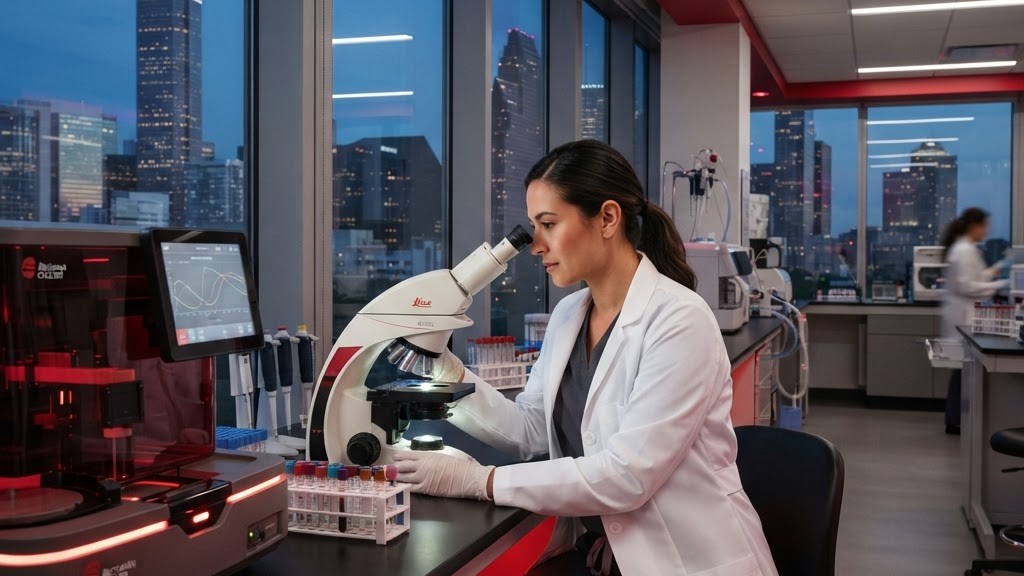
Why the Right Diagnostic Lab Matters
Laboratory results influence decisions ranging from routine cholesterol management to cancer treatment and genetic counseling. Houston patients can use national collection networks, hospital laboratories, public-health services, and specialized pathology centers. Quality involves more than speed: correct patient identification, specimen handling, validated methods, qualified interpretation, privacy, and dependable reporting are essential.
A physician may direct testing to a specific laboratory because of hospital affiliation, specialty expertise, or insurance rules. Always confirm that both the laboratory and any separate pathology interpretation are covered. The organizations below are notable options, but availability depends on the test and location.
1. Quest Diagnostics
Quest Diagnostics operates numerous patient service centers and offers a broad menu of routine and specialized testing. Houston patients often use it for physician-ordered bloodwork, employer testing, and ongoing monitoring. Appointment scheduling and electronic result access add convenience. Insurance coverage and preparation requirements should be checked before the visit.
2. Labcorp
Labcorp combines a national collection network with extensive clinical testing capabilities. Services include routine chemistry, hematology, women's health, genetic and specialty assays. Multiple Houston-area sites make it useful for repeat tests. Patients should bring complete orders and ask whether fasting, timed collection, or medication instructions apply.
3. Houston Methodist Pathology and Genomic Medicine
Houston Methodist's laboratory and pathology programs support hospital care, outpatient diagnostics, molecular testing, and expert interpretation. Integration with specialty physicians can be especially valuable for complex diseases where tissue findings, imaging, and clinical history must be reviewed together. Access may occur through Methodist facilities and physician referrals.
4. Memorial Hermann Laboratory Services
Memorial Hermann provides laboratory services across its hospital and outpatient network. Shared system records can streamline testing before surgery, during hospitalization, and at follow-up visits. Its broad regional footprint helps patients obtain tests closer to home while keeping results available to participating care teams.
5. MD Anderson Diagnostic Laboratories
MD Anderson's diagnostic laboratories are deeply focused on cancer care. Pathologists and laboratory specialists evaluate tissue, blood, molecular markers, and other data used to classify tumors and guide therapy. The concentration of disease-specific expertise is a major advantage for complex oncology cases, second opinions, and clinical-trial evaluation.
6. Baylor Genetics
Baylor Genetics provides genetic and genomic testing connected to substantial medical genetics expertise. Testing may address inherited disorders, reproductive questions, pediatric conditions, and other specialized needs. Because genetic results can affect relatives and future decisions, ordering should be paired with appropriate clinical interpretation and, when indicated, genetic counseling.
7. Texas Children's Hospital Laboratory
Texas Children's laboratory services are designed for pediatric and maternal-fetal care. Child-sized collection expertise, age-appropriate reference ranges, and close coordination with pediatric subspecialists matter when testing infants and children. Many services are integrated into hospital or clinic care rather than functioning as general walk-in testing.
8. Harris Health Laboratory Services
Harris Health laboratories support the system's hospitals and community health centers. They play an important role in safety-net care, chronic disease monitoring, preventive screening, and inpatient diagnosis for eligible patients. Integration with Harris Health clinicians helps connect results to treatment within the same public system.
9. Clinical Pathology Laboratories
Clinical Pathology Laboratories serves physicians and patients across Texas with routine and specialty testing. Houston-area access can make it an alternative to the largest national networks. Collection-site hours, insurance arrangements, and test availability differ, so patients should verify details tied to the exact order.
10. UTHealth Houston Laboratory Services
UTHealth Houston supports laboratory medicine through academic clinics, research programs, and affiliated clinical environments. Its strength lies in the connection between testing, specialist interpretation, and an academic medical community. Access depends on the relevant clinic and program, making it most useful for patients already receiving coordinated specialty care.
Preparing for a Lab Visit
Read the order before arriving and confirm whether fasting is required; fasting unnecessarily can be uncomfortable and medically inappropriate for some people. Ask whether medications should be taken normally and never stop a prescription without clinician guidance. Hydration can make routine blood collection easier unless fluid restriction applies. Bring identification, insurance information, and the complete test order.
After testing, ask when and how results will be released and who will explain them. A value outside a reference interval is not automatically a diagnosis, and a value inside it does not always exclude disease. Trends, symptoms, age, medicines, and test limitations all matter. The best diagnostic lab in Houston is one that performs the required assay reliably, works with the patient's care team, and provides results in a form that leads to informed clinical action.
