
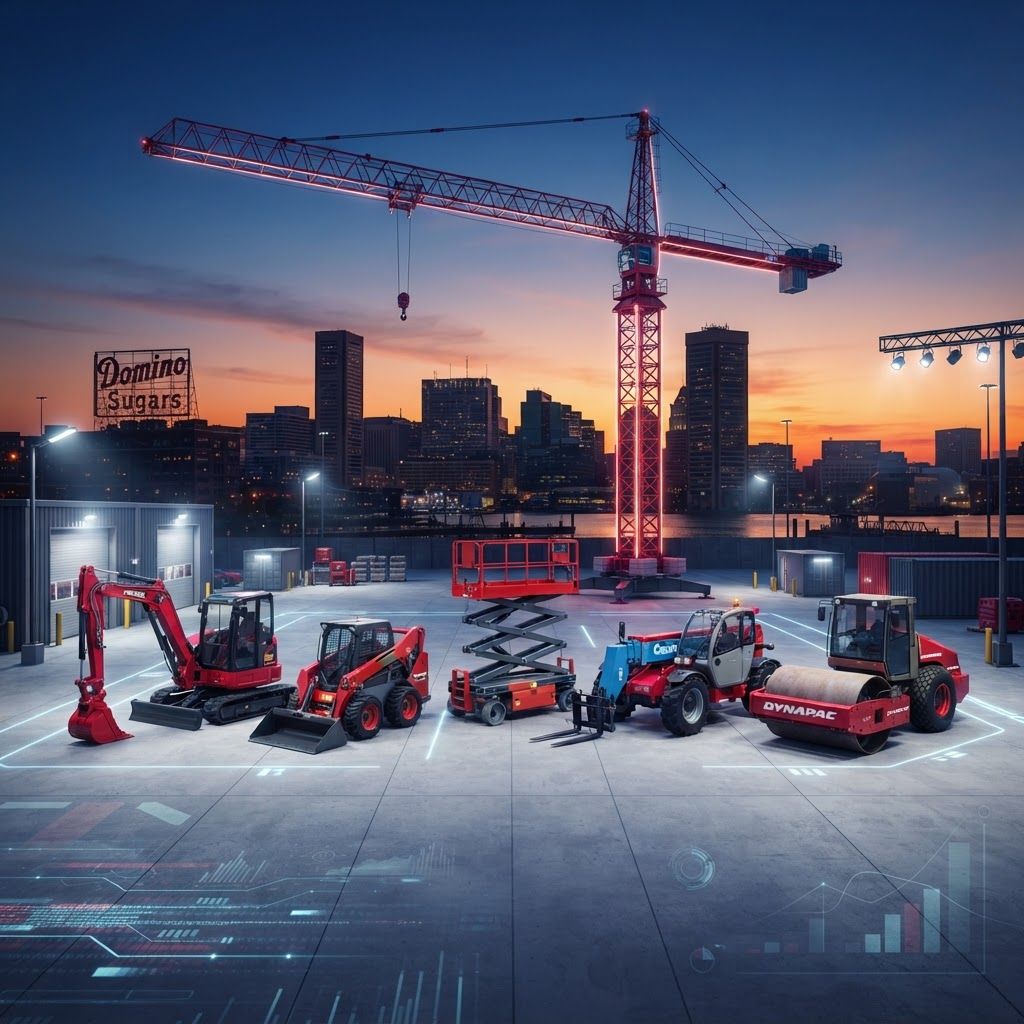
Why Renting Now Beats Owning for Most Contractors
The economics of equipment ownership have shifted decisively. Machine prices have risen, emissions-compliant engines have grown more complex to service, and telematics-driven maintenance schedules require expertise that smaller firms cannot justify staffing. Meanwhile, utilization data consistently shows that most contractors use any given machine far less than the threshold at which ownership pays. Renting converts a capital expense into a project cost that can be billed directly, keeps credit capacity available for bonding and payroll, and guarantees access to current-generation equipment with active manufacturer support.
Baltimore adds specific reasons to rent. Urban jobsites are tight, and the right machine is frequently a compact one: a mini excavator that fits through a rowhouse breezeway, a walk-behind trencher for a narrow side yard, or a compact track loader that will not destroy a client's lawn. Owning a full range of size classes is impractical, but renting the correct size for each phase dramatically improves productivity and reduces damage claims.
Ten Equipment Rental Providers Serving Baltimore
United Rentals operates multiple regional branches with one of the deepest fleets available, spanning earthmoving, aerial work platforms, power generation, trench safety, and climate control, plus digital account tools for tracking rentals across jobs.
Sunbelt Rentals combines a broad general fleet with specialty divisions covering pumping, power, and climate control, which matters on flood response, dewatering, and temporary conditioning work.
Herc Rentals is known for larger earthmoving and material handling equipment along with fleet management support suited to contractors running several concurrent sites.
Alban CAT serves as the regional Caterpillar dealer, offering rental and rent-to-own options with factory parts support and technician depth on heavier machines.
Tri-State Equipment Rental focuses on the local contractor market with compact equipment, attachments, and practical delivery scheduling in city neighborhoods.
Baltimore Tool Rental caters to smaller trades and homeowners, stocking concrete tools, compaction equipment, saws, and specialty hand tools by the day.
Modern Group Equipment provides material handling and lift equipment including telehandlers and forklifts, along with operator training resources.
Chesapeake Equipment Rentals emphasizes responsive local service and a compact-focused fleet suited to residential renovation and site work in dense neighborhoods.
Atlantic Equipment Rentals supplies aerial lifts, scissor lifts, and boom lifts for interior fitout and exterior maintenance work where reach and floor loading both matter.
H and E Equipment Services offers a mixed fleet with strength in aerial and earthmoving categories plus regional service coverage on longer-term rentals.
Understanding Rental Cost Structure
Published day rates are only part of the picture. Rental invoices typically include delivery and pickup charges, which on urban sites can be significant when a lowboy needs street permits or off-hours access. Rental protection or damage waiver programs cover certain risks but rarely all, so verify what your own insurance already provides. Environmental and fuel service fees are common. Overtime meter charges apply when machines run beyond the hours assumed in a daily, weekly, or monthly rate, and attachments such as hydraulic breakers, augers, grapples, and buckets are usually billed separately.
Rate structure rewards planning. Weekly rates are usually equivalent to roughly three to four days, and monthly rates to about three weeks, so honestly assessing duration before booking often reduces cost substantially. Reserving early during peak season also protects both availability and price.
Matching Machine to Task
Productivity gains come from correct selection. Compact track loaders handle grading and material movement on soft ground with minimal turf damage. Mini excavators in the one to four ton range dominate urban utility trenching, footing excavation, and demolition in confined areas. Skid steers with attachments provide versatility on paved sites. Telehandlers move palletized material to upper floors on framing and masonry work. Scissor lifts serve interior fitout, while articulating boom lifts reach around obstacles on facade work. Plate compactors, rammers, and rollers handle compaction by lift thickness and soil type. Trench boxes and shoring are not optional accessories but safety requirements once depth thresholds are crossed. Pumps and generators support dewatering and temporary power, both frequent needs in Baltimore basements and waterfront sites.
Trends in the Rental Industry
Telematics have become standard, providing hour meters, location tracking, fault codes, and utilization data that help contractors bill accurately and return machines before idle time accumulates. Electric and battery-powered equipment is expanding quickly, particularly compact loaders, mini excavators, and lifts, driven by indoor work, noise ordinances, and emissions considerations on occupied sites. Digital reservation platforms now allow booking, extending, and calling off equipment without phone calls, which shortens response time on schedule changes. Operator training and certification support has grown as an included service, especially for aerial platforms where compliance documentation is required. Finally, rental providers increasingly offer fleet consulting, helping contractors decide which machines to own versus rent based on actual utilization data.
Practical Guidance for Renting Well
Inspect and document machine condition at delivery with photos and video, including hour meter and existing damage, because that record resolves most disputes. Confirm attachment compatibility and hydraulic flow requirements before delivery day. Verify insurance requirements and certificate of insurance details in advance. Plan site access seriously in city neighborhoods, including street width, overhead lines, permit needs, and staging space. Fuel and clean equipment before return to avoid service charges. Track hours so you are not paying overtime meter fees unknowingly. Build relationships with one or two providers rather than always chasing the lowest rate, since priority availability during peak weeks is worth more than a marginal discount.
Final Thoughts
Equipment rental gives Baltimore contractors flexibility that ownership cannot match, particularly on urban sites where the correct machine changes from phase to phase. The providers profiled here differ meaningfully in fleet depth, specialty divisions, and service responsiveness. Match the provider to your work profile, plan duration and access carefully, and use telematics data to keep utilization honest. Handled deliberately, rental becomes a productivity strategy rather than merely a cost center.
