
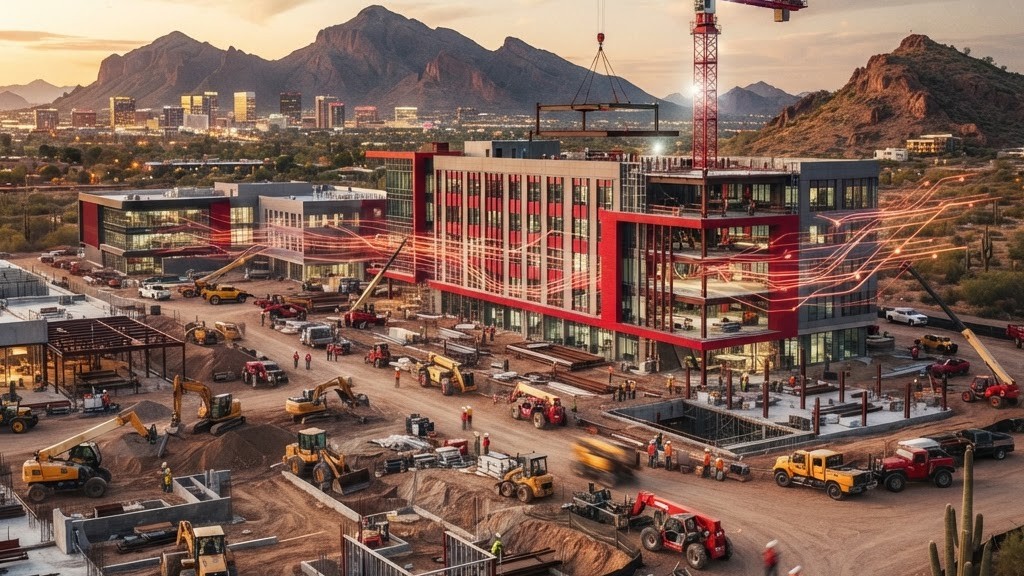
Commercial Construction Across Metro Phoenix
Metro Phoenix continues to attract corporate campuses, semiconductor investment, data infrastructure, healthcare facilities, resorts, distribution centers, mixed-use districts, and adaptive-reuse projects. This diversity rewards contractors that understand local entitlements, utility coordination, labor conditions, desert scheduling, and national procurement. The following companies are notable participants in Arizona's commercial construction market, though each has different sector strengths and ideal project sizes.
1. Clayco
Clayco delivers large design-build and commercial programs, including industrial, distribution, manufacturing, and office projects. Its integrated model brings design, engineering, procurement, and construction closer together. That structure can support fast-moving developments where early equipment decisions and site planning shape the entire schedule.
2. Graycor Construction Company
Graycor has a strong Southwest presence and extensive experience with industrial, retail, hospitality, and corporate facilities. The company understands large shell buildings and complex commercial programs. Owners can benefit from its regional subcontractor relationships and familiarity with high-growth Valley municipalities.
3. Wespac Construction
Wespac Construction is an Arizona-based contractor working across office, multifamily, hospitality, healthcare, retail, and specialty commercial sectors. Its local portfolio includes both ground-up and improvement work. This range can be useful for developers who need a partner from initial site development through interior completion.
4. Stevens-Leinweber Construction
Stevens-Leinweber Construction is known for industrial, office, and tenant-improvement projects in metro Phoenix. Deep focus in the local commercial real-estate market helps the team understand developer expectations, speculative building schedules, and tenant turnover requirements. Repeat relationships are an important signal in these sectors.
5. LGE Design Build
LGE Design Build combines architecture and construction, with a visible portfolio of industrial and commercial projects. Integrated design-build delivery can shorten decision paths and improve alignment between budget and design. It is particularly relevant for clients prioritizing speed, single-point responsibility, and early cost feedback.
6. Jokake Construction
Jokake Construction has served Arizona clients across corporate, education, healthcare, public, and tenant-improvement markets. Its local tenure provides useful institutional knowledge and industry relationships. Occupied renovation experience is valuable when businesses must continue operating around carefully phased construction.
7. UEB Builders
UEB Builders works in commercial, multifamily, hospitality, and mixed-use construction. These project types require close management of finishes, repetitive units, procurement, and turnover sequencing. Owners should evaluate the firm's relevant team and methods for maintaining quality across large quantities of similar spaces.
8. Kitchell
Kitchell is headquartered in Phoenix and is especially respected in healthcare, higher education, and complex program management. The company offers construction and development-related expertise for clients with demanding facilities. Hospitals and institutional campuses benefit from rigorous planning around infection control, shutdowns, logistics, and stakeholders.
9. The Weitz Company
The Weitz Company operates across commercial, industrial, senior-living, and multifamily sectors. National resources and established systems support large developments, while local execution remains key to outcomes. Its experience with occupied and operational environments can benefit projects that require disciplined phasing.
10. Hensel Phelps
Hensel Phelps is a major contractor capable of delivering aviation, government, technology, healthcare, and other complex facilities. The company is known for robust planning and quality processes. It is best matched with projects whose scale and technical requirements warrant substantial management resources.
Choosing the Right Commercial Builder
Begin with sector alignment. A contractor excellent at distribution shells may not be the best fit for a surgical renovation, luxury resort, or clean manufacturing facility. Compare recent projects by scope, systems, delivery method, and jurisdiction. Interview the proposed project executive, manager, superintendent, estimator, and virtual-design lead to understand how the team will actually operate.
Commercial owners should demand transparent preconstruction. Estimates should identify quantities, trade coverage, allowances, contingency, escalation, exclusions, and alternates. Schedules should show permitting, utility releases, long-lead equipment, commissioning, and owner activities—not just field construction. In Phoenix, credible plans also address summer shifts, heat protection, monsoon readiness, dust control, and water use. Technology such as model coordination, laser scanning, and production tracking adds value only when paired with decisive leadership. The best commercial construction company protects the business case while delivering a safe, functional asset ready for tenants and operations.
Aligning Construction with the Business Plan
Development teams should connect the construction schedule to leasing, financing, equipment installation, staffing, licensing, and revenue milestones. A nominal completion date has little value if utilities are not permanent, inspections remain open, or tenant systems cannot be commissioned. Establish precise definitions for substantial completion, phased occupancy, and owner acceptance. During preconstruction, test cost-saving ideas against operating expenses, durability, customer experience, and future flexibility rather than accepting the lowest initial price. Commercial buildings in Phoenix should also be evaluated for heat resilience, shade, efficient cooling, roof performance, and water use. When the contractor understands these business drivers, field decisions can support long-term asset value instead of merely closing today's budget gap. Owners should also schedule a lessons-learned review after occupancy, capturing feedback from facilities teams, tenants, and project leaders. Those insights can improve standards for future sites, reveal recurring operational issues, and confirm whether promised efficiencies were achieved under real Phoenix conditions.
