
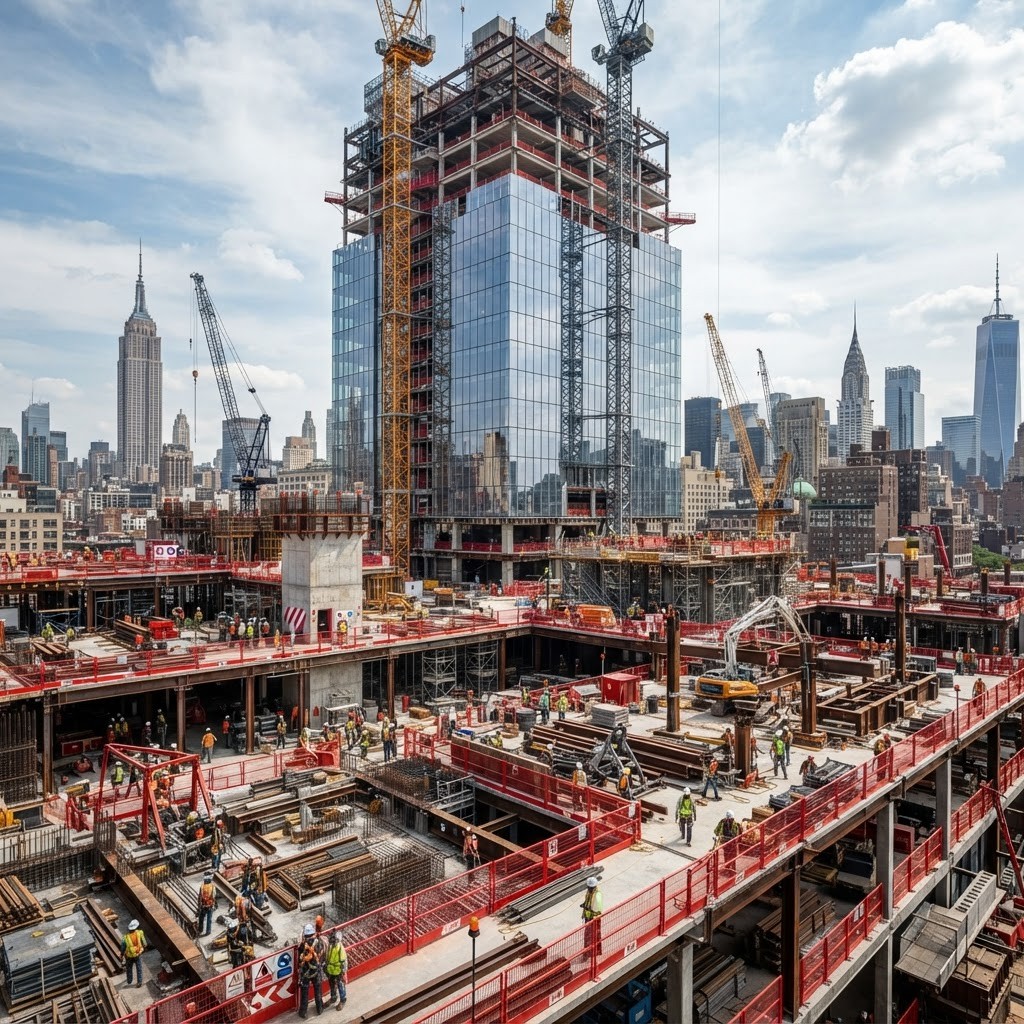
The Complexity of New York Commercial Building
Commercial construction in New York is shaped by expensive space, intensive regulations, intricate building systems, and clients whose operations often continue beside the work. Corporate interiors may need overnight shifts, retail projects depend on fixed opening dates, and laboratories require exact mechanical performance. Ground-up towers add cranes, facade procurement, public protection, and years of schedule risk. These ten companies have notable commercial experience in the region, though owners should match the firm and proposed team to the project’s exact sector and scale.
1. Structure Tone
Structure Tone is a leading name in corporate interiors and commercial renovation. Its New York teams work within occupied office buildings where shutdowns, security, elevator access, and tenant coordination are critical. Clients benefit when a contractor understands both construction and workplace operations. Preconstruction should identify long-lead mechanical and electrical equipment, technology requirements, furniture interfaces, and phased move plans before field work accelerates.
2. Turner Construction Company
Turner offers major-project resources for commercial towers, headquarters, healthcare, sports, and institutional facilities. Its scale supports extensive preconstruction, logistics modeling, safety management, and cost reporting. For sophisticated owners, the firm can coordinate large consultant and trade groups. Selection should still focus on project-specific staffing and accountability; a strong superintendent and responsive project manager directly shape day-to-day outcomes.
3. Tishman Construction
Tishman Construction has managed some of New York’s most recognizable large developments. Its capabilities suit projects involving complex structures, premium hospitality, commercial towers, and multiple stakeholder groups. High-rise work depends on repeated floor cycles, hoist planning, facade sequencing, and early procurement. Owners should ask how the baseline schedule will be tested and how delays in design or material release will be reported.
4. J.T. Magen
J.T. Magen is strongly associated with corporate interiors, retail, technology, hospitality, and commercial projects. The firm’s market position reflects experience with schedule-sensitive fit-outs and brand-driven environments. Retail and office clients should establish approval paths for samples, mockups, millwork, lighting, and audiovisual systems. Fast work succeeds when decisions are made quickly and recorded clearly, not when planning is skipped.
5. Shawmut Design and Construction
Shawmut is a notable builder for luxury retail, restaurants, hotels, cultural institutions, and commercial interiors. These sectors require exact finishes and close coordination with vendors and operating teams. Restaurant projects are especially systems-intensive, combining kitchen exhaust, fire suppression, gas or electric equipment, refrigeration, acoustics, and health requirements. Early equipment schedules and coordinated drawings help avoid expensive field conflicts.
6. Skanska USA Building
Skanska provides construction services for significant commercial, civic, education, healthcare, and infrastructure-related facilities. The company emphasizes safety and sustainability, priorities that increasingly influence commercial leasing and investment. Owners pursuing high-performance buildings should require clear deliverables for envelope testing, energy systems, material documentation, waste practices, and commissioning. Performance goals must be translated into subcontractor scopes and field verification.
7. Gilbane Building Company
Gilbane brings national resources and New York experience to commercial, life-science, education, and institutional construction. Its preconstruction and project-control capabilities are useful for clients balancing cost, schedule, and technical requirements. In laboratories and advanced workplaces, mechanical systems can drive the design. Teams should coordinate equipment heat loads, redundancy, controls, vibration, clearance, and future flexibility before ceilings become congested.
8. Clune Construction
Clune Construction has a strong reputation in corporate interiors and commercial spaces. Interior specialists understand the pressure surrounding lease dates, employee moves, landlord approvals, and work within operating properties. Clients should confirm responsibilities at the boundary between base-building systems and tenant work. Ambiguity around electrical capacity, supplemental cooling, fire alarm, and life-safety modifications can create delays and disputed costs.
9. Pavarini McGovern
Pavarini McGovern, part of the STO Building Group, is known for large New York projects including residential, hospitality, commercial, and cultural work. The company’s experience is relevant to complicated structures and high-end urban development. Owners should examine the contractor’s plan for design coordination, facade testing, vertical logistics, and turnover. On mixed-use projects, separate occupancy dates and operating requirements require particularly careful sequencing.
10. EW Howell Construction Group
EW Howell has longstanding regional experience across education, healthcare, retail, cultural, and commercial sectors. Its history in the New York market supports familiarity with local trades and institutional expectations. For active facilities, clients should discuss infection control, dust containment, temporary egress, noise, vibration, and utility continuity. A contractor’s ability to protect operations can be the defining measure of success.
Evaluating Commercial Contractors
A well-run selection process begins with sector-specific qualifications and a defined delivery method. Compare experience in buildings of similar age, occupancy, technical intensity, and budget. Review safety statistics, insurance, bonding, financial capacity, subcontractor relationships, schedule methodology, and references. Ask each team to identify the project’s five greatest risks and propose practical mitigation. Thoughtful answers reveal more than generic marketing claims.
Commercial owners should also assess digital coordination, but software alone does not guarantee control. Models, field-management platforms, and dashboards are valuable when information remains current and decisions have responsible owners. Contracts must address changes, allowances, escalation, delays, testing, commissioning, training, warranties, and closeout. New York’s best commercial construction companies provide early visibility, protect occupied environments, maintain safe sites, and deliver spaces that support the client’s business from the first day of operation.
