
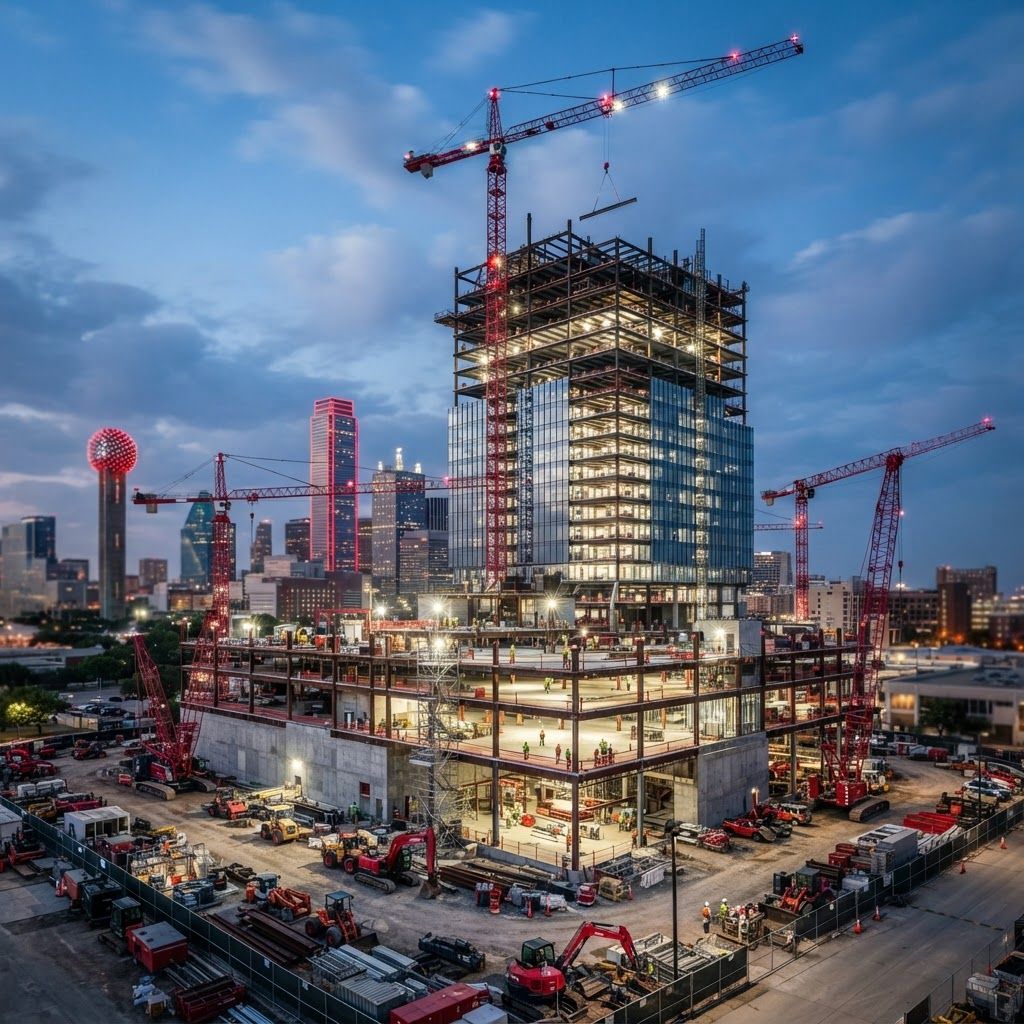
Commercial Building Expertise in Dallas
Dallas-Fort Worth continues to attract corporate relocations, logistics investment, healthcare expansion, and mixed-use development. Commercial projects in this market require builders who understand fast-track procurement, local permitting, tenant coordination, extreme weather, and a large but busy subcontractor base. The strongest construction company combines cost intelligence with field leadership and communicates risk early. This list highlights ten notable firms with Dallas-area commercial capabilities. Rankings should be treated as a planning resource rather than a substitute for project-specific qualification, because an office renovation and a mission-critical campus demand very different teams.
1. The Beck Group
The Beck Group’s Dallas headquarters and integrated architecture-construction model give it a distinctive position. Beck works across office, hospitality, cultural, institutional, and mixed-use sectors. Early collaboration between designers, estimators, and builders can improve constructability and speed decisions, particularly for clients seeking one accountable team from concept through completion.
2. Austin Commercial
Austin Commercial has delivered major projects in aviation, healthcare, corporate, hospitality, and higher education. Its Dallas roots support deep familiarity with the regional trade market and approval environment. The company’s scale, safety systems, and planning capabilities suit large commercial work with complex logistics, technical systems, or public visibility.
3. Rogers-O’Brien Construction
Rogers-O’Brien is a Texas-based builder active in corporate, multifamily, healthcare, mission-critical, and retail construction. It is recognized for adopting virtual design, prefabrication, and lean planning techniques. These tools can reduce field conflicts and help project teams manage increasingly dense mechanical, electrical, and technology infrastructure.
4. Structure Tone Southwest
Structure Tone Southwest has a particularly strong reputation in corporate interiors, renovations, data centers, and commercial fitouts. Working inside occupied towers requires careful access planning, dust and noise control, security coordination, and reliable turnover dates. Its experience in this environment makes it relevant to Dallas tenants and landlords managing high-stakes interior projects.
5. DPR Construction
DPR specializes in technically demanding commercial work, including life sciences, healthcare, advanced technology, and higher education. Its Dallas team applies digital coordination and detailed production planning to projects where building systems are central to performance. Clients with complex quality requirements can benefit from DPR’s technical focus and collaborative culture.
6. Turner Construction
Turner combines national reach with a substantial North Texas presence. The firm can mobilize specialized expertise for sports, healthcare, office, institutional, and large development projects. Strong procurement systems and a broad subcontractor network are meaningful advantages when a Dallas project requires major resources, phased delivery, or unusual technical knowledge.
7. Balfour Beatty
Balfour Beatty serves commercial and public clients throughout Dallas-Fort Worth. Its portfolio includes education, hospitality, residential, and complex building programs. The contractor’s structured preconstruction, safety management, and stakeholder coordination are useful on projects where occupied operations or multiple user groups influence sequencing.
8. McCarthy Building Companies
McCarthy handles healthcare, laboratory, education, renewable-energy, and commercial assignments in North Texas. The employee-owned organization emphasizes builder involvement and planning discipline. Its self-perform experience and technical resources can support schedule control and quality on facilities with challenging concrete, infrastructure, or building-system packages.
9. JE Dunn Construction
JE Dunn’s Dallas operation works across healthcare, commercial, government, education, and advanced industries. Its preconstruction teams support cost modeling, option analysis, and procurement planning well before groundbreaking. That early intelligence can help developers align design ambitions with financing and market realities while preserving key project outcomes.
10. Skanska USA Building
Skanska brings global resources and established sustainability and safety programs to major American building projects, including work in North Texas. The company is relevant for large commercial and institutional developments that require rigorous reporting and stakeholder management. Its scale supports technical benchmarking and formal processes across planning and execution.
Evaluating a Commercial Construction Partner
Developers should request detailed experience from the proposed team, not only the corporate portfolio. Interview the project executive, preconstruction lead, superintendent, and scheduler who will remain involved. Compare fee structures, general conditions, contingency treatment, insurance, safety indicators, quality plans, and proposed technology. A credible contractor should expose uncertainties in drawings, long-lead procurement, utility coordination, and labor availability. Evaluate the company’s history with local authorities and the specific architect, while avoiding assumptions that familiarity alone guarantees performance.
Trends Affecting Dallas Projects
Commercial construction is shifting toward flexible spaces, lower operational carbon, electrification readiness, smart-building controls, and resilient power. Data centers and advanced facilities are increasing demand for specialized electrical and mechanical trades. Meanwhile, office owners are repositioning properties through amenities and targeted renovations rather than relying solely on new construction. Prefabricated assemblies, reality capture, and model-based coordination help teams respond to these pressures. Each company listed has meaningful capability, but the best commercial construction partner is the one that demonstrates sector-specific expertise, transparent leadership, and a credible plan for the actual site. Careful qualification at the beginning can protect schedule, capital, tenant commitments, and long-term building performance.
Before making a final decision, readers should request current documentation, compare detailed proposals on an equal basis, and meet the people who will perform or supervise the work. Careful due diligence helps reveal differences in responsiveness, technical judgment, quality control, and after-project support that may not be obvious from price alone.
