
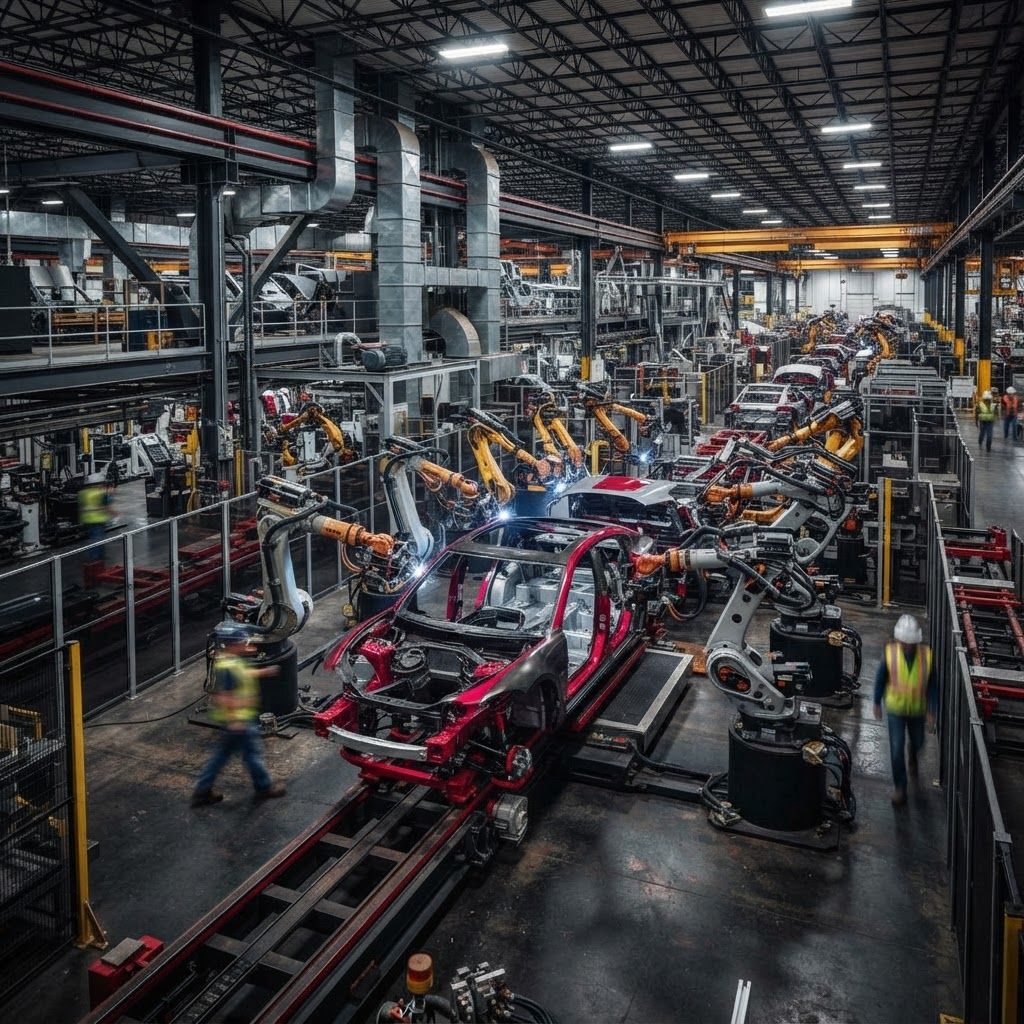
Automotive Manufacturing in North Texas
Fort Worth is better known for aerospace than mass-market automobile assembly, yet it occupies a strategic position in the wider North Texas automotive industry. Interstate access, rail connections, a large labor force, and proximity to major assembly operations support suppliers, upfitters, trailer builders, commercial vehicle specialists, and logistics companies. The city's construction, energy, municipal, and transportation sectors also create steady demand for durable fleet equipment.
This guide uses automotive manufacturing broadly to include vehicle assemblers, truck and trailer producers, specialty equipment builders, and manufacturers with a meaningful regional footprint. Capabilities and local operations change over time, so purchasers should verify current production and service details directly during procurement.
1. General Motors Arlington Assembly
General Motors operates its large Arlington Assembly plant between Fort Worth and Dallas. The facility is a cornerstone of North Texas vehicle manufacturing and has produced full-size sport utility vehicles. Its scale supports thousands of jobs and a substantial supplier ecosystem. Advanced automation, workforce expertise, and high-volume quality systems distinguish the operation, while its regional impact extends to logistics and component businesses serving Fort Worth.
2. Toyota Motor North America
Toyota's North American headquarters in Plano makes the company a major force in the regional automotive economy. Although the headquarters is not a Fort Worth assembly plant, it concentrates management, engineering, finance, and mobility expertise in North Texas. Toyota's reputation for lean manufacturing and continuous improvement influences suppliers throughout the metroplex. Regional companies often look to its production system as a benchmark for quality and waste reduction.
3. Peterbilt Motors Company
Denton-based Peterbilt manufactures heavy-duty trucks close to Fort Worth. Its products serve long-haul freight, vocational work, construction, and municipal applications. Peterbilt stands out for configurable commercial platforms, established dealer support, and growing attention to alternative powertrains. Fort Worth fleet operators should compare payload, duty cycle, service access, driver ergonomics, and total operating cost when specifying a truck.
4. PACCAR
PACCAR is Peterbilt's parent company and an important name in regional commercial vehicle manufacturing. Its broader capabilities include powertrains, parts distribution, connected services, and financing. The organization brings scaled engineering and lifecycle support to demanding fleet applications. For suppliers, PACCAR programs require consistent quality, production reliability, and a clear understanding of heavy-vehicle requirements.
5. REV Group
REV Group produces specialty vehicles across fire and emergency, commercial, and recreation categories through multiple brands. Its products are relevant to Fort Worth-area municipalities, contractors, and transportation operators that need purpose-built equipment. Specialty manufacturing differs from passenger-car assembly because configurations can vary significantly. Buyers should evaluate chassis integration, body construction, warranty coordination, training, and replacement-part support.
6. Martin Marietta Specialty Vehicle Operations
North Texas supports builders and integrators of vocational equipment used in construction and materials handling. Operations connected to major materials companies illustrate the region's demand for mixers, service bodies, and task-specific fleet configurations. These vehicles must be engineered around payload, road conditions, safety, and maintainability. Local access to repair and parts can be as valuable as the original build specification.
7. Load Trail
Texas-based Load Trail manufactures trailers for construction, agriculture, landscaping, transportation, and equipment hauling. Its broad model range includes utility, dump, gooseneck, and heavy-equipment configurations commonly used by Fort Worth businesses. Buyers should compare frame design, axle ratings, braking systems, deck materials, corrosion protection, and dealer support. Correctly matching gross vehicle weight rating to real use is essential.
8. Big Tex Trailers
Big Tex Trailers is a prominent Texas manufacturer and distributor of utility and professional-grade trailers. The brand serves contractors, equipment operators, ranchers, and recreational users across the Fort Worth market. Breadth of product and an established dealer network are major differentiators. Customers should account for tow-vehicle limits, cargo securement, ramp design, and maintenance availability before selecting a model.
9. Supreme Corporation
Supreme, part of The Shyft Group, manufactures truck bodies for delivery, service, and vocational fleets. Its products are relevant to Fort Worth's expanding distribution and home-service economy. Body configuration can improve route productivity when shelving, doors, access points, and payload are designed around the job. Fleet buyers should involve drivers and maintenance teams early in the specification process.
10. Local Upfitters and Fabricators
Fort Worth has numerous independent businesses that install service bodies, cranes, lighting, storage, protective equipment, mobility systems, and specialized interiors. These upfitters fill the gap between a standard chassis and a work-ready vehicle. Their value comes from customization and local support. Buyers should verify engineering practices, electrical protection, weight distribution, regulatory compliance, and whether modifications affect the original warranty.
How to Choose an Automotive Manufacturing Partner
Define the vehicle's duty cycle before comparing brands. Consider annual mileage, idle time, cargo, towing, operating environment, driver needs, fuel or charging access, and expected service life. Commercial buyers should calculate total cost of ownership rather than purchase price alone. North Texas's growing population and freight activity are encouraging investment in automation, connected fleets, electrification, and safer equipment. A manufacturer or upfitter that documents specifications clearly and supports the vehicle after delivery will usually create the strongest long-term value.
