
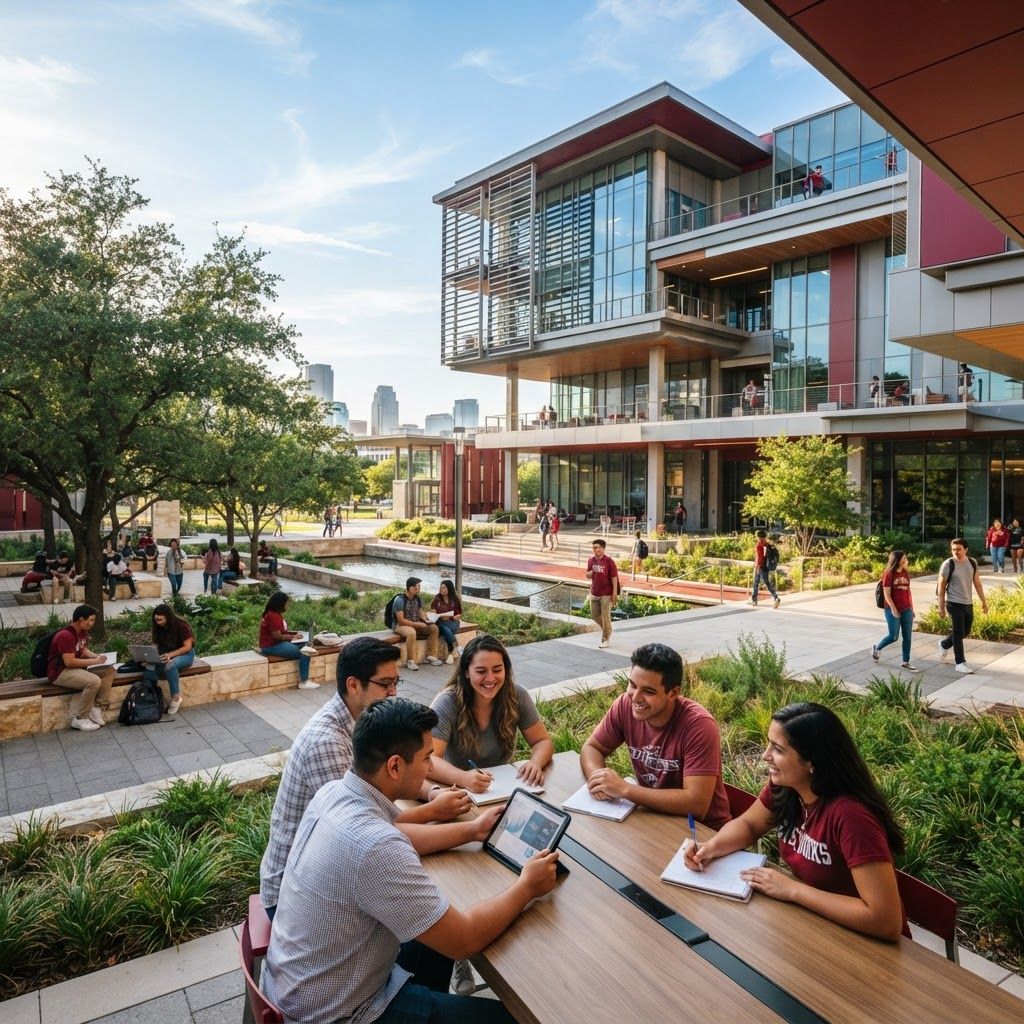
Higher Education Options in Fort Worth
Fort Worth's college ecosystem reflects the city's economy. Students can prepare for careers in healthcare, aviation, business, education, technology, public service, and skilled trades, or begin with transferable general education. Some institutions offer a traditional residential experience, while others serve commuters, working adults, and first-generation students through flexible schedules.
The following list uses college in the broad sense and includes universities, community colleges, and specialized institutions. It is not an official ranking. Accreditation, program approval, tuition, transferability, outcomes, and admissions requirements should always be verified for the specific program.
1. Tarrant County College
Tarrant County College is one of the most accessible starting points for Fort Worth students. Its campuses and learning locations offer associate degrees, university-transfer coursework, dual credit, and workforce programs. Lower tuition and local access can reduce the cost of the first two years. Students planning to transfer should map every course against the receiving institution's degree requirements.
2. Texas Christian University
Texas Christian University provides a private residential university experience in Fort Worth, with programs spanning liberal arts, business, nursing, communication, education, science, and fine arts. TCU is known for campus life, athletics, alumni connections, and a strong institutional identity. Prospective students should compare net cost after aid, program resources, class experience, and career support.
3. Texas Wesleyan University
Texas Wesleyan University offers a smaller private-university environment on Fort Worth's east side. Its portfolio includes business, education, health sciences, liberal studies, and graduate programs. Students who prefer smaller classes and closer faculty interaction may find the setting appealing. Financial aid and program-specific outcomes should be considered alongside published tuition.
4. University of North Texas Health Science Center at Fort Worth
The University of North Texas Health Science Center focuses on graduate and professional health education, research, and public health rather than broad undergraduate study. Its Fort Worth location and healthcare partnerships make it a significant institution for future physicians, pharmacists, researchers, public-health professionals, and other advanced practitioners.
5. Texas A&M University School of Law
Texas A&M University School of Law is located in downtown Fort Worth and serves students pursuing a Juris Doctor and related advanced legal study. Its urban setting provides proximity to courts, firms, government, and business activity. Applicants should compare bar preparation, clinics, concentrations, employment data, debt, and scholarship terms.
6. Tarleton State University Fort Worth
Tarleton State's Fort Worth campus expands access to public university programs for students in the western Metroplex. It serves transfer students, working adults, and graduate learners with programs that may include business, education, healthcare, technology, and public service fields. Format and course availability vary, so students should confirm that the entire degree can be completed on their preferred schedule.
7. University of Texas at Arlington Fort Worth
The University of Texas at Arlington maintains a Fort Worth presence oriented toward selected academic and professional programs. It can be attractive to students who want the resources of a large public research university with coursework closer to work or home. Prospective learners should distinguish between programs delivered in Fort Worth and those requiring travel to Arlington.
8. Remington College Fort Worth Campus
Remington College provides career-focused education in selected occupational fields. Programs and credentials can change, making direct verification essential. Career colleges may offer accelerated structures and practical training, but students should closely review total cost, accreditation, licensing eligibility, completion rates, and employer recognition.
9. The College of Health Care Professions Fort Worth
The College of Health Care Professions concentrates on allied-health and medical-support career training. Fort Worth's large healthcare sector creates demand for many of these roles. Students should confirm externship arrangements, certification preparation, schedule expectations, programmatic accreditation where applicable, and whether the credential meets employer requirements.
10. Southwestern Baptist Theological Seminary
Southwestern Baptist Theological Seminary offers undergraduate, graduate, and doctoral education centered on ministry, theology, worship, and related disciplines. It is suited to students seeking faith-based preparation for religious service and scholarship. Applicants should consider denominational alignment, vocational goals, residential expectations, and financial support.
How to Compare Fort Worth Colleges
Start with the credential required for the intended career. Then verify institutional and, when relevant, programmatic accreditation. Compare net price rather than sticker price by accounting for grants and scholarships that do not require repayment. Include transportation, housing, books, equipment, and lost work hours in the budget. For loans, estimate monthly repayment against realistic entry-level earnings.
Ask for retention, completion, transfer, licensing, and job-placement data in context. Career services should provide concrete support such as internships, employer relationships, portfolio preparation, and interview coaching. Transfer students need written degree plans, while working adults should confirm course rotation and online expectations.
Making the Most of College in Fort Worth
Fort Worth itself is an educational asset. Hospitals, aerospace employers, museums, schools, logistics companies, government agencies, and growing technology firms create opportunities for internships and applied learning. Students should engage early with faculty, career centers, professional associations, and campus organizations.
The best college choice is not necessarily the institution with the broadest name recognition. A lower-cost transfer pathway, a specialized health credential, or a small campus with strong mentorship may deliver greater value for a particular learner. Clear goals, verified data, and a realistic financial plan provide the strongest foundation.
