
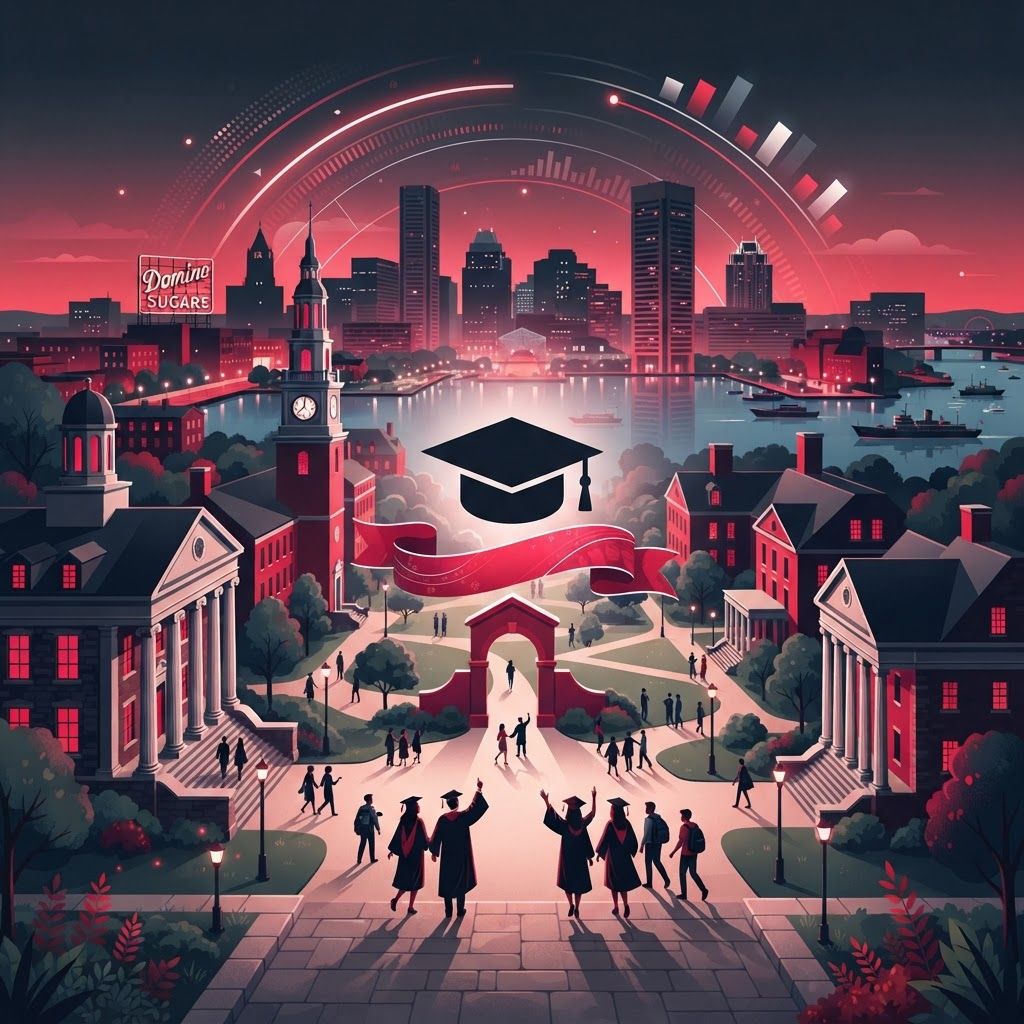
Why Baltimore Is a Standout College City
Baltimore has quietly become one of the most interesting college towns on the East Coast. Within a compact geography, students can access research powerhouses, small liberal arts colleges, faith-based institutions, art conservatories, and open-access community colleges. The city's economy leans heavily on healthcare, biotechnology, cybersecurity, logistics, and public service, which means internships and part-time work are often within a short light rail or bus ride of campus. That proximity between classroom and career is a defining advantage for students who want practical experience before graduation.
Cost of living also plays a role. Compared with Washington, D.C., Philadelphia, or New York, Baltimore offers more affordable housing and a lower daily spend, which stretches financial aid packages further. For families comparing total cost rather than sticker price, that difference can be decisive.
Johns Hopkins University
Johns Hopkins is the institution most people associate with Baltimore, and for good reason. It pioneered the American research university model and continues to lead in biomedical science, public health, international studies, and engineering. Undergraduates frequently work in funded labs early in their academic careers, and the Homewood campus offers a green, walkable setting in North Baltimore. Students drawn to research-intensive study, medicine, or policy careers find an unusually deep bench of faculty mentors here.
Loyola University Maryland
Loyola University Maryland delivers a Jesuit liberal arts education with a strong emphasis on service, ethics, and the whole person. Class sizes stay modest, advising is personal, and the business, communications, education, and psychology programs draw consistent praise. The Evergreen campus feels residential and self-contained while remaining close to city amenities, which appeals to students who want community without isolation.
Goucher College
Goucher College, located just outside the city line in Towson, is known nationally for requiring a study-abroad experience of every undergraduate. That global orientation shapes the curriculum, which is interdisciplinary and discussion-driven. Goucher suits independent learners who want to design a personalized academic path and value international perspective as a core outcome rather than an add-on.
Morgan State University
Morgan State University is Maryland's designated preeminent public urban research university and one of the nation's most prominent historically Black institutions. Its engineering, architecture, business, journalism, and social sciences programs have expanded significantly, supported by growing research funding. Morgan State combines strong school spirit, an active alumni network, and a mission centered on access and upward mobility, making it a compelling choice for students who want both community and research opportunity.
University of Baltimore
The University of Baltimore built its reputation around working adults, transfer students, and career-focused study. With an upper-division and graduate emphasis, flexible scheduling, and downtown location, it fits students who are balancing employment with degree completion. Programs in law, criminal justice, forensic studies, public administration, and business align tightly with regional employers in government and legal services.
Maryland Institute College of Art
MICA is one of the oldest and most respected independent art and design colleges in the country. Students pursue illustration, graphic design, animation, painting, sculpture, and product design in studio-intensive environments with practicing artist faculty. The college's presence has helped anchor Baltimore's creative districts, and graduating portfolios routinely lead to work in publishing, entertainment, branding, and gallery representation.
Peabody Institute
The Peabody Institute, the conservatory affiliated with Johns Hopkins, trains classical musicians, composers, and increasingly, artists working across genres and technology. Conservatory-level performance instruction sits alongside access to a major research university, an unusual combination that lets musicians pair artistry with academic breadth. Its historic Mount Vernon setting places students in the heart of the city's cultural corridor.
Notre Dame of Maryland University
Notre Dame of Maryland University has a long tradition of educating women and now serves a broader student body through coeducational graduate and adult programs. Nursing, pharmacy, and education are signature strengths, and clinical placement relationships across Baltimore's hospital systems give health sciences students hands-on training. Small cohorts and a supportive advising culture define the experience.
Coppin State University
Coppin State University focuses on access, teacher preparation, nursing, criminal justice, and community-rooted programs in West Baltimore. Its scale allows faculty to know students individually, and its urban mission emphasizes service learning and neighborhood partnership. For students seeking an affordable public education with a strong sense of purpose, Coppin State is worth serious consideration.
Baltimore City Community College
Baltimore City Community College serves as the region's most affordable entry point to higher education. Beyond associate degrees, it offers workforce certificates in allied health, cybersecurity, construction trades, and logistics, plus articulation agreements that let students transfer credits toward four-year degrees. For learners testing academic waters or changing careers, it reduces both financial and personal risk.
How to Choose the Right Baltimore College
Start with outcomes rather than rankings. Ask what graduates of a specific program actually do, where they intern, and which employers recruit on campus. Then evaluate teaching format: research-heavy institutions reward initiative and self-direction, while smaller colleges provide structure and closer mentorship. Consider commute and housing realistically, since neighborhood choice affects both budget and daily quality of life.
Finally, compare net cost, not published tuition. Institutional grants, state aid, and transfer credit can dramatically change the math. Baltimore's diversity of institutions means most students can find a program that matches their goals, learning style, and budget without leaving the region.
