
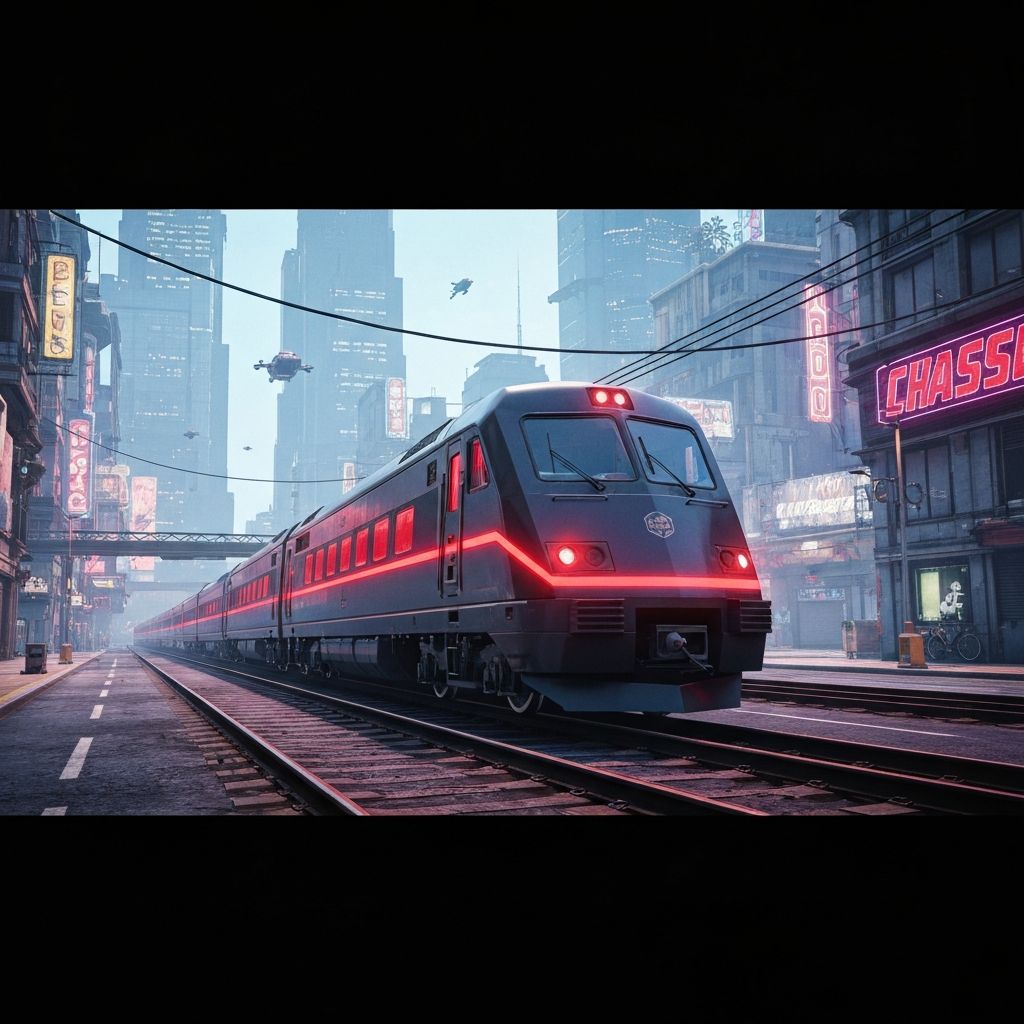
Introduction to the GTA A-Train
The Grand Theft Auto series has long been celebrated for its meticulous attention to detail in recreating urban environments, and the train systems featured throughout the franchise exemplify this commitment to authenticity. The A-Train model, as it appears across various GTA titles, represents Rockstar Games' interpretation of urban mass transit systems inspired by real-world metropolitan railways. From the elevated tracks of Liberty City to the sprawling rail network of Los Santos, trains have served as both environmental storytelling devices and functional gameplay elements that bring the game's fictional cities to life.
Understanding the A-Train model within the GTA universe requires examining both its in-game functionality and the real-world transit systems that inspired its design. Rockstar Games draws heavily from New York City's Metropolitan Transportation Authority (MTA) subway system, with the A-Train designation itself being a direct reference to one of the MTA's most iconic subway lines. This blending of real-world inspiration with fictional adaptation is a hallmark of the GTA series and contributes significantly to the immersive quality that has made these games cultural touchstones.
The A-Train in GTA III and Liberty City
GTA III, released in 2001, introduced fully three-dimensional train systems to the Grand Theft Auto franchise as part of its groundbreaking open-world design. The elevated railway system in Liberty City, known as the L-Train, drew direct inspiration from New York City's subway and elevated rail infrastructure. While the trains in GTA III were not directly labeled as A-Trains, their design, routing, and environmental context clearly referenced the MTA's lettered lines, including the iconic A train that runs between Inwood in northern Manhattan and Far Rockaway in Queens.
The train system in GTA III served primarily as an environmental feature rather than a player-accessible transportation mode in the traditional sense. The rattling, graffiti-covered train cars passing overhead on elevated tracks contributed to Liberty City's gritty urban atmosphere, creating a soundscape and visual environment that immediately evoked the feeling of a dense, lived-in metropolitan area. The scheduled movement of trains along fixed routes added a layer of dynamism to the city that distinguished it from the static environments of most games at the time.
In subsequent Liberty City appearances, particularly in GTA IV and its expansions, the subway system received a massive upgrade in detail and functionality. Players could ride the subway between stations, using it as a fast-travel mechanism across the sprawling city. The interior of subway cars featured advertisements, graffiti, passenger NPCs, and ambient sounds that created one of the most convincing public transit experiences ever rendered in a video game.
The A-Train in GTA V and Los Santos
GTA V, set in the fictional city of Los Santos (inspired by Los Angeles), features a comprehensive rail network that includes both the Los Santos Transit metro system and a freight rail network. The metro system mirrors the Los Angeles Metro Rail system, with above-ground and underground stations connected by rail lines that traverse the urban core and extend into surrounding neighborhoods.
The train models in GTA V are significantly more detailed than their predecessors, featuring realistic lighting effects, interior modeling visible through windows, and physics-based interactions with the game environment. The freight trains that rumble through Blaine County and industrial areas of Los Santos are particularly impressive, with long consists of cargo cars that can be interacted with by the player in creative ways that have spawned countless viral gameplay videos and community challenges.
The Los Santos Transit system serves as both a transportation option and a gameplay mechanic in various missions and activities. Players can board metro trains at stations throughout the city, riding them to different neighborhoods and using the transit map to navigate the sprawling urban environment. The system also features in several memorable story missions and online activities, including the famous train pursuit sequences that have become iconic moments in GTA V's narrative.
Real-World Inspiration: The NYC A Train
The real-world A train that inspires the GTA version is one of the longest routes in the New York City subway system, stretching approximately 31 miles from Inwood-207th Street in northern Manhattan to Far Rockaway-Mott Avenue in Queens, with a branch serving Lefferts Boulevard. The A train runs along the Eighth Avenue Line in Manhattan before crossing into Brooklyn and Queens, serving some of the most diverse and culturally significant neighborhoods in New York City, including Harlem, Washington Heights, Fulton Street in the Financial District, and the Rockaways.
Billy Strayhorn's 1939 jazz composition "Take the 'A' Train," written for the Duke Ellington Orchestra, transformed the A train from a simple transit line into a cultural icon. The song became the Ellington band's signature tune and one of the most recognized jazz standards in history, forever associating the A train with the energy, creativity, and cultural vitality of New York City. This cultural significance undoubtedly influenced Rockstar Games' decision to reference the A-Train designation in their fictional urban environments.
The MTA's A train has undergone numerous upgrades throughout its history, transitioning from early IND R1 subway cars in the 1930s to the modern R46 and R211 models that serve the line today. Each generation of rolling stock has reflected contemporary design trends and technological capabilities, from the art deco styling of pre-war cars to the stainless steel bodies and digital displays of modern equipment. GTA's train models similarly reflect the design era of each game's setting, with older-model cars appearing in period-set titles and more modern designs featured in contemporary entries.
Community Mods and Custom Train Models
The GTA modding community has embraced train models as a popular subject for custom content creation. On platforms like GTA5-Mods.com and the FiveM modification framework, community creators have developed highly detailed custom train models that replace or supplement the game's default rolling stock. These mods range from faithful recreations of specific MTA subway cars to entirely fictional designs that expand the game's transit ecosystem.
Popular train mods include accurate reproductions of the R160 subway cars used on several New York City lines, Amtrak long-distance passenger trains, European high-speed rail models, and even historical steam locomotives that transform the game's freight rail network into a period-appropriate railway. The level of detail in top-quality train mods rivals that of dedicated train simulation games, with accurate interior layouts, working lights and signals, realistic sound effects, and authentic livery designs.
The FiveM multiplayer framework has enabled community servers to create custom roleplay scenarios centered around the train system, including transit worker roleplay, railroad operations management, and elaborate heist scenarios involving train robberies and cargo theft. These community-created experiences demonstrate the enduring appeal of train systems within the GTA universe and the creative potential that these virtual transit networks inspire among the game's dedicated player base.
Technical Details and Game Mechanics
From a technical perspective, trains in GTA games operate on a fixed-path system that differs from the AI-driven navigation used by road vehicles. Trains follow predetermined routes along invisible spline tracks, with their movement controlled by game scripts rather than real-time physics calculations. This approach ensures consistent, reliable train behavior while minimizing the computational overhead that would be required for fully physics-simulated train movement.
In GTA V, trains are coded as virtually indestructible objects that cannot be derailed or stopped by conventional means during normal gameplay. This design decision prevents players from inadvertently disrupting the train system's scripted behavior and ensures that trains remain a reliable environmental feature throughout the game experience. The near-invincibility of GTA trains has become a popular subject of community experimentation, with players testing increasingly creative methods to stop or derail them in entertaining videos.
The sound design of GTA trains deserves particular recognition for its contribution to the game's immersive quality. Rockstar Games' audio team recorded actual subway and freight train sounds for use in the games, including wheel-on-rail sounds, air brake releases, horn blasts, crossing bell signals, and interior ambient noise. These audio assets are dynamically mixed based on the player's distance and position relative to the train, creating a convincing spatial audio experience that enhances the feeling of being in a living, functioning city.
Conclusion
The A-Train model in GTA represents far more than a simple environmental prop. It embodies Rockstar Games' commitment to creating believable urban environments that reference real-world infrastructure, cultural history, and community identity. From the elevated rails of Liberty City to the modern metro of Los Santos, trains have been an integral part of the Grand Theft Auto experience, contributing to the series' reputation as the gold standard in open-world game design and inspiring a vibrant modding community that continues to expand and enhance these virtual transit systems.
