
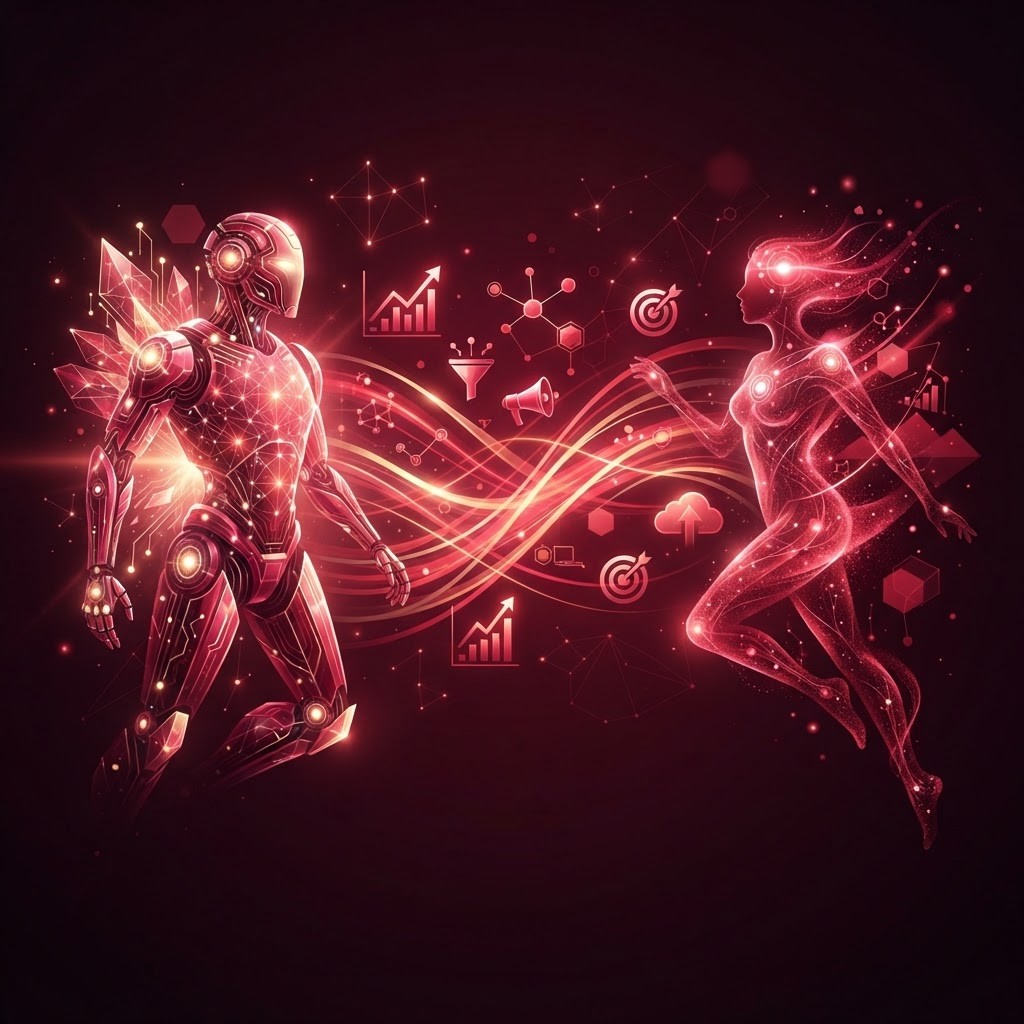
The Fear of Being Replaced
As artificial intelligence grows more capable, many professionals worry that it will make digital marketing obsolete. The reality is that AI is not replacing digital marketing; it is reshaping how digital marketing is done. The discipline itself remains as essential as ever, because businesses still need to reach audiences, build relationships, and drive sales. What is changing is the balance between tasks handled by machines and tasks that require human insight. Rather than eliminating digital marketing, AI is elevating it by taking over repetitive work and freeing marketers to focus on strategy, creativity, and connection.
History offers a useful parallel. Every major technological shift, from the spreadsheet to the search engine to social media, was predicted to eliminate marketing jobs. Instead, each one created new opportunities and raised expectations for what marketers could achieve. AI is following the same pattern, transforming the field while keeping human expertise firmly at the center.
Evolve Your Strategy With AAMAX.CO
Navigating this transformation is easier with a partner that understands both the technology and the enduring principles of great marketing. AAMAX.CO is a full service digital marketing company serving businesses worldwide, and their team embraces AI as a tool that enhances human led strategy rather than replaces it. They use AI to automate routine tasks, sharpen targeting, and accelerate content production while keeping experienced strategists in charge of the creative vision and overall direction. With their digital marketing expertise, they help companies adapt to an AI enhanced landscape without losing the human touch that builds real customer loyalty.
What AI Automates in Digital Marketing
AI is extremely effective at automating the repetitive, data heavy tasks that once consumed enormous amounts of marketers' time. It manages ad bidding and budget allocation in real time, analyzes large datasets to uncover patterns, personalizes content for individual users, and schedules campaigns for optimal timing. It powers chatbots that handle routine customer questions, generates first drafts of content, and produces performance reports automatically. These capabilities dramatically increase efficiency and allow campaigns to operate at a scale that would be impossible manually.
By handling this operational workload, AI changes what a typical day looks like for a marketer. Less time is spent on manual data entry, report building, and routine optimization, and more time is available for high level thinking. This shift does not shrink the role of the marketer; it makes it more strategic and more valuable.
What AI Cannot Replace
Several core elements of digital marketing remain firmly in human hands. Strategy is the most important. Deciding which markets to pursue, how to position a brand, what story to tell, and how to allocate resources requires judgment, experience, and an understanding of business goals that AI cannot provide. AI can execute a strategy efficiently, but it cannot create one that reflects a company's unique vision and values.
Creativity is equally irreplaceable. The original concepts, emotional narratives, and distinctive brand identities that make marketing memorable come from human imagination and empathy. AI can remix and generate based on existing patterns, but it does not truly understand culture, humor, or the subtle emotional cues that make a campaign resonate. Genuine human connection, the ability to build trust and relationships with customers, is another area where people remain essential.
Ethical judgment and accountability also require humans. Deciding how to use customer data responsibly, ensuring campaigns are fair and inclusive, and taking responsibility for outcomes are tasks that cannot be delegated to an algorithm. As AI becomes more powerful, the need for thoughtful human oversight actually grows rather than shrinks.
The New Role of the Digital Marketer
In an AI enhanced world, the digital marketer becomes part strategist, part creative director, and part technology orchestrator. Success depends on knowing which tools to use, how to guide them effectively, and how to interpret their outputs. Marketers who learn to collaborate with AI, using it to amplify their capabilities, will be far more productive and valuable than those who ignore it. The skills that matter most are shifting toward strategic thinking, creativity, data interpretation, and the ability to manage AI tools wisely.
This evolution means that continuous learning is essential. Marketers who invest in understanding AI, experiment with new tools, and adapt their workflows will thrive. Those who resist change risk falling behind, not because AI replaced them, but because competitors who embraced AI outperformed them.
Conclusion
AI is not replacing digital marketing. It is transforming it into a more efficient, data driven, and strategically focused discipline. The routine tasks are increasingly automated, but the vision, creativity, connection, and judgment that define great marketing remain uniquely human. The professionals and agencies that flourish are those that treat AI as a powerful collaborator, letting it handle the heavy lifting while they focus on the work that machines cannot do. Digital marketing is not disappearing; it is becoming smarter, and the humans who guide it are more important than ever.
